advice from a fake consultant

out-of-the-box thinking about economics, politics, and more... 
Showing posts with label Economy. Show all posts

Monday, January 2, 2012

On Holding Down The Conversational Fort, Or, Jobs, Republicans, And Hooey

As the next Congressional fight over payroll tax extensions and unemployment benefits and pipelines gets set up in the next few weeks for either its final chapter or to be kicked down the road a bit farther, one or the other, you’re going to hear a lot from our Republican friends about how much they value work and workers; most especially, they’ll tell you, they value American jobs for American workers.

After all, they’ll say, creating American jobs is the most important thing of all.

But if we were to look back over just the last few months, some would tell us, we could quickly find examples of how Republicans promote ideas that don’t seem to value work or workers at all, much less American jobs.

Well as it turns out, “some” seem to be right; to illustrate one of those examples we’ll look back a month or two or three to a time some Republicans might wish was long, long, ago, in a galaxy far, far away.

A successful comedian usually becomes more megalomaniacal as the success barometer rises. Initial success might be achieved from stand-up but then the comedian envisions a sitcom, then Broadway, albums, extended tours, Europe, and then his or her own production company. These things are all fine. Don’t do dinner theater. Don’t open stuff, like shopping centers or bowling alleys. Don’t do fairs, especially if you follow the pig contest.

--From the book “How To Be A Stand-Up Comic”, by Richard Belzer


So…the House Republicans went and promoted and passed out their payroll tax cut plan, and within that plan was a demand that the Junkie XL Pipeline – sorry, that should be Keystone XL Pipeline – get special “expedited” approvals, despite the objections of those who are worried about their water supply, and we have to do this, right now, those same House Republicans tell us, in order to put more or less 6500 folks to work getting the thing built.

And as we mentioned above, this is because the House Republicans care about American jobs and American workers.

So…it may strike you as a bit odd that the exact same House Republicans sent to the Senate in September the “Protecting Jobs From Government Interference Act” (HR 2587), which has only one purpose: it tells the National Labor Relations Board (the “NLRB”) that if workers at a company decide to form a union, or the company even thinks a union might be coming, and the company, in retaliation, decides to move work from that plant – or, for that matter, decides to move the entire plant – then neither the NLRB nor the United States Courts shall have the authority to do anything about it.

All of this stems from an effort by Boeing to move work from Washington State to South Carolina in retaliation for union activity by the Puget Sound workforce; the NLRB has ruled that Boeing cannot move the work, and the Company and its friends in Congress have joined forces with other anti-Union Members of Congress to move this legislation.

Need a third-party expert opinion to help make sense of the NLRB’s involvement and remedies? Consider this comment from University of Pennsylvania Law Professor Ellen Dannin, via Dennis Kucinich:

The NLRB has decades of experience with cases of this sort, and the National Labor Relations Act is clear that employer actions like Boeing’s violate the law. If this were a murder case, it would be a case in which the police found a person saying : “I did it,” while standing over a fresh corpse with smoking gun in hand.


Decades of experience, did she say? Yes she did – and she was right. In 1964, the Supreme Court ruled that the NLRB had the power to order remedies that include making companies “bring work back”, the relevant case being Fibreboard Paper Products Corp. v. Labor Board, 379 U.S. 203.

The 250 law professors who wrote a letter explaining why HR 2587 is such a bad idea point out that it’s not just about Boeing: companies will no longer have any reason to even bargain with unionized workers (or those who wish they were) before closing plants and moving work overseas, as they have to do now under the law; again, that’s because no one will have the power of enforcement in these cases anymore.

As you might imagine, that’s going to accelerate the departure of jobs overseas, and it won’t take very long to get to 6500, which makes all that Republican fussin’ and fightin’ and sanctimoneoussin’ about Keystone look a bit hollow, eh?

Let’s jump to the side track, as it were, and take a moment to talk about why the question of which Party controls Congress matters: HR 2587 was introduced into the House, and if the Democrats controlled the Chamber it would have died in Committee, and that would have been that…but they don’t, and it didn’t, so the bill made it to the House floor, where it passed with no Democratic “aye” votes and six Republicans voting “nay”.

Then it went to the Senate.

Senate Majority Leader Harry Reid (D-Sometimes Frustrating) has a bit more power than a Speaker of the House to kill any bill before his Chamber, if he’s so inclined; in this case the bill sits on the Senate Legislative Calendar, and unless he says otherwise, that’s where it’ll stay. Of course if Mitch McConnell (R-Hates Obama With The Fire Of A Thousand Suns) were Majority Leader, he would have that bill on the Senate Floor in a heartbeat – and it would pass with a Republican majority, unless Democrats were willing to stand firm and filibuster the thing or the President was willing to use the veto pen, neither of which seems particularly certain.

A companion bill, S 1523, was introduced by Lindsey Graham; it was referred to Committee, possibly to never be seen again – which is also thanks to Harry Reid, with an assist from Tom Harkin, who is the relevant Chair.

At this point I was going to move on to the “what have we learned today” part of the deal, but before I do, I want to take a moment to show you just what kind of legislation our GOP friends will bring to the table, given the chance:

S 1720, the “Put All Your Crazy Eggs In One Basket Act” (not the real bill title, but close enough), was introduced by John McCain just before Halloween (it’s now on the Legislative Calendar, not doing much), and it’s a classic.

This one single bill calls for a Balanced Budget Amendment vote, a semi-flat income tax, repeals “ObamaCare”, repeals Dodd-Frank (Wall Street reform), says you basically can’t sue for medical malpractice anymore, says that if Congress fails to approve any Federal Agency regulation in 90 days, it’s invalid, and then says no Agency can pass any regulation, of any kind, until unemployment hits 7.7%...and there’s a lot more besides, including, I kid you not, forbidding the EPA from regulating the discharge of pesticides into water.

So now let’s get to “what have we learned?”

How about this:

We are going to hear a lot over the next 60 days about how the GOP loves you, the American worker, but at the exact same time they are looking to…well…put all the crazy eggs in one basket, if they can get away with it, and at the same time they’re looking to make it easier and easier to send more jobs to more countries than ever before, even to the point of trying to tell courts and regulators that they can no longer enforce laws Republicans can’t get repealed.

As our GOP friends stand before you, these next couple months, professing their undying love, remind them of this conversation today, and HR 2587, and S 1720, McCain’s “Crazy Egg Basket” bill, and then ask them if they think the GOP really cares about American jobs, or if they’re just getting hustled by slightly-slicker versions of used-car dealership credit managers?

Then you lean in close, look ‘em in the eye, smile just a bit, and you say to ‘em: “And hey, while you’re here…what do I gotta do to get you into a slightly used 1993 Buick Roadmaster Estate Wagontoday?”

Then you can both have a little laugh – while you take their money and run.

Tuesday, November 8, 2011

On Punishing The Job Creators, Or, “The Poor Have It So Good Today”

You know what the problem is with America?
The poor don’t get just how great they have it.

I’ve hear this a lot lately; the basic thrust of the discussion is that all those cars, TVs, DVD players, refrigerators, and stoves that have found their way into the homes of the economic underclass are proof there’s really no such thing as “poor” in America.

If they were truly poor, the argument goes, well…think recycled corn.

And if the poor want things to get better, let ‘em pull themselves up by their own bootstraps – and if they can’t, then let ‘em rot, because that’s the best thing for the economy.

But I don’t buy all that, and by the time we’re done today, I hope to have given you a whole new perspective on how jobs get created in this country.

There isn't a rich man in your vast city who doesn't perjure himself every year before the tax board. They are all caked with perjury, many layers thick. Iron-clad, so to speak. If there is one that isn't, I desire to acquire him for my museum, and will pay Dinosaur rates.

--From the letter "A Humane Word From Satan", by Sam Clemens


We must have completely misjudged how many Americans live here about 15 years ago, because everywhere I go I see vacant buildings.

Empty retail space, empty office buildings, empty factories, and all of it apparently just thrown up for no reason whatsoever.

But then I recently saw some historical pictures from the 1990s, and it turns out a lot of those buildings used to have businesses operating within their now-abandoned walls – businesses which have since gone away.

And that’s when I began to get confused.

You see I’ve always known, just as you have, that it’s all about capital; that’s why it’s only the very wealthiest people who can create jobs in this country.

And I’ve always known that they can only do that when they are 100% certain that nothing was going to hurt their current economic condition, and that any sacrifice on our part, no matter how large, was crucially important to keep this very special source of economic vitality full and happy and creating jobs for America’s future.

And when I look at the statistics, I know we’ve been doing our part: the wealthy have been getting wealthier, faster, over the past 30 years than at any time in memory…and yet, for some reason, all those businesses were closing down.

So many, in fact, that I began to question whether America actually understands how jobs get created. It even began to cross my mind that maybe we’ve been coddling the wrong people.

I mean, what if the actual job creators…are the people who no longer work in those empty buildings?

It makes sense, if you think about it.

The common argument is that those with capital make investments, which creates jobs.

But why would anyone invest capital unless there was perceived demand for a product, or a need to do research to meet perceived future demands?

That seems to suggest demand drives investment; a good way to “prove” the point would be to consider what happens to capital without demand: building factories and ships and warehouses does no good if there are no buyers at the store.

Of course, I’m not the first to think workers drive demand: Henry Ford famously paid his workers double the prevailing wage; part of the idea was to create demand for all those Model Ts he was cranking out in his new factories.

So now that we know who the job creators really are, and we established years ago that we have to do every single possible thing on the face of the Earth to keep the job creators happy, happy, happy…how do we get started?

Well, here’s an idea: the Fed willingly gave more than $1.5 trillion to banks for bailouts, mostly by simply “creating” money; now I’m proposing we do the same for homeowners.

If you have a loan backed by Fannie Mae or Freddy Mac, let’s allow you to apply for a one-time $200,000 markdown on your mortgage – and let’s allow the first “tranche” of any markdown to apply to any back-due loan payments.

The amount of “haircut” (fancy technical term) you might impose on each loan could vary, but $1.5 trillion would allow 7.5 million writedowns at $200,000 each; if you limited the haircut to 50% of the loan value many would be less than $200,000. (It’s estimated that 11 million homes in the USA from are underwater; $2.5 trillion or less would cover all underwater loans.)

Since Fannie and Freddy back $10 trillion or so in mortgages, and you probably won’t be able to write down every loan, how would you decide who gets writedowns?

One way would be to create a “triage score” that incorporates things like the odds an applicant/borrower can pay off a restructured loan and the amount of foreclosed or underwater homes in any given community; the 7.5 million highest (or lowest) scores get the writedowns.

(One caveat: many who are having trouble today with home loans are also laid off; unless we can find ways to keep those folks in homes until they can find work, we’ll still have a substantial foreclosure problem.)

Writing down mortgages does several things: it quickly applies a “moral hazard cost” to those who deliberately lent to unqualified borrowers, it turns millions of “underwater” loans into homes with equity, it turns millions of “nonperforming” loans into “performing” loans, keeping millions out of foreclosure, it gives communities a chance to either stabilize or recover from “mass foreclosure-itis”, and it finally breaks the deadlock between banks and regulators over who will blink first on loan “haircuts” versus bank recapitalizations.

Wait? What was that last one?

Banks are scared to death that if they write down all these loans they will have to find new capital to make up the losses – and they probably won’t be able to raise that new capital by charging a $5 fee to have a debit card.

That could mean a few things: it could mean big banks are going to have to more sneakily raise lots of other fees and sell things to raise capital, or, perhaps, the Feds ease back a bit on capital requirements.

Or…it may mean that the banks end up having to get smaller. Consider this scenario: a forced haircut of significant size, followed by regulators who stand firm on capital requirements, followed by a less-than-stellar round of stock offerings or asset sales; next thing you know, “too big to fail” becomes “we have to spin off some part of the retail business for reasons related to the rules governing capital requirements”.

This could happen without the passage of new regulations or legislation beyond the initial bailout authorization – and even that might be within the power of Federal regulators already, since Fannie and Freddy, as the owners of many of these loans, have the power to forgive some or all of that debt, and capital requirements are not set by legislation.

And where does all that leave you?

Well, you’d have 7.5 million families that could more easily afford to make house payments than before, and those folks will probably take that money and spend it on things they haven’t been buying for several years: home improvements, cars, appliances, and the travel and entertainment markets could all see substantial bumps in sales.

Many, if not most of those families, would immediately go from being “underwater” to having equity, which always helps turn reluctant consumers into willing consumers.

Cities could begin to recover as well, as the number of foreclosures bottoms out; once banks are forced to write those properties down from “2006 value” to today’s market value they’ll be looking to sell ‘em at bargain prices; that’ll help soak up today’s housing supply “overhang”. All of this is good for beleaguered new home builders, who are today in a holding pattern.

And here’s the best part: if you get a handle on foreclosures, and put some cash back in some pockets, and start selling stuff…well, that looks like a bit of a jobs program, even if Congress might not be willing to sign up for one just at the moment.

So how about that?

If we make an effort to give to the actual job creators the same level of incentives that we gave to the “demand responders” since November of ‘08, we could actually find ourselves creating actual jobs with our money – and doing it by the millions, just when we need ‘em.

Considering how fast we were able to find ways to create TARP, QE1, QE2, an alternative auto industry bailout, and anything else a banker could ask for, including, I’m sure, partridges in pear trees…well, we should be able to knock this out over a weekend, assuming we can either make a really convincing argument – or do like the banks do, and lay out a million a day for lobbyists until it gets convincing enough to get things done.

Of course, if we have to we could also start Occupying the Offices of reluctant Members of Congress to help make the point; as long as the end result is some serious pampering of the real job creators, I’m all good.

Sunday, October 16, 2011

On Common Ambitions, Or, Occupy Wall Street Likes Capitalism – Sort Of

Well I’m finally back here at work after another recent series of personal adventures; in the middle of all the fun I’ve been finding time to get down to my local “Occupy” event, and for those of you who have not been keeping up I thought we’d take a moment today to compare a bit of Fox-driven perception to the reality I’ve been seeing.

What I’ve been told to expect, at least in certain quarters of the public space, are dirty filthy hippies with no jobs or ambitions hoping to destroy America while having deviant public couplings fueled by the free distribution of dangerous psychotropic drugs.

Sadly, I’ve found that there’s not really much truth in that description, even as tiny bits of it do ring true; but with a manifesto in hand and a few conversations under my belt we’ll see what we can do to create a picture that will surprise a lot of the 99% who already support Occupy Wall Street, even if they don’t know it yet.

Individuals or individual states may call themselves what they please: but the world, and especially the world of enemies, is not to be held in awe by the whistling of a name. Sovereignty must have power to protect all the parts that compose and constitute it: and as UNITED STATES we are equal to the importance of the title, but otherwise we are not.

-- From The Crisis, by Thomas Paine (emphasis is original)


So before we go any farther, let’s set a few conditions to this analysis: I have only been down to Occupy Seattle in person for a total of about six hours over three visits, and even though I try to follow things nationwide on the twitter and the various Livestreams, there’s obviously a lot being missed that’s not going to be reflected here.

Beyond that, we need to recognize that there is a lot of “frogs jumping out of the wheelbarrow” within the Occupy movement; by that I mean people with a lot of different grievances have come together, and even as many agree on one issue or another, many do not – which probably sounds familiar to many of the folks who populate the Tea Party movement as well.

And I’ll tell you something else, just to get the conversational ball rolling: despite what Glenn Beck might imagine in his wildest fantasies, there are a lot of folks in the Occupy movement who are indeed capitalists, even as they may eschew the term themselves; as evidence to support that proposition we’ll have a look at the statement adopted by The General Assembly.

If you know nothing about the Occupy events, let’s start with the setting: in the case of Occupy Seattle, the event has been taking place at Westlake Park, which is dead square in the middle of downtown; the 1/10th acre triangle is home to a couple of speaking platforms, a fountain, a big feeding and medical tent, and then several smaller groupings of sleeping bundles and a single group with a tarp over their sleeping bags (since I last visited, that “tarp over sleeping bag” tent is gone, thanks to the Seattle Police Department; 10 were arrested in the process).

You can’t use bullhorns to be heard above the street noise, and that’s why you’re seeing those videos of people chanting in unison whenever anything’s said: the “speaker” offers a sentence, then the members of the crowd (who are, collectively, “The General Assembly”) repeat the phrase for everyone else (it’s called “the people’s microphone”); hand signals are used to offer immediate feedback to what’s being said, and votes are used to make decisions, just like an old-style New England town hall meeting.

For The General Assembly to adopt anything, from a plan of action to a Statement, requires great deliberation and discussion, and on my second visit there was an ongoing deliberation as to whether the group should negotiate with the Mayor to move the encampment to City Hall.

Out of the New York City process, as we’ve mentioned before, came a Statement; right off the bat it would tell you this:

We come to you at a time when corporations – which place profit over people, self-interest over justice, and oppression over equality – run our governments.


That doesn’t seem like a ringing endorsement of capitalism, and neither do the parts of the Statement that reference taking bailouts “with impunity”, even as Executives receive “exorbitant bonuses”, nor the comments about the destruction of the farming system or the issues raised regarding “the torture, confinement, and cruel treatment of countless nonhuman animals”; there’s a whole lot more I could cite to make this point, but what you need to take away from this couple of paragraphs is that there is a lot to be said against how we do capitalism, and these folks are voicing some of the same complaints we’ve all had lately.

Despite all that, there are some very telling portions of the statement for those who think Occupy Wall Street is intent on recreating Mad Max in Manhattan; here are a few (not in their original order):

They have held students hostage with tens of thousands of dollars of debt on education, which is itself a human right.

They have continuously sought to strip employees of the right to negotiate for better pay and safer working conditions.

They have perpetuated inequality and discrimination in the workplace based on age, the color of one’s skin, sex, gender identity and sexual orientation.

They have consistently outsourced labor and used that outsourcing as leverage to cut workers’ healthcare and pay.

They have taken our houses through an illegal foreclosure process, despite not having the original mortgage.

They have influenced the courts to achieve the same rights as people, with none of the culpability or responsibility.

They determine economic policy, despite the catastrophic failures their policies have produced and continue to produce.

They continue to block generic forms of medicine that could save people’s lives in order to protect investments that have already turned a substantive profit.

They continue to block alternate forms of energy to keep us dependent on oil.

They have purposely covered up oil spills, accidents, faulty bookkeeping, and inactive ingredients in pursuit of profit.

They have deliberately declined to recall faulty products endangering lives in pursuit of profit.

They have used the military and police force to prevent freedom of the press.

They have donated large sums of money to politicians supposed to be regulating them.


So what am I reading here?

I believe I’m reading something created by a community of people who expect to get an education, find work, and own a home. I believe they expect to find equal pay and safe working conditions at that job, and then they’d like to have some say in how the economy of our country works.

I believe they expect safe products, and access to reasonably priced, but still profitable medicine, and a safe environment that they might be able to pass along to future generations.

I believe they don’t like it when the rules of the game are written by referees who have been bought off by one of the teams.

And if you put all that together, my nervous Conservative friends…I believe you’re looking at a bunch of capitalists who want to take The American Dream and make it work a whole lot better than it does today.

I believe, when you hear them talking about corruption in government, and bank bailouts, and the need for affordable health care, and making American jobs available for an American future, they’re looking to do something about the same kinds of problems that also keep nice Conservative folks up late at night – and when you put all that together, I think you’re gonna find out that, Conservative or Liberal, Progressive or Tea Party, we, all of us, really are the 99%.

So put aside all that Fox “fear porn” stuff for a few minutes, think about the things that are making you upset about this country today, look at what these folks are saying about a lot of the same issues, and see if you can’t find a place for yourselves in this 99%.

Then get down to an Occupy event near you and see where it goes (and by now they are, almost literally, everywhere, including Taipei, Taiwan): ask questions, join The General Assembly for a session, maybe even move the conversation a bit yourself.

It’s free speech, it’s people seeking a redress of grievances in a peaceful assembly, there’s voting…hell, the only way this could be more representative of Truth, Justice, and The American Way is if everyone down there was wearing a Superman suit; so go on down there, be a patriot, speak your piece, do some listening, make some new friends, and let’s see if we can’t build a better planet, one Occupy at a time.

Monday, October 3, 2011

On Imperfection, Or, How Do You Choose A New Bank?

Like a lot of people these days, we have come to the conclusion that it’s time to change our lousy bank.

And it wasn’t even like we chose badly, either – we were customers of Washington Mutual for almost two decades, and we loved ‘em: they were nice people to deal with, they didn’t constantly hammer you every time you came in to the branch with desperate sales pitches, and they didn’t even charge you for using another bank’s cash machines.

It turns out, however, that all that beneficence came at a cost: WaMu made a lot of money making sketchy mortgage loans, and when it all came crashing down, we found ourselves customers of JPMorgan Chase, who we now hate with the fire of a thousand suns.

But it turns out choosing a new bank ain’t all that easy – and that’s where you come into today’s conversation.

"I helped make Mexico and especially Tampico safe for American oil interests in 1914. I helped make Haiti and Cuba a decent place for the National City Bank boys to collect revenues in. I helped in the raping of half a dozen Central American republics for the benefit of Wall Street. The record of racketeering is long. I helped purify Nicaragua for the international banking house of Brown Brothers in 1909-12. I brought light to the Dominican Republic for American sugar interests in 1916. I helped make Honduras "right" for American fruit companies in 1903. In China in 1927 I helped see to it that Standard Oil went its way unmolested...Looking back on it, I feel I might have given Al Capone a few hints. The best he could do was to operate his racket in three city districts. We Marines operated on three continents."

--From a speech delivered by General Smedley Butler to an American Legion Convention, New Britain, Connecticut, August 21, 1931


We had a chance to do a refinancing deal which would lower our mortgage interest rate quite considerably at about the same time that WaMu went down, which we did, and although we thought we’d be doing business with our old bank, we got the news of the Chase takeover in all the confusion as the bank collapsed.

Our new friends at Chase were quite anxious for us to set up an “autopay” arrangement, which we did; three months later they were threatening to take our house for failure to make the payments.

When we had to explain to them that the money was right there, sitting in the account, and that they were failing to collect the payments every month, we knew we were going to have a problem with Chase.

Remember this scene from Seinfeld?

Jerry: I don't understand, I made a reservation, do you have my reservation?

Agent: Yes, we do, unfortunately we ran out of cars.

Jerry: But the reservation keeps the car here. That's why you have the
reservation.

Agent: I know why we have reservations.

Jerry: I don't think you do. If you did, I'd have a car. See, you know how to
take the reservation, you just don't know how to *hold* the reservation and
that's really the most important part of the reservation, the holding. Anybody can just take them.


I actually got to have a variation of that same conversation with the Loan Officer who set up the autopay in the first place, when he asked why we hadn’t been making sure they were collecting the money more carefully, which was a lot of fun, if I might say so myself, even as he clearly hated it. I also made him call Chase Customer Service, in our presence, to fix the problem, which he hated even more.

As you might guess, we don’t have autopay anymore, and from time to time a teller will ask if we want it…and that gives us a chance to tell the story to any other customers who might be nearby, which they always seem to find, shall we say, “relatable”.

But what with all the new fees and the generally lousy atmosphere in the branches these days, not to mention the fact that we’ve come to view Chase as essentially pirates on a financial sea, looking to rob us blind, it’s time to cut ship and move on – and up to this point, that’s actually been a bit of problem.

See, the thing is, we’re having as much trouble finding a bank we like as the Tea Party is settling on a Presidential Candidate – and for the same reason: every one of ‘em has some sort of fatal flaw.

Fun Fact: the NYPD arrested 700 or more people today for marching in the traffic lanes of the Brooklyn Bridge – and in this video, you can see the NYPD leading the marchers onto the traffic lanes of the Brooklyn Bridge.


The standard answer to this question is to choose a Credit Union, but that doesn’t work for us very well as the local Credit Unions don’t really have a presence outside the local area. (We live in Seattle and travel up and down the West Coast from time to time, so this is a bit of an issue for us.)

We have the same problem with banks like Sterling Savings or Umpqua Bank, which seem to have nice reputations, as banks go – and that leaves us having to choose from one of the banks we all hate.

At the moment, the “candidate banks” are basically down to The Usual Suspects: Bank of America, US Bank, Key Bank, and Wells Fargo.

Now we have some personal opinions of our own about each of these banks, but what I want to happen today is that you give us your opinions about each of these admittedly flawed choices: in other words, which one might be the least of the worst?

Think of it as a chance to vent – and if you have a bit of inside dirt on one of these banks that would tell us about fees or cutbacks, or anything else, for that matter, let it fly.

Think of this as an exercise in community “comment carding” – and keep in mind that with Occupy Wall Street and all, there are going to be a lot of folks like us who want a different bank, but won’t be able to make what might be the best possible choice, so let’s see if we can’t also comment to that larger audience as we go along.

Monday’s coming, and that’s a good day to get out of a bank…so let’s see if we can’t get a discussion going that helps a few folks do exactly that.

Tuesday, September 6, 2011

On Bilking The Sophisticated, Or, Check It Out: We’re Suing Banks!

I took a break to enjoy the holiday, as I’m sure many of you did, but my inbox kept busy, and on Friday came a doozy, courtesy of the Washington Post.

You remember that little bit of a banking crisis we had a couple of years back, where banks around the world might have possibly, maybe, just a little, conspired in a giant scheme to package toxic mortgage loans into Grade A, investment-ready securities instruments, which then blew up in everyone’s faces to the tune of a whole lot of taxpayer bailouts?

Well all of a sudden, it looks like an agency of the Federal Government is looking to do something about it, in a real big way.

Last Friday the Federal Housing Finance Agency (FHFA) announced they’re suing 17 firms (I’ll give you a list, bit it’s pretty much all the usual suspects); depending on who you ask the Feds are seeking an amount as high as $200 billion.

As Joe Biden would say, it’s a big…well, it’s a big deal, anyway, and that’s why we’re starting the new week with this one.

“An artist is only answerable to himself. He promises nothing to the centuries to come save his own works. He stands caution only for himself. He dies childless. He has been his own king, his own priest, and his own god.”

--Charles Baudelaire, as quoted in the book Cezanné and Beyond, edited by Joseph J Rishel and Katherine Sachs


So what do we know?

As we said, on Friday the Washington Post and others reported that there were a series of lawsuits filed by the FHFA in their capacity as Conservator of the assets of Fannie Mae and Freddy Mac against darn near everyone.

The FHFA is alleging, to make a long story short, that everyone involved misled Fannie Mae or Freddy Mac (the “Entities”, in the words of the lawsuits), to some extent, and that the misleading involved making representations to the Entities about the various metrics related to what Fanny and Freddy were buying from these banks.

For example, it’s alleged that when certain banks sold batches of mortgage loans to the Entities, they lied about how many of the owners were actually living in the homes; that makes a difference when you’re trying to figure out how likely a borrower is to pay back a loan.

It appears that a defense the banks will offer is that Fannie and Freddy were “sophisticated investors” who should have known the risks buried in the batches of loans they were buying (and they were sophisticated investors: they bought, literally, trillions of dollars worth of loans) – but if it can be proven that the banks were lying about what was in the loan packages, that defense might not do so well in front of a jury.

Everyone involved” includes Bank of America (B of A), Citigroup, JP Morgan Chase, Countrywide (which means B of A is actually being sued twice), Deutsche Bank, Credit Suisse, the UK’s HSBC and Barclays Banks, France’s Société Générale, the Royal Bank of Scotland, Nomura Securities (representing Japan), and GE and GM (GE Capital is a surprisingly large and varied business; GM got in the banking business to finance auto sales, and you may today know them as Ally Bank).

Of course, Wall Street is also part of “everyone”; that’s why the list also includes Goldman Sachs, Morgan Stanley, and Merrill Lynch (which means, thanks to acquisitions, that B of A is actually getting sued three times). The City of Memphis also proudly makes the list, thanks to First Horizon.

Some notable names not on the list? Key Bank and Wells Fargo, who seem to have escaped action so far; there’s also UBS (Union Bank of Switzerland), who was already served with a similar lawsuit in July.

It is difficult to determine exactly how much money is involved, as various sources disagree, but we know that Deutsche Bank is being sued for about $14 billion, all by itself. (B of A is being sued, all told, for a bit over $50 billion; they’ve already paid out more than $12 billion this year to settle another similar claim.)

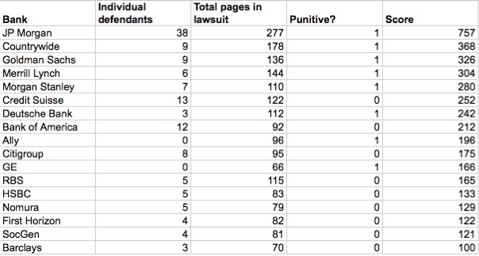
Felix Salmon, at the Seeking Alpha website, has created a chart that seeks to measure who is in the most trouble here; by his measure JP Morgan Chase is far and away at the top of the list…except that the current incarnation of B of A represents three of the top eight spots on his list, which suggests the FHFA is targeting them for the most recovery. (Salmon used the number of individual defendants, how many pages were in the lawsuit, and whether the suits seek punitive damages as his yardsticks; from there he calculated a score that makes up his rankings.)

All this had to happen right now, it appears, because a statute of limitations is in play; the WaPo reports that a failure to file the suits would have meant the FHFA would have lost the ability to recover those monies. (It’s also reported that pre-lawsuit negotiations were stalling, and those negotiations will presumably continue, with a series of impending court dates to help, shall we say, sharpen the focus.)

Now that is pretty much all the story I have for you today on this one – except for a bit of a “discuss amongst yourselves” to finish things up:

It has been suggested that the FHFA is in an inherently conflicted position in all these cases. That’s because the agency is acting as both the regulator of these banks and the “victim” as we seek any monies that may be due from any fraud.

So what would be a better situation?

Should the FHFA continue to regulate the banks they’re suing as a victim, or should another regulator be put in place…or should another Conservator be appointed, leaving the FHFA as “just a regulator”, and not a victim?

It’s a question worth about $200 billion, more or less – and even in these times, that’s still a lot of your money.

Monday, August 22, 2011

On Doing Better Than 50%, Part Two, Or, Is “Made in USA” A Jobs Program?

When last we met, it was to discuss a Big Idea that the Obama Administration might apply to get some job creation going, despite a difficult Congress; the Big Idea was to look at the “Buy American” provisions that exist in our laws, regulations, and Executive Orders and see if we could practice a bit of “jobs arbitrage” by not just meeting the “Made in USA” requirements when governments across this country make purchases, but exceeding them.

(As it stands today, pretty much any “good or service” with more than 50% Made in USA content qualifies as a Made in USA purchase, even if 49% of the “good or service” comes from somewhere else).

At the time, I told you that if all went well we could look forward to comments from both Labor and the Administration as to the practicality of the Big Idea, and as it turns out I have comments for you that hit close to that mark – and a bit more besides:

On Saturday I just happened to bump into Congressman Adam Smith (WA-09); in the course of that conversation I told him what we’re doing here, and he wanted to offer a few thoughts of his own…and when you put all that together, I think we’re going to have a lot to talk about.

“Tis surprising to see how rapidly a panic will sometimes run through a country. All nations and ages have been subject to them; Britain has trembled like an auge at the report of a French fleet of flat bottomed boats; and in the fourteenth century the whole English army, after ravaging the kingdom of France, was driven back like men petrified with fear; and this brave exploit was preformed by a few broken forces collected and headed by a woman, Joan of Arc.

--From The Crisis, by Thomas Paine; essay of December 23, 1776


So the two-second recap of the Big Idea is that if government, at all levels, were Buying More American we could create More American Jobs, and as we mentioned above, the way the rules stand today, 51% Made in USA is good enough – and that seems to leave a lot of room to do better.

Of course, nothing is as simple as it seems, and despite what Tom Lehrer might say, it’s not all skittles and beer for this proposal either.

I have a source in the Administration who would not go on the record for this story; nonetheless I was sent a detailed email response “on background”, which I’ll paraphrase for our use today:

We are looking to expand US trade abroad, and we have made deals for access. We agree not to restrict, for the most part, where purchases can be made, and we expect reciprocity from the rest of the world when their governments do their purchasing - or at least from those governments with whom we have a WTO Government Procurement Agreement (GPA) or a Free Trade Agreement (FTA). (Want even more details? Check out either the Trade Agreements Act of 1979 or this Congressional Research Service report).

The Administration would tell you that 95% of the world’s consumers live outside the USA, making trade reciprocity particularly valuable for the US.

They would also tell you that if we decide on our own to “change the deal”, then we should expect retaliation from other governments.

Beyond that, they would suggest that there are US companies that source many of their products or product components globally, and those companies would actually be hurt by stricter Made in USA requirements.

Finally, the Administration points out that there is a dollar cost for more Made in USA, as opposed to using what can often be cheaper foreign sourcing.


In the introduction I suggested that I had a comment from Labor, and that’s somewhat correct. I contacted the Washington Sate Labor Council (WSLC) for a comment, and they sent me material that came from the Alliance for American Manufacturing (AAM), at the same time telling me that the AAM’s position on Buy American is the same as their own.

It is inaccurate to refer to the AAM as a Labor organization, however, as they are a partnership of Unions, manufacturers, and other interested parties. Among those partners are the AFL-CIO and the United Steelworkers (USW); the USW was one of the founders of the group.

They take issue with a great deal of what the Administration has to say, and I’ll start with a quote from an email sent to me Friday by the AAM’s Steven Capozzola:

The threat of retaliation for buy America is ridiculous. The law [the Buy American Act, 41 USC 10a-d] is specifically written so as to be applied when permissible under our existing trade obligations.


Here’s a quote from AAM material that was referred to me by the WSLC:

…the U.S. is, by far, the world’s largest importer, soaking up a net $819 billion in goods in 2007…The U.S. imports far more than it exports, a balance of sales that our trading partners are anxious to preserve. This is not about restricting imports. It is about using taxpayer dollars, when allowed by our international obligations, to purchase U.S.-produced goods. As the global downturn has progressed, many industrialized countries such as France and China have already taken similar action to support their domestic manufacturing base.

…These trade agreements do however allow for domestic preference under a number of circumstances…These preferences were negotiated for a reason. It would be irresponsible not to utilize them to the fullest extent possible.

…By contrast, other countries have held themselves out of the reform movement and have instead opted to promote their own manufacturing base through closed self-procurement programs. A good example is China, which, in addition to a recent $586 billion stimulus program, continues to subsidize its own producers via deliberate (and illegal) currency undervaluation. Until countries like China make the same commitments, and sign-on to internationally accepted procurement agreements, the U.S. will accomplish nothing by making yet more unilateral concessions.

In addition, as noted above, these contentions rely on the baseless assumption that the U.S. currently has any significant access to foreign procurement markets that would be at risk if other countries “retaliated.” The majority of the foreign stimulus in PPI’s tally is made up of $614 billion being spent by countries that have no procurement obligations towards the United States and that already apply domestic procurement preferences (principally China, but also India and Brazil).

-- Alliance for American Manufacturing, The Facts on ‘Buy America’ and Domestic Sourcing, February 2009


The AAM would also want you to know that in addition to China numerous other countries, specifically Canada, certain European nations, Japan, and Brazil all use other forms of “discrimination” to “preference” their goods over ours when it comes to government procurement: impossible-to-meet technical standards, “murky” purchase procedures, and bid rigging are all tools used around the world to make sure local suppliers are just a bit more, shall we say…reciprocal…than a US supplier might be.

Look, I hate to do this to everyone, but we’re once again running longer than we should, and we still have a lot more to talk about, so at this point I’m going to call “cliffhanger!” and set us up for a Part Three.

Here’s the “agenda”:

We’ll be talking about how the devil’s in the details: specifically, we’ll be looking at what “Buy American” is already excluded from these various trade agreements– and there’s a lot more than you might think, even as some of it is targeted in amazingly specific ways (to do that we’ll be paying particular attention to the annexes to the WTO agreement); we’ll also get Congressman Smith’s reaction to all of this…and once again, we’ll see if we can’t get it all done in 1500 words or less.

And on a lovely summer’s day, what could possibly be better beach reading…what with the redolence of the lazy sea breezes and the surf washing gently up on the shore and all…than 1500 more words on the annexes to the WTO agreement and how it all relates to sneaking a jobs program past recalcitrant Republicans?

I can’t think of anything else either, and I can’t wait to see you there.

Friday, July 29, 2011

On Running Your Own Government, Or, Why Pay The Military?

I have not been talking about the insanity around the debt ceiling and debt and deficit and the efforts of Republicans to drive us all off the cliff, but I am today – and I’m going to do it by allowing you to grab ahold of this problem and see for yourself just how unbelievably bad this manufactured crisis is going to be.

You will hear a lot of conversation about the consequences from others; today, however, you are going to get the chance to be both the President and the Secretary of the Treasury, and you will get to decide for yourself exactly what bills the Federal Government should and should not pay as the cash runs out if a deal is not made by the time borrowing authority runs out.

At that point you’ll be able to see what’s coming for yourself – and once you do, you won’t need me to tell you what ugly is going to look like.

“…no state has the right to secede unless it wishes to…[and] it is the President’s duty to enforce the laws, unless somebody opposes him…”

--William H. Seward, deprecating President James Buchanan’s efforts to preserve the Union, as quoted in the book Battle Cry of Freedom: The Civil War Era


So before I go sending you off to take the reins of power, let’s fill you in on a few things that you’ll need to know.

If no one has explained it to you yet, the Great Big Fuss that is going on right now is set around two issues: there are those who feel that the best way to make this economy better is to ensure that the Federal Government is a smaller player in our economy and not running on a deficit; many of these folks feel the way to achieve this is to make immediate, drastic, cuts in Federal spending.

At the same time, the United States has run up against its “debt limit”. That means the US will be unable to borrow money to fund ongoing government operations, and as you’ll soon see, right now we borrow a lot of the money we need to run today’s Government.

So if you are one of those who seeks to immediately cut Federal spending, you could force that to happen by refusing to allow the Federal Government any more borrowing authority; the fear of what could happen after that is presumably going to force the opposition to accept any deal, no matter how draconian, just to obtain that borrowing authority.

Naturally, the bigger a hostage you’re holding, the more draconian of a deal you hope you can make, and holding the “Full Faith and Credit of the United States” hostage is about as big as it gets; that’s why the Republicans are pushing for everything right this very second, from the end of Medicare and Medicaid to the right to mine uranium right next door to the Grand Canyon.

So with all that in mind, let’s talk money.

In the month of August, the Federal Government is expected to take in $172.4 billion.

There will be a mess of bills that are coming due during the month; that amount totals $306.7 billion, and that means about 44% of the bills must go unpaid.

Where’s that money go?

The Big Five are interest on current debt, which must be paid to avoid a default, payments due to defense contractors, Social Security, Medicare, and Medicaid; the five of those, alone, will be just about $160 billion.

And that leaves $12.4 billion to fund everything else the Federal Government has to do.

That would include the remaining cost of supporting our several wars, the entire Federal law enforcement establishment (for example, the FBI, DEA, ATF, Immigration and Customs Enforcement, the TSA, the Border Patrol, the Federal Marshals’ Service and the Bureau of Prisons), the National Parks Service and the Forest Service, the Centers for Disease Control, the Weather Service…well, just about every single thing the Federal Government does, except the Big Five.

So that’s the situation – and now it’s time for you to become the boss and make the choices:

The fine folks at Bloomberg Government have created an interactive tool that allows you to point and click your way to figuring this stuff out.

You will find your spending choices, and you just click on what you want until you run out of money, which the handy bar on the left will manage for you. When the bar turns red…you’re out of money.

“…Each month, I put all my bill collectors’ names in a hat, reach in, and pull out a name. That’s who I pay. If you keep calling here, then your name is not going in the hat next month.”

--Steve Harvey, quoted in October 2003’s Vibe magazine


OK folks, so now you know where to go, and you know what to do, so let’s make something happen.

Take this tool and use it to create a conversation about just what really is at stake, and watch the look on your friends’ faces when you point out that the entire Federal Government is about to go out of business if Republicans have their way.

I’d tell you the looks on their faces would be priceless – but that’s not true.

Absent a debt ceiling deal, the price is actually going to be about $134 billion, which is the money we’re just not going to have next month, when we’re not doing things like paying for the salaries of active-duty servicemembers or food inspectors or the guards out there at the Supermax.

It should be a fun time, all the way around – unless, of course, you’re one of the 300 million or so of us who are gonna get screwed over by it all.

Tuesday, July 26, 2011

Hitler Holds News Conference, Blames Balanced Budget Amendment For U.S. Defeat

(FNS - Washington, New Germany, April 17, 1947) America’s new Führer, Adolf Hitler, announced today that his official War History would in fact acknowledge that one of the biggest contributing factors to the defeat of the Allies was the insistence of the former United States of America on sticking to its Balanced Budget Amendment, which left them unable to fund the wartime conversion of the US economy for the benefit of the Alliance.

“All those ideas Mr. Roosevelt spoke of”, said Hitler, “Lend-Lease, modular shipbuilding, War Bonds, secret weapons…in the end, all of them were just words, since the Americans’ Congress was never willing to allow the country to fully fund its war effort.”

As has been previously disclosed, Waffen SS historians have already located caches of documents in Washington describing plans to fund a massive military expansion in the former United States by selling War Bonds.

These debt instruments would have allowed the Roosevelt Administration to spend up to 40% of the Gross Domestic Product of the former Nation in defending itself, the former United Kingdom, and other nations against the Fatherland, but for reasons that are still not well understood Conservative politicians demanded that the former US Government never “take on debt for outsiders”, or, in the words of Mae Cadoodie, leader of the American Tea Party movement, “Never invite a foreign entanglement that raises our taxes”.

Had the Americans been allowed to sell War Bonds, or to raise taxes to fund the War, it is estimated that they could have provided tens of thousands of aircraft, millions of military vehicles, and hundreds of ships, but the Balanced Budget Amendment prevented any of that.

This represents the end of a series of political arguments that had been taking place since the 1930s, when some American economists were suggesting that a new idea called “deficit spending” could be helpful in bringing the former USA out of the Great Depression; at that time the Roosevelt Administration was unable to establish agencies such as the Work Projects Administration, which would have built public works projects throughout the USA in an effort to revive the moribund economy.

Mae Cadoodie and others fought back successfully against these ideas, pointing out that the last thing the US economy needed in a bad economy was new taxes; they made the same arguments when the Roosevelt Administration first proposed Lend-Lease as a war emergency measure.

“We cannot inflict punishing new taxes on American industry at this fragile time in our recovery” Cadoodie said in a famous speech in 1939, “and if the market is really there for this military materiel, if it’s not just some boondoggle manufactured by Roosevelt to take money out of the pockets of the American people, then I’m sure the British will be able to find the funding they need from the markets or from charitable donations”.

Cadoodie was unavailable for comment, as she and most other former American politicians are still serving on the Eastern Front, and will be for the foreseeable future.

In a related story, the conversion of the remainder of the American industrial base is underway for the fight against the Russians, and millions of otherwise unemployed Americans are being drafted into the military services in preparation for the final assault.

Friday, July 8, 2011

Obama Wants To Attack The Middle Class? Take Congress Hostage!

By now you have heard that President Obama has chosen to throw Social Security and the Medicare and Medicaid Programs over the side of his proverbial fishing boat as bait to see if he can get Republicans to give him another really lousy compromise, much as he did last December when he gave up billions upon billions of deficit reduction in order to help Republicans preserve tax cuts for billionaires.

And it looks like the President doesn’t really lose if you or I get hurt here: in fact, it seems that, in his eyes, it’s to his advantage to fight against his own base as he seeks to be “the adult in the room” in the runup to the ’12 election.

So we’re going to have to find a way to put The Fear on this guy – and I think I’ve got a plan to force this President to listen.

And it works like this: if this President ain’t gonna be moved by our message…we do it by holding the rest of his Party hostage.

"You've got to put the points on the board. Good effort and style aren't enough. Everyone loves the Chicago Cubs, but no one expects them to win. Be more like the New York Yankees."

--Greg Swienton, COO of Ryder Systems, advising Army NCOs at a leadership seminar, July 2009.


First things first: let me tell you how the hustle is potentially going to go down.

Republicans are going to try to force Obama to offer up 100% cuts in spending, with no new money coming in to Government at all, or they’ll let the whole “debt default” thing come crashing down, which looks like The Best Thing To The Tea Party Ever – and based on past history, this is a deal that Obama, around 11:56 PM on August 1st, will be willing to take.

The two most likely ways to cut spending and get results in the trillions of dollars are to change the connection between increases in your future Social Security benefits and the cost of living (which guarantees that you and I will forever be behind the inflation eight-ball), or to cut the payments coming out of Medicare or Medicaid, which is going to stick it, immediately, to medical service providers, the poorest of the poor, your Grandma and Grandpa (or, maybe, you), and the disabled.

It is rumored that both of these approaches have been put out as options by the President. It is also rumored that, in return, he wants some amount of revenue increases – but it’s also rumored that he went from seeking a dollar in cuts for each dollar in new revenue to something that looks more like $6 in cuts for every $1 in new revenues – with lots more time available for Republicans to play chicken and get even more.

So if the President is not going to put a stop to all this, I think we, ourselves, are going to have to step up and get it done.

What I’m going to propose is brutal, unfair to many of our friends, and vindictive to the point of risking an even worse situation than we have now…but these are desperate times, and I suspect it’s now time for desperate measures.

So here’s what I think we have to do:

Now, today, before this gets any farther, we have to call every single Democratic Member of Congress, House and Senate, friend and foe, and deliver this message:

“I don’t care what you ever did for us before, we are not going to let you do this to us now. We cannot stop Barack Obama directly – but we can do this.

We can target Congressional Democrats.

Each and every one of you, as a group.

And with that in mind, you are now on notice: if you allow this President to make a deal that includes any cuts, adjustments, alterations, or anything else, to Medicare, Medicaid, or Social Security, and you don’t get at least a dollar of new revenue for every dollar of cuts…then you are done.

We will immediately stop giving any Democratic incumbent even one dollar of donations, we will not help you win elections by volunteering – and we will vote for any candidate that’s running against you in the next primary.

Even if it’s not your fault.

That’s how serious we are, and that means you better figure out, right now, how to stop Obama from caving…because now, it’s all on you.

If Obama slips on the stairs and his pen accidentally signs the bill…it’s now your fault.

If Obama puts his pen back in the desk set upside down, and there’s an open window in the Oval Office, and an errant breeze drags the bill across the upside-down pen… it’s now your fault.

So what you better do is you better go make sure there aren’t any roller skates on the stairs at the White House, and go close the windows, and do whatever you have to do, because now, you, and every other Congressional Democrat…all of you, together…are going to be held responsible for what happens.”


And then we gotta stick to it – even if it costs us Jim McDermott and Raul Grijalva and Barney Frank, all on the same day.

We have to show that we will bring even more wrath and destruction than the Tea Party – and we have to be ready to support new Democrats who rise up to oppose the current ones.

And consider this: Labor is already making the effort to recruit and train Progressive candidates, and there are lots of opportunities to partner with unions who would presumably love to have some new partners of their own.

The next negotiating session between the President and Congressional leadership is Sunday, and that means we need to move fast if we want this to work – but Sunday is unlikely to be the last day of negotiations, and after that is when we can really crank up the pressure on Democrats.

Is this unfair to our friends?

Yup.

But that’s too bad, because we have been unfairly taking hits from our friends and Republican bullies alike for three years now - and the only thing that’s going to make it stop is if our friends fear us more a whole lot more than they fear Republicans.

And if you don’t think this can work…well, guess what? The LBGT community got “Don’t Ask, Don’t Tell” repeal passed when Republicans said they would never let it get through Congress – and then the LBGT community told Democrats that if repeal didn’t pass…the gAyTM was gonna be forever closed.

And then, mirabile dictu, repeal passed, in a lame-duck Congress, even when virtually all observers had said it had no chance.

That is the power of The Fear, and if we want to win this fight, we need to be the ones putting The Fear on our Democratic friends, not the other way around.

So get up, grab the phone, and start reminding the nearest Democrat that unemployment, in this economy, really, really, sucks – and there’s no reason in the world why they can’t be just as unemployed as anyone else.

It’s time for hardball, folks – and in this fight, we need to be the ones with the hardest balls.

Because if we’re not…the terrorists win.

Tuesday, May 24, 2011

On Hole Cards, Or, "Drill, Baby, Drill"? Why? Is Canada Out Of Sand?

In America, today, there are three kinds of drivers: those who look at the other gas pumps down at the ol’ gas station and think: “Oh my God, I can’t believe how much that guy’s spending on gas”, those who look at their own pump down at the ol’ gas station and think: “Oh my God, I can’t believe how much I’m spending on gas” – and those who are doing both at the same time.

Naturally, this has brought the Sarah Palins of the world back out in public, and once again the mantra of “Drill, Baby, Drill” can be heard all the way from the Florida coast to the Arctic National Wildlife Refuge.

But what if those folks have it exactly backwards?

What if, in a world of depleting oil resources, the last thing you want to do is use yours up?

To put it another way: why isn’t all our oil part of the Strategic Petroleum Reserve?

Consider the inexorable logic of the Big Lie. If a man has a consuming love for cats and dedicates himself to the protection of cats, you have only to accuse him of killing and mistreating cats. Your lie will have the unmistakable ring of truth, whereas his outraged denials will reek of falsehood and evasion.

--From the book Ghost of Chance, by William S. Burroughs


So here’s the thing: we produce a surprising amount of our own oil right here in the USA (in fact, we’re the world’s third-largest oil producer), but we don’t produce enough to cover our current use, and that’s why we import about half of the roughly 19 million barrels of oil we use daily. The vast majority of that is used in vehicles or for heating; almost none is used to generate electricity.

Our largest suppliers of oil, despite what you might think, are not all from the Middle East: instead, it’s Canada, Saudi Arabia, Mexico, Nigeria, and Venezuela, in that order.

(Perhaps you’re thinking: “Canada? Oil?” Yes. Canada and Oil. They provide us with more than twice as much as Saudi Arabia from huge “oil sand” resources, primarily in Alberta; the exploitation of those resources has created a huge environmental controversy.)

Now if you ask me, an ideal situation would be one where we decided to get out of the business of using oil altogether – and to help make my point, we have some helpful numbers from a guy that you pay every day to figure this stuff out: Mark Doms; he’s the Chief Economist for the US Department of Commerce, and, to paraphrase Little Feat, he’s always handy with a chart.

According to Doms, 60% of our 2010 trade deficit (about $265 billion) represents the cost of imported petroleum products, and if things continue through December as they did the first three months of this year, in 2011 every American, man, woman, and child, will pay a “tax” of about $1000 to import all that petroleum.

Do you know what we, individually, spend on gas? In March of this year, the average household spent just over $300 on that month’s gasoline; 5 months ago that number was $56 lower. The way it works out, every time gas goes up 10¢ a gallon, it costs the average household another $7 a month.

And that’s not all: less than half of the total cost of imported oil is paid at the pump: about 44% of imported oil is used by businesses; another 15% is used by governments across the USA, and that means almost 60% of the cost of imported petroleum is “folded into” the price of everything else.

(A quick author’s note: you’ve seen the words “oil” and “petroleum” used liberally in this story; the exact literal reality is that in each instance we should really be referring to “petroleum products”, and that’s because we import and export not just crude oil, but a variety of other petroleum products. I get tired of using the phrase “petroleum products” over and over, and I’m probably using “oil” and “petroleum” more interchangeably than I should.)

So get this: if we were out of the importing oil business, we’d save about $300 billion a year – and as it turns out, over a 10-year period we could actually convert the entire US auto fleet to electric cars powered by windmills by providing $15,000 cash “buy-outs” for today’s 135,000,000 gasoline cars and building the wind generation and “smart grid” we’d need to support the effort…and doing all that would cost…wait for it…about $250 billion a year.

If I get the math right, 20 years after we first started building windmills and subsidizing cars, everything would be paid off; and every year after that the US economy would generate a $300 billion “profit” on our investment – unless the price of a barrel of oil goes up. If it does, the amount of money coming back to our wallets every single year from then on, obviously, also goes up.

And if we were out of the “using oil for driving” business, once everything was paid off we could put almost $4000 a year (in today’s dollars) right back in the pocketbooks of every family in this country – which, if you ask me, represents a pretty good “tax cut”.

Let’s also keep in mind that any new oil drilled on our public lands might not necessarily end up in the US; that’s because even if oil companies were 100% free to “Drill, Baby, Drill” in our waters to their hearts’ content…they’d also be perfectly free to sell as much of that same oil, anywhere in the world, to whatever entity might end up being the highest bidder – and today, our friends in places like India and China are desperate to be that high bidder.

Put all of this together, and you get back to the question I posed at the top of the story: why in the world would we be in a hurry to “Drill, Baby, Drill”, when we could, instead, put all our efforts into getting out of oil, which would save us so much money that the conversion pays for itself?

Then, when oil’s running $400 a barrel or so, let’s use our oil to pay China back the trillion dollars we owe ‘em…which, at current production rates, would only take about 400 days, assuming it were possible to divert all our production for that purpose.

To state it a bit more ironically, it may be that the smartest thing we can do right now is to conserve every possible drop of oil we have…until we don’t need it any more, and it becomes a sort of Strategic Cash Reserve that can help strengthen the dollar and reduce the national debt in the years to come, both at the same time.

Or to put it another way, the next time someone tells you they want to “Drill, Baby, Drill”...you can step right up, look them square in the eye, and ask: “Why do you hate America?”

And won’t that be fun?

Tuesday, May 10, 2011

On Killing Medicare, Or, You Stand Up, They Run Scared

Oh, my, has there been a lot of news since we spoke last about the Potential Impending Death Of Medicare: obviously we’re going to have to talk about the implications of Osama Bin Laden’s death (but we’ll do that another day), President Obama very publicly congratulated Donald Trump for having the leadership skills to know that Gary Busey was the one who needed to be fired after the way he ran the men’s cooking team on “The Apprentice”, and, of course, there was that “extreme ironing incident” on the M1 near London’s Mill Hill.

But what you may not have noticed is that in the past two weeks the Grim Weeper himself, Speaker of the House John Boehner, has gone from saying “I fully support Paul Ryan’s budget, including on Medicare” to saying that the Paul Ryan “Let’s Kill Medicare” plan is “an idea … worthy of consideration”—and when that happens that quickly you know somebody applied what we might politely describe as being at least “an equal and opposite force”.

And what I’m here to suggest today is that the opposite force in question…is you.

When I left for college, I was determined never to be a victim again. I would take my lead from the Hollywood tough guys I had always looked up to: Charles Bronson, Clint Eastwood, Ned Beatty. So on Day One of my freshman year at Dartmouth, I walked into class and punched the first person I saw—my Ethics professor, Dr. Buneta.

--From the book I Am America (And So Can You!), by Stephen Colbert


So as we said, it just a couple of weeks ago that we were talking about the then-underway Congressional Recess and killing Medicare and how you could go make yourself well understood by your local member of Congress; people did exactly that, and all of a sudden the backpedaling was under way.

As we mentioned, back then it was full speed ahead for the Ryan budget plan—but two weeks of facing the voters later, Michelle Bachmann, the Chair of Congress’ Tea Party Caucus and the Woman Who Would Usurp Sarah Palin, says that:

I supported that budget blueprint, though I’ve expressed caution about how we approach the issue of Medicare. We must keep our promises to those who receive Medicare benefits, and those who are nearing the age of Medicare eligibility. Our challenge is to reduce the soaring amounts that government spends on health care, without burdening those who are most vulnerable.


And it’s not just her: virtually no legislation moves through the House unless it first clears the Ways and Means Committee, and Chairman Dave Camp says this about the Ryan plan…

“I am not interested in laying down more markers. I am interested in solutions.”


…and that is his way of saying Ryan’s proposal is toast.

Beyond that, it looks like the Republicans’ most immediate “tactical” effort, tying big cuts in the program to an expansion of the Federal Government’s “debt ceiling”, is also coming apart at the seams; to that end we have the Republican House leadership now suggesting that they understand the urgency of passing the debt ceiling even if the Medicare “reforms” are not in that agreement.

(There is, however, an element of uncertainty still extant: Speaker Weeper spoke to the Economic Club of New York Monday; he told them he’s going to attach lots of conditions to that debt ceiling extension, after which he went off to a private spa to be dipped in whatever orange liquid they use to obtain his peculiar hue.)

Republican Representative Joe Walsh, of Illinois’ 8th, says that he would like to see the Party continue to push the Ryan plan as an issue in the ’12 campaign. That might work well in certain Congressional races, but it would seem to be a problem for any Republican Presidential candidate—and we should note that Walsh himself was elected in ’10 with a very narrow margin of victory.

So that’s all good news, but it’s probably not the end of the story…and if you ask me, the next battle is going to look more like no battle at all.

Here’s what I mean:

A great way to negotiate a deal is to start out with a crazy demand, and then, when that idea falls off the table, come back with something slightly less crazy that looks good enough to the other side to be acceptable.

Another variation on this theme is to start out with an extreme demand, and then you “meet somewhere in the middle”, which ends up moving the entire negotiation farther in your direction than you might have ever achieved by “normal means”.

You would think Democrats would be smart enough to not go along with such a strategy—but with Osama dead, and the “Democrats are soft on defense” argument getting tougher to make all the time, there is going to be a ton of effort going into the ’12 campaign to show that Democrats are “soft on the deficit”, and there is a real possibility that this Administration and certain Democrats in Congress will be susceptible to some of that pressure.

This will begin to play itself out, I suspect, as the effort to reconcile the budget visions offered from the House, Senate, and Administration continues through the summer—and if you want to get a sense of how that battle might look, check out today’s hearing (Perspectives on Deficit Reduction: Social Security) before the Senate Finance Committee.

Senate Finance is Max Baucus’ Committee (Orrin Hatch is Ranking Member), so this is a Blue Dog Chairman; he’s also one of those who might be happy to make compromises to “lower the deficit” that we won’t like—including supporting cuts to Social Security or raiding the Social Security Trust Funds.

One way that could be done…very quietly…would be to put a cap on all Federal spending, and then lower that cap by some amount each year, ignoring the fact that Social Security has its own funding source and is in no way connected to the deficit—and they tell me that’s what Nancy Altman, the co-chair of Strengthen Social Security, is going to be saying to the assembled Senators today:

“Social Security lacks the legal authority to deficit-spend, and so, cannot run a deficit. Because it cannot run a deficit, it cannot add to the federal deficit…

Some policymakers are proposing a so-called universal cap as a mechanism to control federal spending. It is important to understand that unlike the general fund, Social Security already has an automatic spending cap. If Social Security were ever to lack sufficient revenue to cover the cost of scheduled benefits, the law provides that those benefits be reduced automatically

To include Social Security in deficit legislation, even with the explanation that the inclusion has nothing to do with deficit reduction, risks reinforcing the widespread belief that Congress is raiding the trust fund…”


(Full Disclosure: I’m associated with the Campaign for America’s Future, and they’re part of Strengthen Social Security.)

It’s a short story this time, so let’s wrap it up here: we’ve had great success this past couple of weeks convincing pretty much every politician in the United States of America that Social Security and Medicare/Medicaid matter to us, and that getting crazy with these programs really is political suicide—but these programs have been under assault since the very day they were born by people with their own agendas and more or less all the money in the world to fund an endless series of fights…and you can kill a popular program in subtle ways that most voters might not even notice until it’s too late; with all that in mind, this one very big victory is not a war finally won.

The shape of the next fight is going to be made more visible today, and I would encourage you to swing by C-SPAN to see how it went

Even more importantly, I want y’all to think about what this past couple of weeks really meant: we went out in force, and we scared the hell out of the politicians who thought they would slam through some major changes that we’d just somehow…accept.

Democrats and Republicans alike need a bit of direction as this electoral season gets underway, and the messages we send out there obviously have the power to turn an entire discussion, so look at what you did, let it give you a bit of confidence that you can have an impact…even in this seemingly impossible year…and then let’s get ready for the next fight, which is going to be just as rough, and just as high-stakes—but this time much of the action will be subtle and deliberately “obfuscated”, and we’ll have to be even more alert if we want to see the scam before it gets set into stone.

And of course, we’ve got to keep showing up for those “Town Halls”, eh?


FULL DISCLOSURE: This post was written with the support of the CAF State Blogger's Network Project.

Monday, April 25, 2011

On Happy-ing Their Gilmores, Or, Will Body Bags Be The New Gold Watch?

We are continuing a recent theme here today in which two of my favorite topics are going to converge: Social Security and in-your-face political activism.

I have been encouraging folks to take advantage of the recent Congressional recess to have a few words with your CongressCritter about the proposed Death Of Medicare and all the proposed cuts to Social Security…and you have, as we’ll discuss…and now we have an opportunity to do something on a national scale, just as we did a few weeks ago in support of Social Security.

This time, we’re going to concentrate on fighting the idea that retirement ages should go up before we become eligible for Social Security and Medicare (and elements of Medicaid, as well), and that Americans should just keep right on working until the age of 67 or so—which isn’t going to be any big problem…really…trust us.

Now that just makes no sense, and to help make the point we have a really cool video that you can pass around to all your friends—and your enemies, for that matter, since they’ll also have to worry about what happens to them if they should ever make it to old age.

“…Art can create a climate of sensitivity in which it is possible for change to occur…”

--Shabana Azmi, on Riz Khan’s Al Jazeera program One on One


Members of Congress are at home this week, and they love to go out and meet the voters—but it hasn’t been as much fun all of a sudden for some of them, and there are several videos out on the Web right now where it looks like Members wish they hadn’t been hanging out where the public could see them so easily.

Now some of these videos are loud and boisterous—but the one that should really scare Republicans was Charlie Bass’ appearance in Hillsboro, NH on the 4/20 holiday.

If you look at the crowd, they’re older, for the most part—and for the most part they came to the meeting with their own information, meaning that they weren’t so much looking for the Congressman to tell them what was up as they were looking to tell Mr. Bass (who represents the State’s 2nd District) that they weren’t too happy with him about this “entitlements reform” deal.

Now they weren’t there with pitchforks and torches by any means, and a lot of them were supportive of many of the Congressman’s other positions—but they were extremely unhappy about the idea that Medicare would become a voucher system (just so you know, Bass would insist that it’s a “premium support system” whenever the word “voucher” came up), and they did not find the argument that “this won’t affect you” very convincing, either.

In addition to the obvious question (basically, “why would the plan be better if it only sticks it to our kids and grandkids?”), a woman from the crowd asked a question I don’t think Karl Rove ever thought would come up: you might not be sticking it to senior citizens today…but she wondered what’s to prevent conservatives from coming back in a few years and asking those under 65 why they should be supporting those old people and their “Cadillac plans”—at which point it will be “stick it to the old folks” season, and Medicare will officially die, along with a lot more old and disabled people, sooner than they should have.

And he wasn’t the only one to have a bit of a tough week at what used to be really friendly Town Halls: Pat Meehan (PA-07) got himself into a shouting match with his putative employers, so did Lou Barletta, he of Pennsylvania’s 11th…and so did Catfood 2.0’s architect, Paul Ryan, who had to face what he politely described as an “enthusiastic” crowd in Milton, Wisconsin.

“Happy learned how to putt! Uh-oh!”

--Adam Sandler, from the movie Happy Gilmore


To put it bluntly, the Members are hating it, big-time, as it appears that their 2009 “Town Hall Goose” has suddenly become just a little too good for the gander.

And if we’re already making life hot for these folks…why not just keep on pushing?

That’s the idea behind “Don’t Make Us Work ‘Til We Die”, which is an effort of the fine folks at Strengthen Social Security to highlight the fact that a lot of people right now are proposing to raise the retirement age; either to 67, or to something north of that…for the good of America, of course.

After all, if you’re a firefighter, or a nurse, or maybe you work in the trades, or a restaurant kitchen, or you drive a gasoline truck…or maybe you’re a smokejumper for the Forest Service…why would working until 67 be a problem for you?

Here’s a video that makes the point very nicely:

embed src="http://www.youtube.com/v/VB-g52TshO4?fs=1&hl=en_US&rel=0" type="application/x-shockwave-flash" width="400" height="300">

(By the way, they would love for you to spread this video far and wide; grab the embed code and just go nuts—or, if you prefer, email the link—and in the interests of Full Disclosure: I’m associated with the Campaign for America’s Future and they’re one of the members of the Strengthen Social Security coalition.)
.
On Wednesday and Thursday all of this goes outside and hits the streets all across the country, and to make it easy, the same website can help you find an event near you—or, if you live in Wyoming or something, you can attend the “virtual event”—either way, just visit the handy website and go from there.

So there you go: we have Republicans feeling mighty uncomfortable all of a sudden, we have a chance this week to get out in public and make the point in a bigger way—and now you even have the perfect video to send to that one relative who always forwards you Michael Savage’s latest missives.

Now get out and keep the momentum going forward—and don’t forget, it’s really easy to look at the person next to you in line at the grocery store and say: “Can you believe how they’re trying to screw us out of Social Security?”

That’s about all it takes to get a pretty good conversation going…and if you repeat that process, about a million times…well, that’s how politics gets done.


FULL DISCLOSURE: This post was written with the support of the CAF State Blogger's Network Project.

Tuesday, March 15, 2011

On Petals And Metal, Or, Today And Tomorrow, Street Actions Are Afoot

For the past couple months I have been talking a lot about “taking it back”, and I have two great chances for you to do just that over the next two days.

One of them involves actions that are taking place all over the USA—but the other is a very special and particular event which will be taking place in Vancouver, British Columbia on Wednesday.

This’ll be a short story…but by the time we’re done, you’ll have stuff to do this week.

A young lady visitor on the set of “Never Give a Sucker an Even Break” asked W.C.Fields if he liked flowers. Fields replied he was very fond of Four Roses.

--Ronald J. Fields, from the book W.C.Fields By Himself


So here’s what’s up:

Tomorrow, MoveOn.org and a ton of others are planning “Defend the American Dream” rallies around the country…in fact, as of the time this was written there are 277 events planned, all on the same day.

A few weeks ago Social Security workers held “informational picketing” events at Social Security offices around the country to make Americans aware that proposed Republican budget cuts would create huge “bumps in the road” for those who want their Social Security checks to go out on time, or who might like to speak to an employee on the same day they call the office.

That’s part of tomorrow’s program as well, with Washington DC’s office a sort of starting point from which our anger with what’s been going on can spread.

So if you’re in DC tomorrow, right after office hours, the event will take place at 5:30 PM at the Social Security office at 2100 M Street NW, and there is a handy “meetup page” to give you more information if you need it.

But maybe you’re not going to be in DC.

We still got you covered: this page right here will let you enter a zip code and find an event near you.

For example, there’s a Rally at the San Diego County Administration Center—which, as y’all know, is maybe eight blocks from the end of the runway at Lindbergh Field—and Jim Brown and Virginia Huschke, who are putting on the event, report that they had 1000 people show up last week at the same place for the same thing…so you gotta be there.

Maybe you’re in Michigan…and if you can get to the Veterans’ Memorial in Niles after work tomorrow, United Steel Workers Local 13729 and MoveOn Michiana want you. The Memorial, for those unaware, is located at Waterfront Park, right by the Main Street Bridge and across the street from Massimo’s Pizza—which means afterwards you can pick up a meatball sub or somethin’ and not even have to cook dinner. (Maybe it’s just me, but I am not down for the ranch pizza.)

If you’re in Mobile, Alabama, swing by the cannon at Mobile Memorial Park (on Government Street), where hundreds of protesters intend to use the cannon to take the city hostag—no, wait, I made that part up.

They are intending to have a lovely demonstration, however…and if you think Alabama is an unlikely place for this kind of rally, think again: folks who might have been big on the Tea Party a few months ago are starting to think again, and this is a great chance to help those with seeds of doubt do a bit of “germinating”, as it were.

So that’s tomorrow’s set of events…but what about that Vancouver thing we were talking about?

Well this is good.

The Yes Men” are well-known pranksters, and some of their past efforts to “correct corporate identities” have been downright diabolical, including the time they pretended they were the Dow Chemical Corporation, and they held a press conference to announce that Dow was assuming all liability related to the industrial accident at Bhopal, India, which killed at least 3400 people…which, naturally, forced Dow to go on TV and immediately announce that the people of Bhopal could basically go suck an egg, because Dow wasn’t actually planning on forkin’ over a dime on their behalf.

Now on Wednesday, at noon, in beautiful downtown Vancouver BC, a prank is going down…and The Yes Men want you to help make it work…and they want you in costume.

Can you make yourself look like a reporter? They’re particularly looking for you to bring a camera—and if it’s on a tripod, that’s even better.

If you resemble a “businessperson at lunch”, they want you too.

Even random “crowd folks” are wanted in a “come as you are” kind of a look.

Now the only hitch we have on this is the meetup information, which they were supposed to send on Monday. For the moment, with no better information available, why not plan to hang out at the Downtown Vancouver Library around 11AM, and I will either update this story to add new information, or I’ll keep sending them messages to arrange for someone to come by the Library and find the group of “reporters” and “businesspeople at lunch” and “random crowd members”.

I told you this would be a short one, so that’s the deal: after work today, there are “Defend the American Dream” rallies all over the country for you to attend, which can be found right here, and on Wednesday, The Yes Men will be putting on one of their very special pranks in Downtown Vancouver—and they want you to come on down and join in the fun.

“Taking It Back” is important, but there’s no reason we can’t have a good time while we’re doing it, and that’s what these events are all about…so go have a good day at work—but on the way home, take some time to stand up for your country.

And if you can work it out, bring the kids.
After all, a really good education starts at home…and this, this thing we’re doing right here…this is education.