advice from a fake consultant

out-of-the-box thinking about economics, politics, and more... 
Showing posts with label History. Show all posts

Sunday, March 20, 2011

On Monday Morning Philosophy, Or, Founders Tell America: “You Figure It Out”

In our efforts to form a more perfect Union we look to the Constitution for guidance for how we might shape the form and function of Government; many who seek to interpret that document try to do so by following what they believe is The Original Intent Of The Founders.

Some among us have managed to turn their certainty into something that approaches a reverential calling, and you need look no further than the Supreme Court to find such notables as Cardinals Samuel Alito and Antonin Scalia providing “liturgical foundation” to the adherents of the point of view that the Constitution is like The Bible: that it’s somehow immutable, set in stone, and, if we would only listen to the right experts, easily interpreted.

But what if that absolutist point of view is absolutely wrong?

What if the Original Intent Of The Founders, that summer in Philadelphia…was simply to get something passed out of the Constitutional Convention, and the only way that could happen was to leave a lot of the really tough decisions to the future?

What if The Real Original Intent…was that we work it out for ourselves as we go along?

“…you see, all the majesty of worship that once adorned these fatal halls / was just a target for the angry as they blew up the Taj Mahal…”

--From the song Gasoline, by Sheryl Crow


The reason this is coming up today is because I’ve been writing a lot about Social Security lately, and I keep getting comments from folks who see no Constitutional foundation for such a program.

To sum up what I often hear, if there is nothing in the Constitution that specifically provides for Social Security, then, if it’s to be done at all, it’s something that should be left to the States. (The 10th Amendment is used to reinforce this point.)

A lot of these folks, from what I can see, hearken for a simpler time, a time when America had no “foreign entanglements” or National Banks…a time when men of the soil worked their farms with no fear of Debt or The Taxman….a time when government worked best by using local wisdom to deal with local problems.

In other words, we’re basically having the same arguments over the shape of this Government that Thomas Jefferson and Alexander Hamilton were having in 1787—and for those who don’t recall, Hamilton won, which reflects the reality that we don’t all live on farms and hunt turkeys and Indians, and that State Governments are just as capable of ignorance and foolishness and greed and blind hate as any Federal Government.

To reinforce their arguments “fundamentalists” fall back on some version of the Original Intent theory, which basically assumes the Constitution was written by men who miraculously created a perfect document, and that all the answers to today’s problems would be found by simply allowing the Original Intent to shine through.

I’m here to tell you that couldn’t be more wrong—and to prove my point you need only consider the Civil War.

Despite what you might have heard in Virginia, the Civil War really was about slavery, and the reason we had that fight in the 1860s was because there was no way the question could be settled at the Constitutional Convention.

Those Founders who supported ending that “peculiar institution” were never going to convince slaveowning Founders to give up their property, and as a result of the desire to get a Constitution drafted that could be ratified by “the various States” there were compromises made, including the 3/5ths Compromise and Article Four’s requirement to deliver fugitive slaves to their owners upon demand, which resulted in the Fugitive Slave Acts of 1793 and 1850.

The Intent Of The Founders, on the question of slavery, was to let time work it out.

The same kind of “let time work it out” thinking led us to Article 1, Section 8, and the “general welfare” clause.

Congress is empowered to enact legislation that provides for the “common defense and general welfare of the United States”…but there is no specific interpretation of what the phrase means (in fact, there is no glossary at all for the Constitution, which means there are plenty of other examples of, shall we say, "unclear phrasing").

Since there is no specific reference as to how Article 1, Section 8 and the 10th Amendment are supposed to interact or what the Founders’ Intent might be, we are again forced to apply our own interpretations, over time, to figure out how to resolve the inevitable conflicts.

We had to do that because, even as there were proponents of a Federal system, there were plenty of Delegates at the Convention who wanted nothing to do with a strong central government. They wanted to keep a system in place that resembled what we had under the Articles of Confederation, where the Federal Government had no ability to compel the payment of taxes and States had the choice of whether to “accept” Federal laws…or not.

Over time, of course, we’ve come to realize that having one air traffic control system, and not 50, was a good idea, and that funding things like disaster response on a national level makes sense, even if Texas wants to go it alone or something, and we probably all agree today that if States are willing to allow 12-year-old factory workers to work 16-hour days, then Federal child labor laws are a reasonable thing to make that stop—and all of this progression of history is happening because the Original Intent was to let the future figure out where the 10th and Article 1, Section 8 would “find their center”.

The Original Intent Of The Founders, apparently, was that white men who did not own property, women, and those not pale and fair and of European descent had no reason to be involving themselves in the affairs of government, as that was the list of who was not allowed to vote at the time we began our experiment in democracy; over time we’ve seen fit to change that—and at every step along the way there have been Cardinals of Interpretation ready to tell us that with each change we were doing violence to the letter and the spirit of the Constitution as they knew the Founders would have intended it to be.

Am I entitled to create or possess any form of pornography because the First Amendment prevents Congress from abridging free speech, or is the general welfare furthered by allowing society to protect itself from the exploitative effects of pornography by limiting or banning completely the production or possession of certain materials that are considered unacceptable?

The Founders seem to have offered no obvious intent when they created this conflict, which makes sense, because the possession of child pornography didn’t really exist as an issue in 1789.

I’m guessing that today we are not anxious to have each of the 50 States adopt their own rules (after all, who knows what some crazy State might do?)—but they did put that “general welfare” clause in Article 1, Section 8, and over time, our view of Constitutional law has come to accept the compromise that the Founders could not have foreseen.

The fact that the Supreme Court resolves these kinds of conflicts at all was not laid out in the Constitution, nor was the fact that the Federal Government’s powers are superior to those of the States; it took the 1803 Marbury v Madison and 1819 McCulloch v Maryland rulings to figure out, when there are multiple claims of liberty, which were to be put ahead of the others.

Can you guess why?

That’s right, folks: it was because they had Delegates at the Constitutional Convention (and States who had to ratify the finished product) who did not want to give the Court or a Federal Government that kind of power, and the only way to get something passed was to sort of “leave things open” and let time work it out.

Here’s an example of how one of the Founders tried to tried to kill the “Original Intent” argument before it even got off the ground: James Madison, who kept the only known complete set of notes during the Constitutional Convention never released those notes during his lifetime (he’s also credited with being the principal author of the document, possibly because his were the best notes).

Why did he do that? It appears to be because that Founder’s Intent was to make the Constitution’s words stand on their own, without his notes to frame the debate—and in fact the document had been in force for almost 50 years before those notes saw the light of day.

The Cardinals of the Supreme Court, some of whom claim they can divine Original Intent for any and all situation, are hoping that you’ll forget that they really serve to resolve disputes where the intent of the Founders seems to collide with the intent of the Founders—and all of that brings us right back to Social Security.

It is true that the Constitution, as it was written in 1789, does not contain the words “you may establish Social Security”—but it is also true that there were no words that would allow anyone who is not a white male to vote, or to prohibit the ownership of slaves.

Congress, acting with the authority to provide for the general welfare, took Roosevelt’s proposal and enacted it into law. The Supreme Court, in 1937, took up the question of whether the 10th Amendment prevented Congress from enacting Social Security with a series of three rulings, and here’s part of what they had to say:

Counsel for respondent has recalled to us the virtues of self-reliance and frugality. There is a possibility, he says, that aid from a paternal government may sap those sturdy virtues and breed a race of weaklings. If Massachusetts so believes and shapes her laws in that conviction, must her breed of sons be changed, he asks, because some other philosophy of government finds favor in the halls of Congress? But the answer is not doubtful. One might ask with equal reason whether the system of protective tariffs is to be set aside at will in one state or another whenever local policy prefers the rule of laissez faire. The issue is a closed one. It was fought out long ago. When money is spent to promote the general welfare, the concept of welfare or the opposite is shaped by Congress, not the states. So the concept be not arbitrary, the locality must yield. Constitution, Art. VI, Par. 2.


So there you go: the next time someone tells you that a program like Social Security is unconstitutional because of Original Intent, be very, very, suspicious, and keep in mind that the Constitution was written, intentionally, with the idea that a lot of problems were simply going to be kicked down the road to future generations of Americans.

Constitutional Delegates, after all, were politicians, and if there is one thing that politicians love to do it’s to kick a problem down the road so that something can get done today.

The history of the last 225 or so years has been a long journey down a long road that took us past slavery and Reconstruction and suffrage and Jim Crow, and to assert, as the Cardinals of the Court do, that all those questions were answered that summer in Independence Hall is to be either amazingly blind or deliberately untruthful—and the fact that they get to dress in robes and sit behind something that looks quite a bit like an altar doesn’t change that even one little bit.


FULL DISCLOSURE: This post was written with the support of the CAF State Blogger's Network Project.

Thursday, August 19, 2010

On Saving Us From The Immoral, Or “Ready, Fire…Aim!”

It was about a week ago that we saw the ruling throwing out California’s Prop 8; that decision has now been appealed, and we will see, at some point in the future, how the 9th Circuit Court of Appeals handles the matter.

A couple of days later, I had a story up that walked through the ruling, describing the tactics used by the Prop 8 proponents, which, in the opinion of the Judge who looked at the evidence, were basically to try to scare Californians into thinking that gay people, once they’re able to get gay married, will somehow now be free to evangelize your kids and make them gay, too.

In the course of answering comments on the several sites where the story is up, I noticed that there were those who felt the Bible should be guiding our thinking here…that if it did, we would be better off than where we are today, with all those immoral gay people running around free to do all those immoral gay things.

This led me to an obvious question: are those who have been using the Bible as a sort of “divining rod” to figure out who is immoral and who is not…actually any good at it?

There are those who seem surprised that a defective rattrap like the Mulford law could be endorsed by the legislature of a supposedly progressive, enlightened state. But these same people were surprised when [California’s] Proposition 14, which reopened the door to racial discrimination, was endorsed by the electorate last November by a margin of nearly 2 to 1.

--From The Nonstudent Left, by Hunter S. Thompson, published in “The Nation”, September 27, 1965 (links were added for this story)


So as I said above, there are lots of folks who are just absolutely convinced that the Bible can effectively help us figure out who is being moral and who is being immoral; others are convinced that, with the proper application of the “Judeo-Christian values” that form the basis of our system of Government, we can protect ourselves from the immorality that constantly threatens out American Way Of Life.

Let’s see how that’s been working out.

For about 400 years Christians tried, and tried again, to save Jerusalem and the Holy Land from the immoral Muslims; we know those efforts as the Crusades. In the effort to save the world from that immorality thousands upon thousands of Christians and Muslims were killed in war, thousands more Jews were killed who just kind of happened to turn up along the way, and in 1212, thousands of children either did or did not participate in another Crusade that led virtually all of them into either death or slavery.

Still another Crusade ended the immorality of rivals competing for Venice’s monopoly control over the marketing of Byzantine trade goods. (That took two years, from 1202 to 1204 and led to the sacking of Constantinople).

Here’s what happened with yet another effort to protect Europe from the immoral:

When national feeling and the adoption of religious ideas later associated with the Protestants made Bohemia a threat to European stability, at least in the eyes of the Holy Roman Empire and the pope, a Crusade was declared against Hussites, who were named for John Hus, their first leader. Some decried this as a false Crusade, saying that greed was being sanctified by ecclesiastical banners. But most of Europe endorsed the brutal warfare and the reimposition of Catholicism. This was, in their eyes, a Crusade for Christ’s church and people, as valid as any of the expeditions to the Holy Land.


It turns out that believing in “ecclesiastical poverty” was another one of those immoral things that had to be stamped out to protect the rest of us…and that’s why certain French Christians were subjected to the Inquisition, starting in the 1300s.

Being a Jew could be immoral, too, which is why officials of the Spanish Inquisition killed somewhere between 10,000 and 600,000 of those who refused to convert to Christianity as the Moors were being driven out of Spain.

Ever heard of Galileo? He became famous because he built telescopes that could prove that the Earth orbits the Sun…which was immoral because it was heretical (which essentially means the Church, who told everyone else what the Bible really means, did not agree). He did not have a fork shoved through his chest and jaw to shut him up before he was burned at the stake for those beliefs because he had friends in high places who could protect him.

Ever heard of Father Giordano Bruno? He believed the same things, he had no friends in high places…and he did get the Heretic's Fork, after which he was burned at the stake to protect the public from his particular brand of immorality.

Sorcery was immoral from the beginning for Church theologians, but magic was OK. Believing in witchcraft was immoral, before 1400, and those who believed in witches, the Bible told us, were heretics who needed to be punished for the protection of the rest of us…but by 1487, when the Malleus maleficarum was published by the Catholic Church, practicing the witchcraft which recently didn’t even exist was now considered idolatry and apostasy, punishable under law…and all that is a long way of saying that thousands and thousands and thousands of “witches” were killed, on orders of the Church and local authorities, partially to try and stop the bubonic plague, which, as the Bible taught us, was being caused by witchcraft…which only recently, the Bible taught us, didn’t even exist.

Do you know what a Bruloir might be?

It’s an oven that is specially designed to cook the living person inside in the most painful way possible (you put them in a cold oven, then heat it up)…and it really gained popularity as a moral means of killing those plague-promoting witches in the second half of the 16th Century.

I could go on and on and on…but let’s have a look at where we’ve been so far, and see what we can learn:

If you believed that the Earth orbits the Sun, and you taught that to others, you were immoral, a heretic, and a menace to society, and had to be exterminated for the good of the rest of us.

If you believed that being Islamic and living in Jerusalem was no big deal…you were immoral, a heretic, and a menace to society, and for hundreds of years entire Christian armies were going to try to exterminate you for the good of the rest of us.

Protestant?
Immoral, at least once.

Jew?
Immoral, at least twice.

Exterminations all around, please.

When the witches caused crop failures, or the plague, or engaged in their orgiastic behavior, we were darn lucky to have the Bruloir available for the protection of our collective morals…eh?

Even to this very day, theologians warn us to beware of rock ‘n’ roll, I kid you not, because “these musicians have been primarily responsible for the dramatic rise in Satanic practices among young people today.”

And now it’s the damn homos, wanting to destroy our American Judeo-Christian Bible Law And Morality with their efforts to get fag married and turn our babies into lesbian cannibals…even though Pastor Fred Phelps very clearly tells us that God hates Fags….which they somehow can’t seem to understand, which is why we have to pass laws to try and protect our Judeo-Christian values.

Now I don’t mean to rain on anyone’s parade here, and I know this is a great campaign issue for Republicans, but if you’re standing in front of the “Protecting Morality Scoreboard”, and the score reads, say, 0-11, and you’re the 11, and every time you’ve screwed it up so far piles of bodies end up strewn all over the place…and now you’re here to tell us that God and the Bible want to shut down the same-sex weddings because you just absolutely know that they’re a moral threat to society…why, exactly, are we supposed to believe you have any idea what you’re talking about?

Tuesday, March 9, 2010

On The Fear Of Government, Or, Let's Get Back To Basics

It seems like everywhere you look these days, someone’s trying to spread...The Fear.

All around us...in every town...on every corner...a massive Army Of Fear is standing by, according to the Messengers, ready at a moment’s notice to obey the dictates of some unappointed Czar or another.

Just ask Glenn Beck: concentration camps for the white people, jackbooted stormtroopers ready to snatch the guns from your cold dead fingers...Socialist Government-Controlled Healthcare That Threatens Your Not Socialist Medicare...it’s all coming, my friends—and unless we organize, as a community, to return to the values of the Founding Fathers, The Government, meaning that awful Obama and Nancy Pelosi and Harry Reid and George Soros and all the other Evil Community Organizers, will win.

There’s no government, we’re told, like no government.

You know who would find all of this fear of self-government just entirely bizarre?

The Founding Fathers.

In today’s conversation we’ll consider the fundamentals of American patriotism, we’ll ask one of those Founding Fathers how he saw the role of Government—and we’ll toss in a few words from Abraham Lincoln, just for good measure.

"...There's a lot of different scenarios...We've got a great union. There's absolutely no reason to dissolve it. But if Washington continues to thumb their nose at the American people, you know, who knows what might come out of that. But Texas is a very unique place, and we're a pretty independent lot to boot..."

Texas Governor Rick Perry, April 15, 2009


In a conversation about American Patriotism, it’s hard to find a better place to start than with the words of Thomas Paine...as long as you actually understand what he’s trying to tell us.

“The trouble with people is not that they don't know but that they know so much that ain't so.”

--Henry Wheeler Shaw, as Josh Billings, The Encyclopedia of Wit and Wisdom


Lots of people figure it’s just plain common sense that Government must be evil, and to make their point they regularly quote from the very first paragraphs of Paine’s seminal work, which, coincidentally, is also entitled Common Sense:

“...Society is produced by our wants, and government by our wickedness...Society in every state is a blessing, but government, even in its best state, is but a necessary evil...”


But what these observers fail to understand is that, in the end, Paine’s not condemning government’s intrusions as much as he is man’s frailties.

Consider this passage, from just a bit farther down on that same page:

“...Government, like dress, is the badge of lost innocence: the palaces of kings are built on the ruins of the bowers of paradise. For, were the impulses of conscience clear, uniform, and irresistibly obeyed, man would need no other lawgiver; but that not being the case, he finds it necessary to surrender up a part of his property to furnish means for the protection of the rest; and this he is induced to do by the same prudence which, in every other case, advises him out of two evils to choose the least. Wherefore, security being the true design and end of government, it unanswerably follows, that whatever form thereof appears most likely to ensure it to us with the least expense and greatest benefit, is preferable to all others.”

(Emphasis appears in original)


So...what is Paine actually saying?

Since people don’t always do the right thing, you need a government that governs wisely and well—and the last thing that you want, if you want security...is no government at all.

Paine continues by giving an example of how a community of people formed out of nothing will eventually have no choice but to organize themselves—and in a turn of phrase that our Tea Party friends would do well to note, Paine goes on to say this about societies forming governments:

“...And however our eyes may be dazzled with show, or our ears deceived by sound; however prejudice may warp our wills, or interest darken our understanding; the simple voice of nature will say, it is right.”


You’ll notice that when Paine writes about government he is referring to a thing which is imposed upon a people by a King, or someone similarly placed. Of course, since “Common Sense” was written before the American Revolution, what he could not yet do was speak from experience about a different kind of government: one that is created by the people themselves.

Abraham Lincoln could, however...and one November afternoon, he did:

“Fourscore and seven years ago our fathers brought forth on this continent a new nation, conceived in liberty and dedicated to the proposition that all men are created equal.

Now we are engaged in a great civil war, testing whether that nation or any nation so conceived and so dedicated can long endure. We are met on a great battlefield of that war. We have come to dedicate a portion of that field as a final resting-place for those who here gave their lives that that nation might live. It is altogether fitting and proper that we should do this. But in a larger sense, we cannot dedicate, we cannot consecrate, we cannot hallow this ground. The brave men, living and dead who struggled here have consecrated it far above our poor power to add or detract. The world will little note nor long remember what we say here, but it can never forget what they did here.

It is for us the living rather to be dedicated here to the unfinished work which they who fought here have thus far so nobly advanced. It is rather for us to be here dedicated to the great task remaining before us—that from these honored dead we take increased devotion to that cause for which they gave the last full measure of devotion—that we here highly resolve that these dead shall not have died in vain, that this nation under God shall have a new birth of freedom, and that government of the people, by the people, for the people shall not perish from the earth.

(Emphasis added)


Government of the people, by the people, for the people.

In other words, a government that belongs to us, run by people of all political persuasions, working for the benefit of everyone.

What would Abraham Lincoln say to today’s Tea Party community? I suspect the obvious question he’d want to ask is: “In a country where we are the government, why in the world would you be afraid...of yourselves?”

And that is the question we should be putting to those same people.

We should be asking them why they are afraid to help captain the Ship of State...why they are afraid of the same democracy Ronald Reagan thought was the greatest on Earth...why, if they really feel that patriotic, they are afraid to do exactly what Abraham Lincoln and Thomas Paine told us would be best for the Nation: be a part of your own government, charting your own future, along with all of the rest of the citizens of the United States...and, most importantly of all, we should be asking why they are, today, so afraid of our shared democracy that they can’t help the rest of us as we try to turn Pluribus...into Unum?

Saturday, January 2, 2010

On Making It Work, Or, An Open Letter To Network TV

After a decade-long slide into semi-irrelevance, it’s now being announced that the major television broadcast networks are considering leaving behind the “free TV/advertiser supported” business model in order to turn themselves into something more closely resembling a cable operation; the idea being that they could create a second revenue stream from the same “subscriber fees” that are paid by cable and satellite operators to all the other channels those operators carry.

This has become necessary, according to the networks, partly because the market has become so fragmented...which, naturally, is cable’s fault—and presumably the fault of the disloyal viewer, as well.

Another reason driving the change is related to the desire of the networks to have a source of revenue that’s more reliable in times of economic downturn, when advertisers often try to husband scarce resources by cutting back on all their expenses, particularly advertising dollars.

Will this new change in the business model reverse the fortunes of the networks?
Is it possible that the networks are simply poor business managers?

And what about...Krystal Carey?

Tune in for the rest of the story—and we’ll find out.

“Customer in a restaurant: How do you prepare your chickens?
Cook: Oh, nothing special really. We just tell them they’re gonna die.”

--From "Plato and a Platypus Walk Into A Bar, Thomas Cathcart and Daniel Klein


Dear ABC, NBC, CBS, and Fox,

We’ve come a long way together, and I know times have been tough lately—well, for a decade or so, anyway—what with the MTV and the Jon Stewart and the ESPN and all...but let me ask you a question:

Aren’t the majority of the problems your “mainline” networks face today actually problems of your own making?

Now before you get all defensive on me, let’s have a look at the record:

There was a time, not so very long ago, when NBC and Fox, particularly, were flying high in the ratings wars.

In the 1980s NBC had a great run of shows, from “Hill Street Blues” to “The Cosby Show” to a little thing called “Late Night With David Letterman”.

They also had “Taxi”, “The Golden Girls”, “Cheers”, “Miami Vice”, “Matlock”, “Family Ties”, “Alf”, and “The A-Team”.

And that was before “Friends”, “Seinfeld”, “ER” and “Mad About You” all became the 1990s version of “Must See TV”. (“LA Law” had a long enough run that it existed in both eras.)

In other words, a huge proportion of the shows that you see in syndication today were all part of the NBC family in roughly a 20-year period.

Over at CBS, the lineup during the same time period included “Cagney and Lacey”, “Dallas”, “Knots Landing”, “The Dukes of Hazzard”, “Magnum P.I.”, “Murphy Brown”, “Newhart”, “Walker, Texas Ranger”, and the last couple of years of “M*A*S*H*”...and, thanks to some trouble at NBC...”The Late Show With David Letterman”, which, along with “60 Minutes”, is still there to this day.

For NBC, the money was good: in 1985 the network’s profit doubled, and by 1997 it had doubled again to over $500 million.

CBS had hit shows that were popular among a less-desirable (read: older) demographic (but fewer of ‘em than NBC’s giant stable of hits), and as a result, despite the $6.8 billion in 1998 revenues it was another of a long series of “loss years”...but at least they could say the losses were decreasing, from over $130 million in ’97 to a mere $12 million in ’98.

For ABC, this was a period of downward spiral culminating in takeover. Among the shows that were filling space in between their few hits (most notably “The Love Boat” and “Home Improvement” and “Matlock”, which was snatched away from NBC for the last three years of its run) were such tragically bad classics as “Battle of the Network Stars”, “Doogie Howser, M.D.”, “Full House”, “Growing Pains”, and the singularly awful Cop Rock.

The resulting financial troubles led to ABC itself being snatched away from its former independence in a 1995 takeover by The Walt Disney Company.

And then there’s Fox. The same network that always seems to find the lowest common denominator (they once matched up Tonya Harding and Paula Jones in 2002’s Celebrity Boxing) also managed to bring to the air in its first 15 years “21 Jump Street”, “Party of Five”, “Melrose Place”, “Martin”, “Beverly Hills 90210”, “Ally McBeal”, “In Living Color” (yes, Virginia, the Wayans Brothers came from somewhere...), “Mad TV”, “Futurama”, “The Tracey Ullman Show” and its slightly more successful spin-off, “The Simpsons”—and the show that might sum up the entire enterprise, for good and for ill: Married...With Children.

By 1990, the then five-year-old network was on the air three nights a week—and they were booking $500 million in advertising revenue.

So, TV...do you see a pattern here? The networks with the best (or at least the most popular) shows were the ones making money—and CBS and ABC...not so much.

Of course, you can have very popular programming and still lose money doing it...which brings us to sports.

From the mid-80’s until not very long ago, the television networks were more than happy to pony up pretty much any amount of money for sports programming—to the point that buying your kid one of Glambo’s “My Little Pony” Edition M4A1 carbines for her 8th birthday (the same weapon used by our troops today, and a bargain at only $1147.95...) seems to be downright logical by comparison.

Who follows “March Madness”? CBS has been following it, avidly, as one of the broadcasters of the tournament. In 1985 CBS paid $20 million for the TV broadcast rights, and by 2005 that number had grown to $420 million.

But here’s the thing: the ratings CBS achieved in the 1985 broadcast were roughly 90% of the highest ratings the NCAA Tournament ever achieved, and despite the fact that CBS valued the Tournament enough to pay 20 times as much for the rights in 2005, the actual 2005 audience was only 2/3 of the 1985 audience.

Football has been a black hole for broadcasters as well—for decades.

ABC, NBC, and CBS admitted in 1992 that they had lost $200 million, collectively, in the first two years of their 1990 agreement, with CBS being hit particularly hard (baseball and football, together, knocked $320 million off of the CBS bottom line that year).

Fox, seeking to create a “buzz” for their new network, paid more than $1.5 billion in 1993 for a four-year deal to broadcast NFL games (ending the League’s 38-year relationship with CBS in the process)—and the value of the current round of contracts between the NFL and four networks (NBC, CBS, Fox, and ESPN) has, in the intervening years, ballooned to over $20 billion.

Remember that comment about losing money even with popular programming? The Super Bowl fills 37 slots in the list of the top 100 highest rated shows of all time...but that said, NBC apparently had problems selling all its available ad space for the broadcast of the XLIIIrd iteration of the event...which appears to be a problem for the upcoming XLIVth game as well...and if you follow the numbers, the ratings have not gone up in a way that could be seen as commensurate to the cost of the broadcast rights.

(With the exception of the 2000 contest, no Super Bowl in the 21st Century has cracked the Top 40 highest rated shows of all time. 17 games from the prior Century are in that Top 40. If you don’t consider the year 2000 to be part of this Century, lower that number by one.)

The Olympics? At this point, the rights fees paid by NBC represent 40% of the total budget of the International Olympic Committee, including $600 million for the 2006 Games alone and $2.2 billion for the 2010 and 2012 Winter and Summer Games—and before the first event is even broadcast, GE CEO Jeff Immelt (GE is NBC’s current owner) has already reported that he expects the network to lose $200 million on the 2010 Vancouver broadcast.

(How many times has an Olympics broadcast cracked the Top 100? Twice—and both of those broadcasts were in 1994.)

Let’s sum up where we are so far: for roughly 20 years, the “big” networks have been either losing money with bad programming or losing money by spending too much money on big events...or to keep a popular show just one more year, as happened with ER and almost happened with Seinfeld.

How much would a network spend for that final year? The cost of producing a single episode of “ER” rose from $2 million an episode to $13 million from 1997 to 1998.

To make up for wasting so much money on those big events, the networks have been cutting back as much as possible—which is why we now see lots of “reality TV” and “talent shows” à la “American Idol”, which can cost less than $500,000 an hour to produce.

The theory is that the “big” productions will drive the viewer to the “smaller” shows—which presumably means that the calculus around CBS is that the glorious television spectacle that is the “New Adventures of Old Christine” is keeping viewers tuned in for “Gary Unmarried”—and if not, maybe the spectacle that is “Two and a Half Men” will.

The funny thing is, TV, that you actually have an incentive to invest in better shows: the revocation of the Fin-Syn Rules. In the early 1990s TV networks were, for the first time, permitted to have a financial interest in the shows they run on their networks (the “Fin” part of Fin-Syn) and the restrictions on networks syndicating shows were removed (which, obviously, was the “Syn” part).

This means if networks create shows that can be resold over the years the networks get to have an equity interest in the money that’s generated. One source of future income: selling a show like “The Bernie Mac Show” or “Who Wants To Be A Millionaire” or a “CSI” derivative to a cable network or a local TV station...another, “direct distribution to consumer” technologies like DVD or implanted neural TV memory chips or home holodecks.

Fun Fact: Desi Arnaz and Lucille Ball are credited with creating the syndicated television industry; this based on the decision, radical for the time, to record episodes of “I Love Lucy” on film, and the even more inspired decision to take a $1000 a week pay cut in return for ownership of those syndication rights...or to put it another way: TV, you often suck at recognizing innovation when you see it.


The problem: if your library is full of “Hee Haw Honeys”, “The Simple Life” or The Jay Leno Show...well, those are the kind of shows that end up in the $5 DVD bin, not as $ 120 box sets shaped like robot heads...and that’s the direction that networks are taking far too often.

Ironically, a lot of the most innovative TV out there is not coming from the networks at all, but instead from their “insurrectionist” cable competition: shows like “Curb Your Enthusiasm” and “It’s Always Sunny In Philadelphia” and the mighty SpongeBob Squarepants (which, last week, had more viewers at 11:30 on a Thursday morning than every broadcast television show for that entire week, with three exceptions—and all three of those were football games).

Lucky for the networks, they own a lot of those cable properties—or, in the case of ABC, their parent owns lots of ‘em, including the aforementioned ESPN, The Disney Channel and the ABC Family Network. (In the case of Disney, cable operations in 2009 provided twice the revenue and eight times the income of the broadcast operations.)

Oddly enough, the formerly united Viacom and CBS are now separate companies with the same CEO, Sumner Redstone. Among the Viacom properties: MTV Networks, the home of both the mighty sponge and the Colbert Nation, Logo (home of “RuPauls’ Drag Race” and the now extra-controversial “Sordid Lives”), and soon, the DreamWorks production operations.

Sometimes it works in reverse: the cable operator Comcast is buying 51% of NBC in their own effort to vertically integrate; combining production and distribution opportunities under one corporate roof.

And all of that is a long way to go to get to finally answering the questions at the “top of today’s show”, but here we are:

TV, I hate to be mean about it, but you have demonstrated over and over again that you are not so great at making smart business decisions—especially when it comes to managing your cost structure in a thoughtful way—which makes me think that if you change the business model, you’ll find a way to screw it up...and you’ll probably do it by giving too much money to the last season of shows like “CSI: Jablib, Wisconsin” and baseball and football and the Olympics while at the same time prematurely cancelling the next “Arrested Development” that comes along.

And since you seem to be bad at delivering shows, the odds are that over time advertising income will be hard to keep on an upward path...but of course, you could fix that problem—theoretically—and being less dependent on “Survivor” might be one way to start.

And what about Krystal Carey?

Well, the soap business sucks, too—after all, it’s expensive to make soaps, and there’s little chance of selling them as DVD sets—and that’s why everybody on “All My Children” recently got substantial pay cuts, and why “Days of Our Lives” may not survive past 2011.

So there you go, TV: you can continue to play the “today’s results are the only thing that matters” game, or you can scale back all the money associated with the network TV process to make it more economically viable...and if Leno won’t take $2 million a year, I’m pretty sure my friend Cliff Barnes would, and he’s even funnier (“I’m so short, I have to go up on girls...”), or you could just abandon broadcast TV entirely—which, of course, should mean that you’ll be giving back that valuable radio spectrum you’re borrowing from us at the moment so that we can auction it off to someone who wants to give it a good home.

Anyway, TV, this has been a long letter, and it’s time to go, so you think about all this, and we’ll talk again soon,

Your friend,

fake

Monday, December 14, 2009

On The Futility Of War, Part Two, Or, Twelve Times The Charm?

We are halfway through a story that is about to turn winter in one of the most beautiful places in the world profoundly ugly.

Just like in a Cecil B. DeMille movie, we have a cast of millions, we have epic scenery, and we have made acquaintance with someone who will go on to perform a heroic act.

Unlike your typical Hollywood production, however, this movie is not going to have a happy ending--in fact, you could make the argument that it's not over yet.

So wrap yourself up in something comfortable, grab something to drink...and when you're ready, we're packing up and heading to the Alps.

So for those of you just coming to the story, here's where we're at:

There has been, for as long as anyone can remember, some degree of "friendliness balanced with hostility" in the relationship between the Austrians, Italians, and Ladins who have been living in the Tyrol, a region of the Alps just to the east of Switzerland.

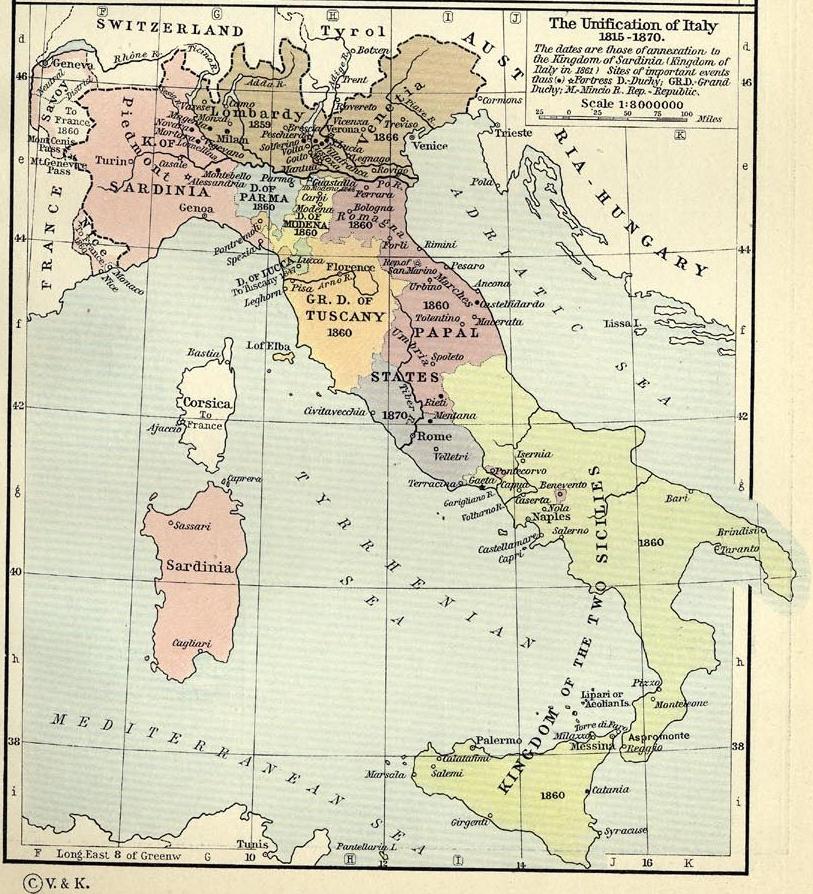
In the 1800s, a variety of national unification movements emerged, leaving Italy, the Austro-Hungarian Empire, and Germany in possession of various parts of the Tyrol.

For those unfamiliar with the geography, the Alps would represent a bit of trim extending all the way across the top of Italy's "boot"; if the boot had a buckle, it would be where the Italian, Austro-Hungarian, and German borders come together in the center of the Alps.

As WWI approached, there was some question as to whether Italy would join the Central Powers (Germany, Austro-Hungary, Bulgaria, and the Ottoman Empire) or the Triple Entente (Russia, France, Britain, and eventually, the United States).

Italy broke its neutrality by signing the Treaty of London and attacking Austrian and other Central Powers forces along a 450-long offensive line stretching from Lake Garda to not quite Trieste.

In May of 1915 the Italians had 875,000 troops trying to mount an attack uphill, the goal being to emerge near Zagreb, Croatia (and cover their backsides at the same time, thus the attack on the Lake Garda region), so they could wheel north and attack into Austrian territory while simultaneously moving south along the Adriatic coast; the Austrians were defending from the peaks with roughly 300,000 troops.

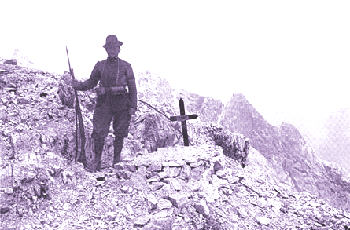
Among those troops were units specially trained in mountain combat; those units recruiting from the mountain guides and hunters who lived in the mountain regions. The Austrians had in their command a legendary mountain guide-turned-hotelier named Sepp Innerkofler, who had more than 50 "first ascents" on some of the world's toughest peaks under his belt.

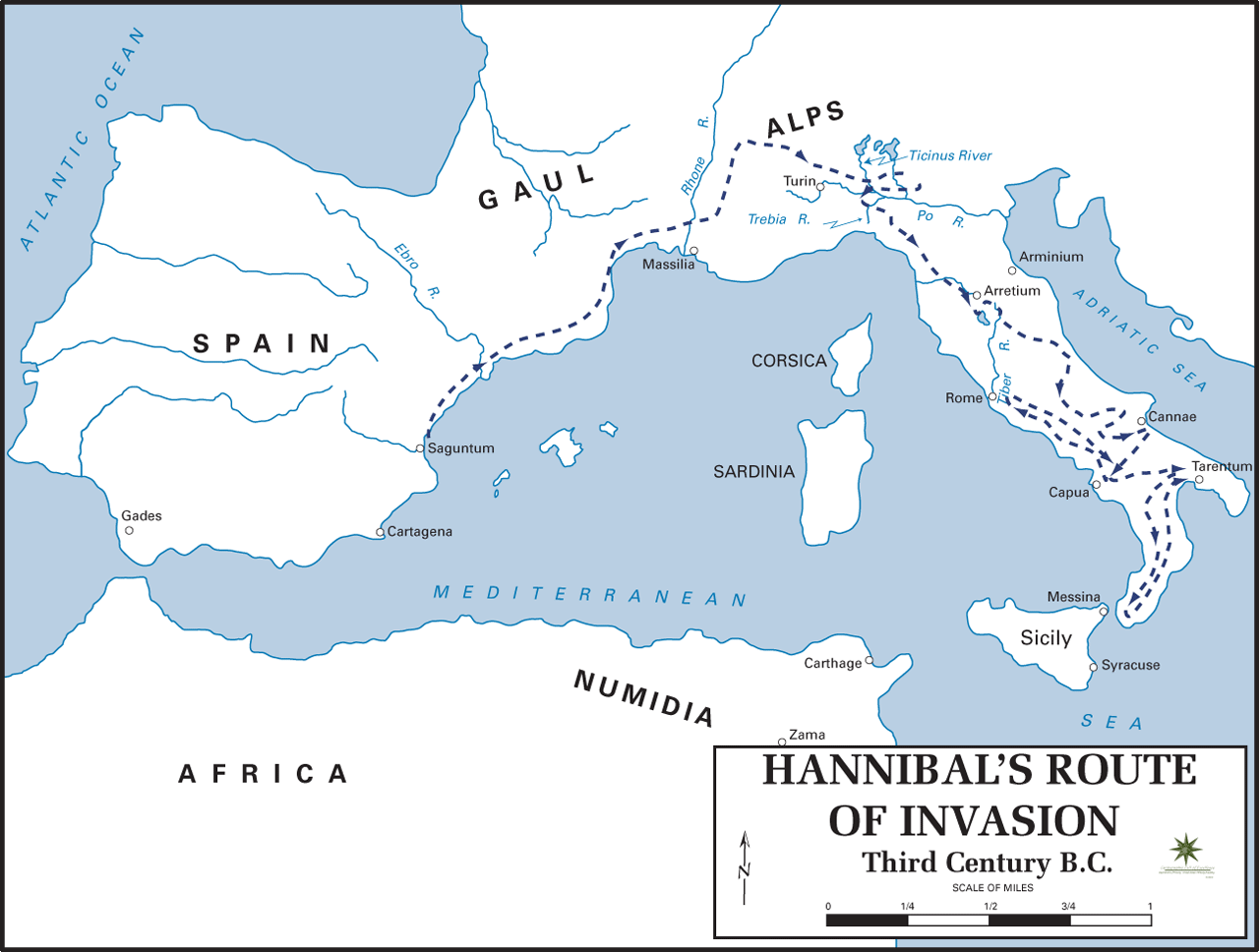
For those with a memory of history, Hannibal did the same thing on a much narrower offensive front, 2200 years ago, starting from roughly Nice, France and ending up between Turin and Milan, in what is today Northern Italy--a feat he performed at great cost to his own forces.

And now, you're caught up.

The Battles Of The Isonzo Begin

"Our vigil is ended. Our exultation begins ... The cannon roars. The earth smokes ... Companions, can it be true? We are fighting with arms, we are waging our war, the blood is spurting from the veins of Italy! We are the last to join this struggle and already the first are meeting with glory ... The slaughter begins, the destruction begins ... All these people, who yesterday thronged in the streets and squares, loudly demanding war, are full of veins, full of blood; and that blood begins to flow ... We have no other value but that of our blood to be shed."

-- Gabriele D'Annunzio, April 25th, 1915


The first four of the twelve Battles of the Isonzo were fought, along that long front, between May and December of 1915. The main tactic, on both sides, was to use artillery as a way of "softening up" the opposition, after which somebody would have to run up a hill, under fire, in an attempt to dislodge someone else from their well dug-in position (which explains why controlling the high ground is so vitally important).

"The men rest for a few hours, trying to dry out. At noon, they form a line, dropping to one knee while the officers stand with sabres drawn. The regimental colours flutter freely. Silence. Then a trumpet sounds, the men bellow 'Savoy!'[the name of the royal house] as from one throat, the band strikes up the Royal March. Carrying knapsacks that weigh 35 kilograms, the men attack up the steep slope, in the teeth of accurate fire from positions that the Italians cannot see. An officer brandishing his sabre in his right hand has to use his left hand to stop the scabbard from tripping him up. The men are too heavily laden to move quickly. Renato remembered the scene as a vision of the end of an era: 'In a whirl of death and glory, within a few moments, the epic Garibaldian style of warfare is crushed and consigned to the shadows of history!' The regimental music turns discordant, then fades. The officers are bowled down by machine-gun fire while the men crawl for cover on hands and knees. The battle is lost before it begins. The Italians present such a magnificent target, they are bound to fail. A second attack, a few hours later, is aborted when the bombardment falls short, hitting their own line. The afternoon peters out in another rainstorm."

-- Renato di Stolfo, describing his view of the First Battle of the Isonzo


As the Italians attacked the Austrians were basically engaged in a slow retreat into the highest mountain redoubts, destroying the rail and road infrastructure as they went.

kambara.jpg

Among the unbelievable tales of combat from those first engagements is this account of how bulls were used as a tool of assault:

"...Realizing that Korada must be captured, if at all, by dash and surprise, the Italian brigadier in charge of the attack gathered a herd of fierce bulls, which are numerous in that part of Venetia, and penned them in a hollow out of sight of the enemy, while his artillery began to bombard the hostile trenches. When the animals were wrought to a frenzy of rage and fear by the noise of the guns, they were let loose and driven up the mountain against the Austrian positions. Their charge broke through many strands of the wire entanglements, and before the last of them fell dead under the Austrian rifle fire, Italian troops with fixed bayonets had crowded through the gaps in the wires and captured the position..."


By the time the fourth battle was over the Austrian commanders' extremely effective defense not only had the Italians stopped cold--literally--but even worse, the few miles gained in those seven months had already cost the Italians 250,000 dead or wounded soldiers.

A Soldier's Death

The Austrians were losing soldiers as well--including Sepp Innerkofler.

July 3rd had found Innerkofler under attack on the Croda Rossa early in the day, and, amazingly, deer hunting later in the afternoon a couple miles away at the Alpe di Andert:

"...We start the descent at 12 and 13.50 are the Alpe di Andert. Lieutenant Gruber goes back to his position as we head towards the Kulewaldplatz, where our 6 men, they start hunting with deer starting from the so-called Bastrich. I look forward to the post until the end of the broad valley. 5 are found deer and fox-1, I will see two but failed to hit them. He fired a total of 8 shots, but unfortunately it is the prey of a single chapter. And so, as two hours and a half ago we were engaged in a manhunt, now we are dedicated to our unique pleasure to that of the deer!..."

--From Sepp Innerkofler's diary entry, July 3rd, 1915


July 4th, however, was a bit of a different story.

Innerkofler and five members of his "flying squad", all top climbers, were ordered to dislodge a group of Italian mountainsoldiers (Alpini) from a mountain peak. To make this happen Innerkofler's team was required to perform a vertical ascent upon the Monte Paterno--an ascent that was actually among his resume of Alpine "first climbs"; a feat he had achieved 19 years earlier and many, many, times since.

The climb was completed by sunrise, and with the sun at their backs the Austrians began to attack with grenades and small arms and the thud of their own artillery sending shells just overhead into the Italian position. Austrian and Italian machine gun emplacements were trading fire across the ridges at each other.

There are several versions of what happens next, including an almost Wagnerian account--but the eventual outcome of each is the same: Innerkofler is killed by a rock-wielding Alpini.

The Italians, risking Austrian fire, recovered the Austrian's body and give him a funeral with full respect, burying him on the Paternkofel.

With four of the Battles of the Isonzo down, there were still eight to go.

The next May, after an exceptionally bitter winter and spring and with more equipment, the Italians were preparing to attack, again, from north of Milan to up above Lake Garda--but the Austrians had two Armies in the mountains, who were able to drive the Italians back into their own northern plain, stopping the Fifth Battle before it ever got started.

It's reported that the Austrians had to fall back from that newly acquired land partly because of problems running a logistics operation through the mountains...and also partly because the Russians mounted an offensive to the Austrians' east. The cost to the Italians was substantial, however, as they were forced to commit 500,000 troops to the defense of the Lake Garda region.

In this environment, the Italians and Austrians were not limited to the use of traditional means of killing each other--in fact, rockslides and avalanches were becoming weapons of mass destruction, as this description of an action at the Col di Lana in April of 1916 indicates:

"...so the entire western margin of Col di Lana was carefully and patiently mined, an undertaking which probably took months of hard work, and several tons of high explosives were distributed in such a way as to destroy the whole side of the mountain above which the enemy was in- trenched.

The explosion that followed was terrific. The earth shook as if rocked by an earthquake, and the havoc wrought was so great that out of the 1,000 Austrians who held the position, only 164 survived."


Just a few months later, on just one day (December 13th, a day which became known as "White Friday") 10,000 soldiers are said to have died in avalanches; the problem being so serious that both sides had detachments of soldiers assigned specifically to the avalanche rescue mission.
avalanche over tracks.jpg

This went on for months and months and months, with neither side really accomplishing anything in terms of territory gained. The Italians, however, were growing their Army, both in size and in the amount of materiel they could put in the field, until October of 1917, when either the Twelfth Battle of the Isonzo or the Battle of Caporetto took place (pick your favorite name; various sources use both).

The Austrians, coming down from the buckle of our boot, mounted an attack that was so successful that the Italian 2nd Army collapsed in disorganized confusion to the south, suffering severe levels of casualties; the better organized 3rd and 4th Armies seem to have lost about 20% of their forces "coming to the rescue".

While the Italian Army under General Cadorna had begun the battle with 1,250,000 troops, in two weeks he lost roughly 320,000 of them to death or capture, along with most of his Army's artillery--and his own job. An additional 350,000 soldiers were reportedly wandering the countryside, for the moment unattached to any military organization.

400,000 people became refugees in those two weeks.

Eventually the Austrians had to retreat back into their own territory; some of the reason for that being related to the same problems the Italians were having maintaining supply lines through mountains, some of the reason for that being that the Austrians were losing on other fronts.

This was not the end of the fighting along the Italian-Austrian frontier, nor the end of the ethnic conflict that has peppered the region's history, but you get the idea: no one ever really won any victories that mattered, but thousands upon thousands of people died in the effort, and hundreds of thousands more were wounded--again, all for nothing, really.

"...das Schlagwort vom lebenslangen Lernen für alle - auch für Politiker - gilt..."

(English translation: "...the slogan of lifelong learning for all - even for politicians - applies...")

--Luis Durnwalder, Governor of the Autonomous Province of Bolzano


Is There A Moral Here?

Now at some point in this story we have to answer the question of...what is the point of all this?

Folks, I hate to be the bearer of bad news, but the moral of this story is that there is no point.

More or less 400,000 soldiers died on both sides, countless more were wounded, and hundreds of thousands of people, if not millions, became refugees.

Sepp Innerkofler's hotel was bombed as he and so many other of his friends, both Austrian and Italian, were killed up in those mountains.

And all of it for nothing.

Italy was not able to advance its national interests at all (in fact, things got much worse), and despite everything that happened back and forth over those years, Austria certainly saw no gains: in fact, thanks to this war, the Hapsburg Dynasty also went the way of "Cats" and the Ottoman Empire...closing, after a long run.

If it was my job to apply all of this to some war that my bosses were fighting...I think I'd be looking at Afghanistan, and I think I'd be looking at the place as a collection of tribal communities, rather than one big country; and I think I'd be telling my bosses that all those talking heads--and just plain folks--who think we should "defeat the Taliban" through some military campaign so that we can come home, having achieved some kind of ultimate victory, need to understand that you will never defeat anything up in the mountains simply be throwing a bunch of people and equipment at the problems.

Instead, you're going to have to consider whether it's possible to help the Afghans create something like what is happening in the Tyrol today, where protections for the various tribal and ethnic groups could be laid out in a framework that reassures Pashtuns, Persians, and Turcoman alike that they have a place in a community of interdependent communities.

This has been a long and, at times, rather depressing, look at who we are as people, and I wanted to end on a postscript that is a bit happier...and it all comes back to Sepp Innerkofler.

Despite the fact that his hotel was bombed, and he was killed, the family carried on, as did the strength of his reputation...which is why you can, even to this very day, hike the Sepp Innerkofler Höhenweg (Ridgeway, in English), and why, should you find yourself a bit tired from the hike, you can stay at Sepp's original Hotel Dolomitenhof, rebuilt since the war, where the legacy also continues, as Innerkofler Katharina recently noted in an email exchange we had:

"...of course we are proud of our grand-grand pa. We´ve a little museum in our hotel, where we show his climbing successes and explain his destiny."

Saturday, December 12, 2009

On The Futility Of War, Part One, Or, Snow Becomes A Lethal Weapon

We have another one of those "amazing history" stories for you today--and this one's a real doozy.

We're going to spend the better part of four years in the Italian Alps (or, to be more accurate, what was intended to be the Italian Alps), and by the time we're done, nearly 400,000 soldiers will have been killed--and 60,000 of those will have died as a result of avalanches that were set by one side or the other.

In the middle of the story: a mountaineer and soldier who was so highly regarded that even those who fought against him accorded him the highest honors they could muster, creating a legend that lives on to this very day.

And even though a young Captain Erwin Rommel fought in these battles...it's not him.

Oh, by the way: did I mention that there are also some handy object lessons for anyone who might be thinking about fighting a war in Afghanistan?

Well, there are, Gentle Reader, so follow along, and let's all learn something today.

"Coming back from a long weekend in the desert, traffic is lousy. Next to the highway, an electric billboard proclaims ONLY 24 SUNSETS UNTIL CHRISTMAS and I am stuck beside it long enough to watch it change to 23--get 'em while they're hot, apocalypse coming soon, reserve your sunsets now while supplies last."

--Gabriel Wrye, "Straight Time"


Location, Location, Location

Let's begin the setup for this story by checking out some prime European real estate:

Italy, as you know, is that "boot" protruding into the Mediterranean--and if the top of the boot had really cool trim and a big buckle, the trim would run from Nice, France (formerly Nice, Italy), on the west, touching Innsbruck and Salzburg, Austria, and then past Bratislava, Slovakia and on into the Hungarian plain. The trim would also veer south, and that portion of our metaphorical "carnival decoration" would encompass Ljubljana, Slovenia (which is about 100 miles south of Salzburg), eventually rolling out into the suburbs of Zagreb, Croatia.

Other notable nearby cities include Marseilles, Grenoble, every city in Switzerland, Strasbourg, Munich, Venice, Bologna, Milan, Turin, and Genoa, all of which are 100 miles or less from the boot's appliqué.

This is the Alps, and, in 1910, France, Switzerland, Italy, Germany, and the Austro-Hungarian Empire all have borders that snake through the area. The last three were all relatively new countries, none having gone more than 50 years since their most recent versions of "unification"--and that buckle we spoke of earlier? That would be roughly where the Swiss, Austrian, and Italian borders meet today, near the Stelvio Pass...which is part of an area known as the Tyrol.

matterhorn small.jpg

Switzerland's Matterhorn (part of the Pennine Alps) is one of numerous mountains that are all above 10,000 feet over on the west side of the region; the highest peak of the equally spectacular Tre Cime di Lavaredo (known in German as the "Drei Zinnen") is located about 10,000 feet up in the air, a couple of hundred miles or so to the east in the Dolomite Range.

Just like in my part of the world (Washington's Cascade Mountains) you can get a lot of snow up there, and the combination of extreme snow and weather, high altitudes, and nearly vertical climbs created, by necessity, residents with unique mountaineering skills (the techniques that led to the use of pitons, carabiners, and rope ascents and descents were all developed here)...skills that became quite valuable to the military authorities in those five countries.

Mountaineers Become Soldiers

By the start of the 20th Century, troops like the Italian Alpini (who, to this day, still serve in the Italian Army), the French Chasseurs Alpines (who are also still serving and have a recruiting pitch that's way past "Be All You Can Be"), the Austrian Landesschützen (who also have a modern presence in today's Austrian Armed Forces as the 6th Jägerbrigade and the Österreichs Gebirgsbrigade, mountain infantry and "mountain combat engineers", respectively), and the "Standschutzen", who were essentially the Austrian military's Alpine "farm team", were all stood up to protect the various national interests that were present in the mountains.

All of the armies and militias involved had access to the best hunters and mountain guides that could be found--and since smuggling and poaching was part of mountain life, a lot of people knew a lot of paths, knew how to bag game with the fewest shots possible--and knew how to use those skills while keeping out of sight of the flatlanders and tourists--and "revenooers"--who might be venturing into the neighborhood.

Among all those mountain dwellers, perhaps the most skilled of the hunters and guides was Sepp Innerkofler. As the new century began, he had built his decade-old guide business into a hotel business--presumably learning better "customer service" that that practiced by his equally famous uncle Michael, who would apparently leave customers on ledges to wait for him to finish a climb if they couldn't keep up. (Michael died in 1888, the victim of an ice bridge collapse.)

One measure of Sepp's skill: he had to his credit the "first ascent" up more than 50 of the most difficult peaks in the Alps--which wasn't that easy, considering that Michael had something like 10 times that number under his belt.

"...only a few of the hundreds of walkers who leave the Longéres pass for the Lavaredo pass every day in summer and autumn realise [sic] that they are moving in an environment which was made sacred by events in the Great War..."

--Tito and Camillo Berti, "Guerra in Ampezzo e in Cadore"


I could tell you an entire additional story about Italy and the relationship with Austria (and later Austro-Hungary, both ruled by the Hapsburg Dynasty), but what you need to know today is that over the centuries there had been a long-simmering conflict between the Italians and the Austrians (and the Ladins, a third ethnic group that inhabits the Tyrol).

At the time of the American Civil War Austria's territory extended a bit south of the Alps; and part of the beginning of Italian unification history (the "Risorgimento") was the effort to reduce Austrian influence in the north of today's Italy and in the Italian Tyrol.

help us viceroy.jpg

As Europe was stumbling its way into World War I, much of Italy's population wanted to stay neutral (which, for the moment, was official Government policy), and some did not, seeking, instead, an alliance between Italy and the Austro-Hungarian Empire.

Opposing the Empire was the Rebel Alliance...no, wait, that was "Star Wars".

The actual opponents, Russia, France, and Great Britain, were known as the "Triple Entente", which was the side the United States later joined. Germany eventually declared war against everyone in Europe, except the "neutral" countries and the other "Central Powers" (Austro-Hungary, Bulgaria, and the Ottoman Empire--which, like the show "Cats", was just about to close after a very successful 600-year run), who they joined.

By the time it was all over, more than 50 declarations of war were issued by the various combatant nations.

Trouble In The Neighborhood

It's now 1915, and despite the fact that Italian policy tilts toward neutrality, Sepp Innerkofler has been seeing a lot of new activity in his neighborhood...and the alp-glow notwithstanding, he was pretty sure that it wasn't the mythical King Laurin.

You cannot sustain an army in the mountains without a lot of infrastructure in place, especially a large one, and what Innerkofler was seeing was indeed the beginning of Italian military preparations--preparations that were being countered, as best as possible, by the Austrian military:

"The Italian Alpinis, as well as their Austrian counterparts...occupied every hill and mountain top and began to carve whole cities out of the rocks and even drilled tunnels and living quarters deep into the ice of glaciers like the Marmolada. Guns were dragged by hundreds of troops on Mountains up to 3 890 m (12,760 feet) high. Streets, cable cars, mountain railways and walkways through the steepest of walls were built."

--From the article "Tyrol", courtesy of the Embassy of Austria


And as it turns out, the Italians were going to need every bit of army they could get...because for a piece of the action, including some Alpen territories, the Italians had agreed, in the until now secret Treaty of London, to fight on the side of the Triple Entente powers--but in order to win the Tyrol...well, they were going to have to win the Tyrol; a task which will require the Italian Army to fight their way through either the Dolomites, on the one side, or the Julian Alps on the other...or both.

Hannibal had accomplished a similar task on the eastern side of the Alps--2200 years before--but to do it he left a huge portion of his Carthaginian forces dead in those mountains; victims of both the ancient angry mountain soldiers (the forebears of the same mountain folk Innerkofler lived among in 1915) and the brutal winter conditions.

The Italian commander, General Luigi Cadorna, had 875,000 troops at his disposal on May 23, 1915 (the day the Italians declared an end to their neutrality); against him the Austrians could only field about 300,000 troops--but many of those troops were natives defending their own real estate...and for the moment, they held the strategic real estate on the tops of the mountains.

Remember the description we gave in the beginning about the boot's appliqué?

The smart thing to do, if you're commanding 875,000 troops trying to go north, is to get around the right edge of the fringe on that boot (the mountains are somewhat lower on that side) and get your people onto the Hungarian plain...which is nice and flat and provides lots of room to maneuver.

The problem is, if you get too committed to that plan, you may end up with Austrian troops in Milan, attacking you from the rear. To prevent such an occurrence, Cadorna attacked on an offensive line that stretched from the "buckle" of our boot, way up in the Alps, to the city of Gorizia, which is all the way over to the top and right, if you were looking at a modern Italian map--and which just happens to be on the way to the nearby Adriatic port city of Trieste.

If you then follow the route of today's A1 and A2 highways you get to Zagreb...and that's the way to the Hungarian Plain.

If you can succeed in advancing uphill past Lake Garda (the Lago di Garda, in Italian, and the first part of the route up to the buckle), then you can cut off the railroad from Trentino north to Innsbruck; this would prevent the Austrians from moving any troops into northern Italy.

It's time for us to stop for today: we have a lot of story to go, this is a natural point to take a break, and, to be completely honest, 4,000 words is too much even if you're trapped in your car on the New York Thruway with nothing but a Snuggie, a laptop, and a mobile Internet service provider.

When we come back tomorrow we'll get to the story of what happened when Italy deployed their newly enlarged Army, which is a story that, in some ways, is still being told; additionally, the idea that there is a lesson here for those who are being tasked with executing a war strategy in Afghanistan will be explored.

Harmony and balance matter in life, so go watch some Johnny Bravo or something, clear your head of all of this, and we'll all meet back here tomorrow for Part Two.

Tuesday, September 22, 2009

On Improbable Realities, Part One, Or, “I Want A Jet Car With Frickin’ Lasers…”

When it comes to getting around, Americans love to consider the question of “what if…?”

As a result, our cars have evolved into “land yachts”, our trucks have become “monster trucks”, and the desire to drag our living spaces around with us has morphed into converted busses with rooms that pop out of the side, a Mini-Cooper hidden under the master bedroom floor, and self-tracking satellite dishes that fight for space on the roof with air conditioning equipment.

And for more than a few of us, “what if…?” has even extended to “what if my car…was a jet car?”

In today’s improbable reality I’m here to tell you that Chrysler engineers asked that exact same question, for roughly a quarter of a century, and as a result they actually designed and deployed seven generations of cars with jet engines—and they came darn close to putting the eighth-generation design on sale to the general public.

It’s a story of pocket protectors and slide rules and offices full of guys who look a bit like Drew Carey…but as we’ll see in Part Two, it may also be a story of technology that couldn’t be perfected “back then”, but could be reborn in our own times.

As so often happens, a bit of “setting up” is needed, and to get this story going we need to discuss exactly how jets—particularly gas turbines—work.

In the case of an automotive engine, the idea is that air is drawn into the engine, that air is compressed, fuel is added, and the air/fuel mixture is then set on fire with a spark plug. This rapidly heats the mixture, it expands, and the energy created by that expansion is used to turn a turbine (a variation on a fan) which is connected to the driveshaft that eventually turns the wheels.

Some aircraft and helicopter engines also use this design to turn propellers, but the majority of aircraft jet engines force the expanding air/fuel mixture out the back of the engine in the form of “thrust” that, to put it as simply as possible, “make airplane go fast”.

From an engineering point of view, there are a lot of advantages to a turbine engine.

In contrast to a design that requires pistons and valves and a crankshaft and a cooling system and a system for oil distribution, turbine engines have very few moving parts, are cheaper to manufacture, and require a relatively small amount of maintenance. They also have very long service lives compared to piston engines.

Beyond that, turbines start right up on very cold days. Because jets output lots of heat you never have to wait for the jet car’s heater to “warm up”, and they can burn virtually any combustible liquid or volatile gas as fuel.

Vibration is very low, and you get 100% of available torque at 0 rpm, which means you don’t have to “rev up” the engine to get the wheels to start turning (something that is also true of vehicles powered by electric motors).

“Eagles may soar, but weasels don't get sucked into jet engines”

--John Benfield


So that’s the why…now how about the “who did what when?”

1954, 1955, and 1956 saw Chrysler rolling out the first-generation CR-1 turbine engine. One vehicle was produced in each of those years; the ’55 version was designated the Plymouth Belvedere Sportone CR-1 Turbine Special. (The 1956 version of the same vehicle was rated at 100 horsepower and 13 MPG.)

By 1959 the CR-2 engine was in service, again only in “testbed” vehicles, and it had achieved ratings of 200 horsepower and, after a 1,200 mile demonstration run from Detroit to Princeton, New Jersey, a far more respectable 18 MPG.

Operating these vehicles had taught Chrysler a few things about the disadvantages of turbine designs:

--the gases that come out the back of the car are really, really hot (temperatures can climb above 1000 degrees F.).

--after you put your foot on the gas, there is an annoying delay before the turbines (and the wheels) start spinning faster.

--because you’re basically dumping fuel into the combustion chamber, fuel economy sucks.

--the CR-1 and CR-2 engines did not offer “engine braking”, which means there would be extra wear and tear on the brakes at the wheels, and, because the driver would be constantly “riding” the brakes, increased potential for a heat-related braking system failure.

An engine was coming along that would address these problems, and in 1961 it was dropped into the visually stunning TurboFlite, which looked like a cross between two famous automotive avians: an early 1960s T-Bird and a late 1960s Plymouth Superbird. This Chrysler-designed and Ghia-built car even featured a clear “bubble” canopy that lifted up to allow passengers to get in and out.

The CR-2A engine featured fancy new engineering that dramatically reduced the acceleration delay and provided engine braking, and in 1962 one of the two Dodge Darts that was fitted with this engine was taken on a 3,000 mile national tour (New York City to Los Angeles) to introduce the concept to the public. (Two other cars, both Plymouth Furies, were also fitted with turbine engines that year.)

At this point we need to talk about the most unusual characteristic of this type of car: its singularly unique sound.

If you can imagine the sound of a Learjet taxiing several hundred feet away you might have a pretty good idea of—well, actually, you don’t have to imagine it if you don’t want to. You can hear it for yourself by watching the film produced by Chrysler to document that 1962 cross-country trip.

By 1963, a fourth-generation engine had deployed new technology that recycled heat from the exhaust to “preheat” the intake air. This dramatically reduced the exhaust temperature while making it easier to set the intake air on fire, which significantly increased both fuel economy and horsepower.

Other improvements further reduced “acceleration lag” and provided better engine performance while idling.

There is just too much story for one day, so we will stop right here and pick up the rest next time. Before we finish, a quick recap of where we’ve been, and a preview of where we’re going:

Chrysler, among other manufacturers, was experimenting with using jet engines to turn turbines; the idea being to replace the piston engines used in virtually every car built from that day until this with something better.

Four generations of engine had already been produced, many of the problems that were associated with the original design had been either partially remediated or fully resolved, and a significant effort was underway to introduce the idea of “jet cars” to the motoring public.

In Part Two, Chrysler puts a turbine car in the hands of 200 lucky families, we continue a history that may not be over yet—and in a most unexpected development, we’ll discover the common heritage that links the 1956 Ford Thunderbird, the 1961 Lincoln Continental, the 1964 Chrysler Corporation Turbine Car, and the 2009 Dodge Challenger.

So how about that? A decade-long story of history, engineering geekery, and conceptualism…and all of it presented in the form of useful objets d’art.

And in Part Two: lots more to come.

What’s not to love?

Monday, March 16, 2009

On Ruling The Arctic Frontier, Part Two, Or, There's Stormier Weather Ahead

In order to complete today’s story we return to travelling the seas around the High Arctic...and in telling the first half of the story we were introduced to a sea captain and his parrot, we examined the destruction of a tribal village by United States Marines—and we learned that “tricing up” someone is not some kind of weird dating ritual.

The story has already raised questions of race and culture; and as we move forward it’s going to encompass whaling, an incredible rescue, and more personal trials and tribulations—not to mention the Brewery Worker’s Union—and if all that wasn’t enough, we’ll even bring in a few thousand reindeer to round the whole thing out.

So put on your caribou fur, clean up your sled runners--and let’s head north to Alaska, before the rush is on.

Those of you who were with us last time will recall that we are telling an epic tale of 19th Century Alaska...and for those of you who were not, let’s bring you up to date:

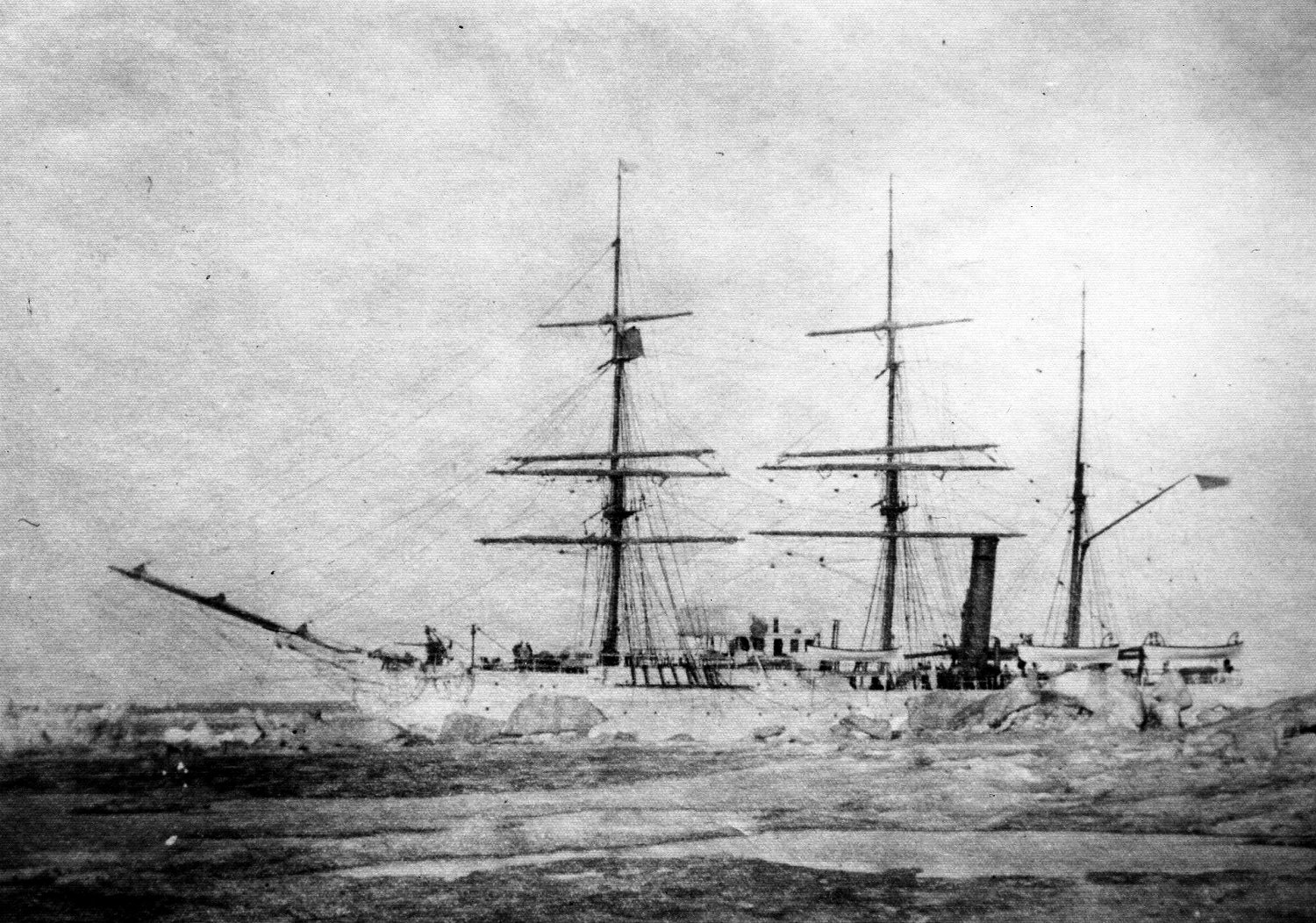
Captain Mike “Hell-Roaring” Healy, possibly the most influential man in the Arctic at the time, had risen from a Georgia plantation birth to become the commander of the most important ship in the Arctic, the Revenue Cutter Bear.

From his Aleutian base at Unalaska, his influence ran from Anchorage to Point Barrow—and even to Siberia...and within that “sphere of influence”, his word was absolutely the way it would be.

In many ways he was the United States in Alaska: his was the only (white man’s) law in a lawless Territory, he carried the mail, and he and his ship were often the first responder in emergencies.

There had been controversy, however—and when Part One of this story ended Captain Healy had just survived an investigation into his methods—and his alleged heavy drinking--while in command.

And with the catching up out of the way, let’s talk reindeer.

Despite what you might think after hearing about Captain Healy’s involvement in the destruction of that tribal village in Part One of our story, he was regarded as a man who cared deeply about life in the tribal communities.

And when American officials worried about those communities, the biggest fear was starvation.

For those not aware, most of the time, most of the interior of Alaska is geographically inaccessible, and to make things worse, what little growing season there might be is too short to allow for any real agricultural production.

That means much of what Alaska natives were eating was gathered from the sea...and since the foreign ships had come to the Arctic, those resources were getting a lot more scarce. (Much of the rest of the local diet was caribou, which is a migratory animal, which means the presence or absence of fresh meat would depend on the location of the herd.)

In the late 1800s, when the whalers had moved from the Pacific to the Arctic as the whale catches began to decline farther south, the walrus and sea lions that were quite abundant in the far north became a natural choice for harvest. At the same time, hunters had begun to work the region with rifles, which was forcing the caribou herds farther inland.

The obvious downside to this new activity was that it was becoming harder and harder for native subsistence hunters to gather enough food for their communities as these animal populations began to decline...which was something the two men who had been sent to Wales, Alaska on the Bear to establish a school had quickly noticed.

(There are those who question whether the new hunting was as serious an issue for the natives as the new educators thought it was; suggesting instead that natural forces were causing the declines in population.)

It was also well known that just a few miles across the Bering Strait, in Siberia, natives were practicing “reindeer capitalism” (the reindeer eat the omnipresent lichen, making them the perfect animal for herding in an Arctic environment).

In 1891, on board the Bear, those two men, their boss (Dr. Sheldon Jackson) and Captain Healy came up with the idea of importing Siberian reindeer to Alaska so that Alaskan natives might have a go at reindeer herding themselves. By the next year, with no official permission from Washington, they brought over the first 16 reindeer.

(It should also be noted that in addition to reducing perceived starvation, the other purpose of encouraging the local population to herd reindeer was to “civilize” the natives through assimilation with the newly arrived Americans; and developing an interest in capitalism was felt to be an effective way to advance that goal.)

By 1900 there were more than 3300 reindeer in Alaska.

The potential future? Sheldon Jackson himself wrote in 1895 that the 400,000 square miles of Alaska’s interior could support 9.2 million head of reindeer, which could employ as many as 287,500 herders.

The actual outcome? More or less 125,000 deer were processed, either for food or clothing, from the 1890s to the 1920s; and more or less 10% of those were owned by the Lomen family of Nome, Alaska.

In the 1930s, the herd grew to 650,000, but declined to as few as 25,000 in the 1950s. A renewed interest in herding began in the 1960s, and to this day there is an active reindeer industry in the State.

At the same time Healy was sailing reindeer around the Bering Sea, he was sailing himself into further trouble back home.

A variety of interest groups had been banding together to express their displeasure with Healy’s ways...including, oddly enough, the San Francisco branches of both the Brewery Worker’s Union and the Women’s Christian Temperance Union; and the problem had been building since the investigation of Healy in 1890 had cleared him of all charges.

When Healy had been accused of cruelty in that investigation, his response had been to say:

“We are empowered by Congress to suppress mutinies. We have no right to exercise magisterial functions. Our functions as such are exercised by policemen. We must suppress mutinies. A policeman does not sit in judgment on a man before he acts. We are not allowed to hold trials . . . If a mutiny occurred at San Francisco, to quell a mutiny or disturbance we would go and arrest the man, and turn him over to the police. But, up there, where there is no jail to bring men to, that is the last resort, to trice men up.”


And the Investigating Board, in that action, had supported him. But times were changing, and in 1895 25 officers of the various Bering Sea cutters jointly signed a new statement of charges against Healy.

The crux of the matter again revolved around his behavior while drinking; among the charges were accusations that he discovered a burial at sea occurring on board his ship without his knowledge—and that he made his entrance to the somber occasion by announcing that “Aboard this ship I am the resurrection and the life.’’

In another incident Healy was accused of literally being “falling-down drunk” on duty: it was alleged that he stumbled right off the dock at Unalaska and into the water at an official social event.

This and the other alleged incidents were investigated back in Washington, DC—and this time, the Investigating Board found him guilty of various forms of bad conduct, “Tyrannous and abusive conduct to inferiors”, and “Placing a vessel in a perilous position while in an intoxicated condition, thereby endangering the lives and property under his command.”

It was recommended that he be dismissed from the Revenue Cutter Service, but the man who had the final word on the matter, Treasury Secretary John G. Carlisle, gave this order instead:

“That Captain Michael A. Healy be dropped to the foot of the list of Captains of the Revenue Service, and that he retain that place hereafter; that he be suspended from rank and command and kept on waiting orders for a term of four years. and that he be publicly reprimanded by reading this order on board all vessels of the Revenue Cutter Service, by the commanding officer of each, at a muster of the commissioned officers, and admonished that if again found guilty of the excessive use of intoxicants during the term of this sentence or thereafter, whether afloat or on shore, he will be summarily dismissed the Service.”


Just as Healy had changed the way the Service operated in Arctic regions in years past, his conviction changed the way the Service operated from that day forward. The excessive use of alcohol was now seen as an offense that demanded serious punishment; and beyond that, the very types of punishment that were allowed had themselves changed as a result of the Healy case.

In a sense, it was almost the end of the “Wild West”—in San Francisco and in Alaska—and as frontier times came to an end so did the tolerance for frontier justice.

At this point, we interrupt the tale of Captain Healy to tell a quick story about the Bear. In 1897 eight whaling ships, with 265 crew aboard, were trapped in winter ice in and around Point Barrow...and the great concern was that they would starve if no relief effort could be effectively mounted.

In November of 1897 the Bear was called upon to take up the task (despite the late date), departing from Port Townsend, Washington, and making its way to Cape Vancouver, Alaska under the command of Captain Francis Tuttle. (There had been an effort to bring Healy out of suspension for the mission, but that was not to be.)

Because of the pack ice, the ship could go no farther north, so the Captain ordered a small party to set out overland roughly 1500 miles, hugging the coast, in order to get rescue supplies to Point Barrow. Remember the reindeer? Along the way, the Overland Expedition was able to locate and purchase from local herders almost 400 head, which were used to pull sleds with supplies...and which would eventually be used for food.

It was now December 15th—which, in Alaska, means nearly 24 hours of darkness, temperatures that can easily plummet below minus 50 degrees F. (-45 C.), and an exceptionally difficult landscape...with no possibility of communications between the ship, the shore party, or those hoping to be rescued.

There were other hazards as well, as reported by Lt. E.P. Bertholf, of the shore party:

“My interpreter, a half-breed Russian, had been listening to the conversation among the natives, and he informed me he drew from their talk that they realized I was unable to obtain other means of transportation in that out-of-the-way place, and thought it was a good time to force me to increase their pay, thus showing a marked similarity to the actions of some of their more enlightened white brethren in civilization. But there was no help for it, as I was obliged to have their teams, so I was forced to listen to their demands.”


The shore party travelled along the coast for about 100 days, finally reaching Point Barrow on March 26, 1898. The Bear reached the same point July 28 of that year, and by August the crews (having suffered no fatalities) were on their way out of the Chukchi Sea and heading south.


At the end of his suspension in 1900 Healy returned to command aboard the Revenue Cutter McCulloch, which had fought in the Battle of Manila Bay—but a series of personal tragedies fell upon him, including the order to turn over command of the ship, leave the Arctic, and assume command of the Revenue Cutter Seminole, out of Boston. In the course of returning to Seattle in July of that year he apparently experienced a psychotic episode that caused junior officers aboard the ship to physically restrain him in his cabin. It is reported that at one point he attempted to cut his wrists with the crystal of his own watch.

Healy was treated at Port Townsend...and, amazingly, in 1902 his case was reviewed; and as a result of that review he was returned to command aboard the Revenue Cutter Thetis. He was able to complete cruises to Alaska in 1902 and 1903, after which he finally retired. He died in San Francisco, August 30, 1904, of a heart attack.

(A few words on the death of the Bear are in order at this point. The ship, as we mentioned, survived to be the flagship of Admiral Byrd’s Antarctic expeditions in the 1930s—and astonishingly enough, it even served in World War II on patrol in Greenland waters. In 1962, it had been renovated to become a restaurant and museum in Philadelphia, but it sank in waters off Boston as it was being towed there...proving that even a ship would “rather be here than in Philadelphia”.)

Way back at the beginning of Part One I promised you a surprise ending that would make this story of Arctic history relevant to today’s times...so here it is:

Captain Mike Healy was born a slave.

His father, an Irish immigrant, had chosen to live with a woman who had been born a slave, and under the Georgia law in force at the time, not only would Mike and all her other children automatically be classified as slaves, their father was prohibited from freeing them.

That’s why they were sent to Boston for their education.

It is reported that the 10 children had varying skin tones, which meant James, who was darker, could not “pass” as white...but Mike could—and apparently he successfully did.

He is today regarded as the first black commanding officer of a United States ship—although there are some who might consider a discussion of the “one-drop rule” to be appropriate before offering the good Captain that distinction.

I promised to answer one other question as well: how did this story never become a movie?

Dr. John Murphy provides that answer in his “Portrait of Captain Michael A. Healy”:

“In the late 1930s representatives of the film industry, planning to make a film on the life of the noted captain, wired to Healy’s daughter-in-law their wish to examine his four-volume diary. When they arrived it was in ashes. Apparently the daughter-in-law, reading the diary for the first time, learned that her husband’s grandmother had been a slave.”


So that’s the epic tale: born a slave in Georgia, but also born to the Arctic, Captain Mike Healy saved lives, changed the Revenue Cutter Service’s way of doing business—twice—and remains a controversial figure to this day, even as the ships that represent his name and his most famous command continue to ply the seas.

And now, as Paul Harvey would have said: you know the rest...of the story.