advice from a fake consultant

out-of-the-box thinking about economics, politics, and more... 
Showing posts with label Election 2008. Show all posts

Wednesday, December 19, 2007

On Watching A Campaign Train Derail, Or, I Just Love Hillary’s Problems

As the Democrats have raced toward the first primary contests, I have to a great extent kept to other tasks in my writing. It has been my wont to let the events develop; and to a large extent there has been almost no editorial writing in this space regarding the Democratic nominees.

That ends here.

From the beginning I have distrusted Hillary, I don’t like how she’s running her campaign, and it’s my belief that she represents exactly what we shouldn’t be voting for.

And now, in what may be the best holiday present yet, everything I dislike about her is becoming part of the public record.

So what is it about the Senator that bothers me so much?

How about she seems incapable of giving a straight answer to any question?
How about she’ll say anything, no matter what, to gain the nomination?
How about she’ll do anything, no matter what, to gain the nomination?
How about in the recent personal attacks on Obama, she’s proving it?

"We need to put forth a positive agenda for America."

--Hillary Clinton, Novenber 16th, 2007.


For readers not keeping track, those close to Hillary want us to know that Obama "attended a Madrasa”, will be dogged by drug use issues, and my personal favorite, is an opportunist "Who began running for President as soon as he arrived in the United States Senate"…as opposed to Clinton, who, if I recall correctly, waited until her fourth or fifth term as a Senator to run.

The candidate herself has maintained an air of “plausible deniability”; choosing not to answer questions regarding the assertions made by those close friends.

Of course, there are those who would suggest that these actions emanating from her campaign are not valid criteria by which to measure her as a candidate—that these are personal attacks, not a discussion of “policy” issues; and therefore they remain beyond our examination.

A ridiculous argument, indeed.

At the heart of the American mindset is the idea that Government is not to be trusted--and those who seek high office, even less so; at least until they can prove they deserve our trust.

“Voters will have to judge us, and that’s what I welcome…”

--Hillary Clinton on the “Today Show”; December 17, 2007


Recent events (and you can probably think of a few without my help) suggest that trust matters even more today than ever before.

With all due respect, the Clinton history does not inspire my trust:

--Tons of corporate PAC money (more than any candidate of either party) is flooding into her campaign.

--Millions more from undisclosed sources is going to support the Clinton Presidential library.

--In the face of this (with an Administration currently in power who has made reverence to donor interests a religion even bigger than…well, religion) we are told that there is no connection between library donations to the former President and this Presidential campaign, no reason to disclose the donor’s names—and no possibility that the effect of all these donations will be to sway this candidate into acting just like the current corporatist Administration.

--A candidate who tells us she will cover all Americans in her healthcare plan—by requiring the uninsured to purchase insurance…who tells us she will not negotiate...and she will negotiate with Iranian leaders without preconditions; and a candidate who believes Mr. Bush when he tells us voting to declare the Iranian Army a terrorist organization is not a precursor to war.

--A candidate who would apparently rather seek the assistance of President Bush the Elder than President Jimmy Carter in her efforts to promote world peace.

The agent of change, we’re told.

Over and over again she comes up wrong on so many issues—the Iraq war, the restoration of the Constitution, the need to change the Military Commissions Act, and on and on and on.

Oh, and let’s not forget that Hillary’s friends are concerned about the dirt Republicans might sling at Obama…try, if you can, to visualize a cloud of flying mud slightly larger than a spherical Gobi Desert and you might have a conception of how much will be flung at her by those same Republicans.

Now I will acknowledge that a candidate who is slipping in the polls, as Hillary is, must begin to confront her opponent…and you’ll notice that I did not fault Mr. Clinton’s attacks on Obama’s experience. Frankly, I disagree with elements of his statement; that said, I can easily see this as a reasonable argument to raise regarding an opponent.

But the Madrasa stuff, and all that goes with it…it really stinks of desperation; her unwillingness to attack personally makes a real statement about her own integrity; and the illogical nature of her denials regarding all that corporate money suggests a “politics as usual” attitude that we need to toss out--not re-elect.

There are those who will vehemently disagree with the tone and tenor of this discussion.
They will be quick to point out that the “politics of personal destruction” will damage all the candidates.

My response: sorry, folks, but the Hussein and cocaine train has already left the station; and those who sow shall reap.

I’d also tell them that a candidate who doesn’t respect her own opponents (or the power of her own ideas above the power of personal attack) is not likely to be the kind of President that will respect opposing nations who don’t support her views—and haven’t we had enough of that already?

With that in mind, I’m glad her campaign is “coming off the rails”…and I can’t wait to see what form of self-destruction her desperation leads her to next.

Saturday, June 16, 2007

On Nothing In Particular, Or, A Few Words About Everything

I have been mulling over several thoughts recently, none of which seem to individually offer a complete day’s work, and I ask the reader’s indulgence as I attempt to stitch some of these disconnected concepts into a larger, and hopefully more interesting, quilt.

Let’s start with immigration:

The “immigration debate” seems to be a story of Mexican migration, and the entire focus of the current discussion is how to control the Mexican border.

But that really misses what immigration is all about in this country.

Here’s the numbers: the Pew Hispanic Center tells us that about 1/3 of immigrants come from Asia, another 1/3 from Latin America, and the final 1/3 from the rest of the world.

Of the 1/3 of immigrants from Latin America, about 60% of those are Mexican.

What do these numbers tell us?
Two things:

--A “perfect fence”, if such a thing could be created, would only prevent a subset of illegal immigration.

--If you really want to control illegal immigration, build walls around airports. That’s where the immigrants actually come from.

Speaking of walls…

…how does building a giant fence on the Mexican border keep out “terrorists’?

Ignoring the fact that Timothy McVeigh didn’t need to scale any walls, I will tell you here today that the “Jalisco Wall” will never prevent more than one terrorist from entering the country.

Do you know why?

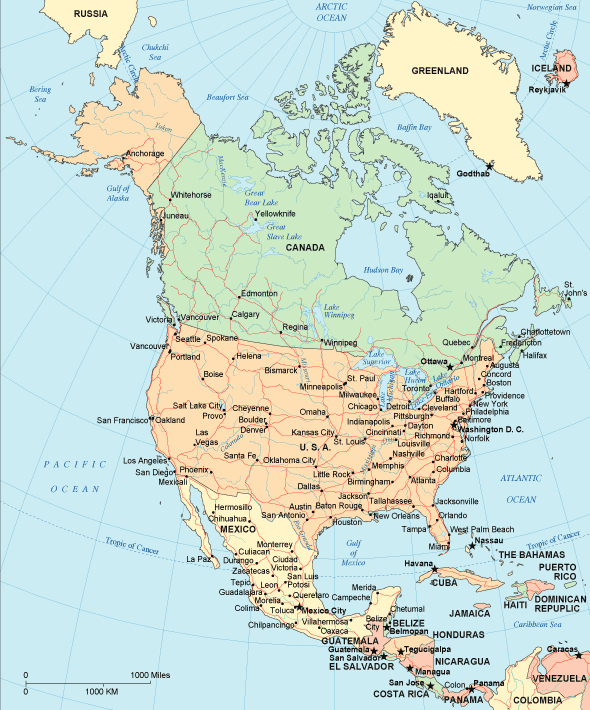
Because that terrorist will come back and say: “They have a wall at the Mexican border now…” to which the “terror manager” will reply: “Hey, look at this map! Why don’t you just cross the Canadian border? They don’t have a fence...”

And that will be the end of that.

By the way, here’s an immigration hypothetical for you:

If Canadians were predominantly non-white (or even worse, French…), what do you suppose the odds are we’d be talking about securing two borders today, instead of just one? Think about that the next time the conversation comes up.

What about that whole “immigrants and jobs” thing?

I would encourage everyone who has not seen “Roger and Me” (Michael Moore’s story of how GM “dejobbed” Flint, Michigan in the early 1980’s) to see the film, and see what happened to that city. That process, repeated a thousand times over, is why we have so few manufacturing jobs in this country.

Did Mexicans crossing over the border in the dead of night cause that?
My guess is that answer will be no.

When considering the impact of immigration, ask yourself these questions:

--Did textile mills close in the South because of Mexican immigrants?
--Did the shoe industry leave New England because of immigrants?
--Would US Steel and Bethlehem Steel still be names we recognize if it wasn’t for those pesky immigrants?
--Are the immigrants forcing the auto industry into its current troubles?

The jobs lost because of those actions didn’t go to illegal immigrants, they went to other countries.

What’s the lesson?

Even if you could monitor every person on the planet, and you could somehow keep out the “undesirables” with prefect success, it still wouldn’t fix a single one of the problems we discussed above. Money can travel to the cheapest workers these days, and a border fence (or two) isn’t much of a barrier to a multinational corporation.

Next topic:

“Can Obama possibly have the experience needed to be President?”

How often has that question come up?
“How many grains of sand are there on the beach? “ is the Zen answer.

Here’s the response.

An actor, a haberdasher, and a former Air National Guard pilot all had the skills required (in varying degrees…)-why not a sitting Senator?

Next time this issue comes up, try the “Prime Minister’s Questions” test.
Huh?
It’s simple: ever seen Mr. Blair answer those questions every week in the House of Commons? It’s a bit rough-and-tumble, and the Prime Minister is expected to have some ability to provide reasonable answers-or be shouted down in the process. Now try to picture the current crop of Presidential contenders answering “Prime Minister’s Questions” week after week, with no teleprompter in the room.

This test will quickly shorten the candidate list-but it won’t eliminate Obama.

Moving on:

Have you ever seen anybody who needs a hug more than Tucker Carlson?

I watch him yap-yap-yapping away and it just makes me feel…sad.

Somebody take him on a roller coaster or something-and soon.
The poor man needs it.

One more “vent” and I’ll call it a day:

Since ’06, as a community, we have petitioned our Government for the redress of our Grievances, if you will, on issues that are truly matters of life and death, and the responses have ranged from disappointing to maddening-and beyond.

We are in a difficult position here-even those we consider our friends are moving more slowly than we want. We cannot allow ourselves to be placated, but we have to be pragmatic as well.

I have no solution for this problem, only perspective, and a piece of advice:

When you find yourself on the verge of giving up altogether, take a step back and consider where this debate was 18 months ago-and how far we have already pushed the envelope. We are getting there, far too slowly, but we are getting there.

It is we who control the debate now.
To paraphrase a line from Walt Kelly, “we have met the majority, and it is us”.
There will be efforts to alter the terms of the discussion, and there will be diversions along the way; but we can end this war, and we can change how we deal with heath care, and we can still have a planet that resembles the one we were born on, if we just remember that we’re winning here, not them.

And with that off my chest, perhaps we can fold up the allegorical quilt until the weather turns again, and enjoy a bit of summer.

Saturday, April 21, 2007

On The Vagaries Of History, Or, Texas, Know Thyself

A document produced in the heat of our Nation’s birth, back in that distant time of 1776, remains etched in our consciousness today for its revolutionary declarations regarding the roles of Citizen and Nation.

To this day it remains as relevant as it did then, both as a rallying cry for Freedom, and an expression of our greatest aspirations as a People.

Another document, produced in the town of Washington, remains much less well known, yet that document also offers great relevance, and warnings that shine clear and bright through the fog of today’s politics.

“When a government has ceased to protect the lives, liberty and property of the people, from whom its legitimate powers are derived, and for the advancement of whose happiness it was instituted, and so far from being a guarantee for the enjoyment of those inestimable and inalienable rights, becomes an instrument in the hands of evil rulers for their oppression.

When the Federal Republican Constitution of their country, which they have sworn to support, no longer has a substantial existence, and the whole nature of their government has been forcibly changed, without their consent, from a restricted federative republic, composed of sovereign states, to a consolidated central military despotism, in which every interest is disregarded but that of the army and the priesthood, both the eternal enemies of civil liberty, the everready minions of power, and the usual instruments of tyrants.”


Sound familiar?
Wait, there’s more...

“When, long after the spirit of the constitution has departed, moderation is at length so far lost by those in power, that even the semblance of freedom is removed, and the forms themselves of the constitution discontinued, and so far from their petitions and remonstrances being regarded, the agents who bear them are thrown into dungeons, and mercenary armies sent forth to force a new government upon them at the point of the bayonet.”


We have before us a manifesto, which warns against the dangers of a Government that would disregard all interests but the Army and the priesthood, which has seen a Government fail in its duties to protect the rights of its citizens, and which has been forged in a political environment where moderation had disappeared.

A document that was really concerned about the merging of Church and State:

“In this expectation they have been cruelly disappointed, inasmuch as the Mexican nation has acquiesced in the late changes made in the government by General Antonio Lopez de Santa Anna, who having overturned the constitution of his country, now offers us the cruel alternative, either to abandon our homes, acquired by so many privations, or submit to the most intolerable of all tyranny, the combined despotism of the sword and the priesthood.”


Has anyone guessed the identity of this document that has provided these quotes?

For those who have not, it is the Declaration of Independence of the Republic of Texas.

I don’t know if you saw the George Bush/John Kerry debates in 2004, but I can recall Mr. Bush telling Kerry we would never allow other nations to be, in effect, “the deciders”; that the opinions of other nations are not what should guide America’s actions.

In March of 1836, Texans took a different view:

“Nations, as well as individuals, are amenable for their acts to the public opinion of mankind. A statement of a part of our grievances is therefore submitted to an impartial world, in justification of the hazardous but unavoidable step now taken, of severing our political connection with the Mexican people, and assuming an independent attitude among the nations of the earth.”


Texans knew the consequence of the denial of civil liberties, and that is addressed here as well:

“It incarcerated in a dungeon, for a long time, one of our citizens, for no other cause but a zealous endeavor to procure the acceptance of our constitution, and the establishment of a state government.”...

...”It has failed and refused to secure, on a firm basis, the right of trial by jury, that palladium of civil liberty, and only safe guarantee for the life, liberty, and property of the citizen.”...

...”It has demanded the surrender of a number of our citizens, and ordered military detachments to seize and carry them into the Interior for trial, in contempt of the civil authorities, and in defiance of the laws and the constitution.”


Apparently Mexico also had an “enemy combatant” problem, and a Guantanamo of their own.

The Declaration also warns that the very ability to have a working democracy depends on an effective educational system.

Compare this, from the Declaration:

“It has failed to establish any public system of education, although possessed of almost boundless resources, (the public domain,) and although it is an axiom in political science, that unless a people are educated and enlightened, it is idle to expect the continuance of civil liberty, or the capacity for self government.”


To this:

“In a recent essay on the history of education in Texas, historian James Smallwood claims that "from the early Spanish era down to the 1980s, the story of education, allowing for occasional setbacks, has been one of great strides forward . . .." He ends his article, published in the collection of essays Texas: A Sesquicentennial Celebration, by arguing that "The Spaniards would have marveled to see one of the best educational networks--from primary grades to graduate schools--in the United States."

Compare Smallwood's optimistic analysis with an announcement made by the Texas Education Agency on July 13, 1984, concerning the results of the first pre-professional skills tests given primarily to sophomore college students who wish to be enrolled in schools of education to become future teachers of the children of Texas. The students had to earn passing scores in math, reading, and writing. Of the 2,738 students who took the test at 51 of the 65 teacher training institutions in the state, 46 percent failed. Worse, only 10 percent of the blacks and 19 percent of the Hispanics who took the test passed, compared to 62 percent of the Anglos.

Education officials with the TEA called the results "depressing." Disastrous might be a better word. The results of this test, like many other achievement tests given to students and teachers alike, point to a fundamentally troubled public education system. "I don't blame the students per se," said Education Commissioner Raymond Bynum. "After all, they graduated from a high school and passed some college English and math courses. I don't know who's to blame."


And it now appears those unprepared teachers have had their impact-the American Legislative Exchange Council reported that Texas 8th-graders have moved up from 41st in the nation to a solid 39th in a 2005 evaluation.

Texas Government has, as you might expect, gone a bit crazier than usual recently, and you need look no further than the history of Tom DeLay and Texas' 2003 Redistricting to find an excellent starting point.

Texas education went national with “No Child Left Behind”, with apparently predictable results, and we can only guess what effect this would have on the Federal Government over time.

This election is an opportunity for the US to look to its founding principles, to reconsider what kind of a Nation we really are, and to make choices that more correctly reflect our history and heritage.

And so it is for Texas.

So in closing, a suggestion:

Take some time today, read your Republic’s founding document, heed its warnings, and let’s make choices that are better for Texas, better for America, and better for the rest of the world.

As wise men in Washington, Texas said on March 2, 1836:

“Nations, as well as individuals, are amenable for their acts to the public opinion of mankind...”

Even in Texas.