Washington (FNS)—An exclusive investigation by FNS reporting staff has identified and confirmed, through a second source, the Obama Administration’s secret plans for resolving issues with certain residents of Arizona that has been in the news over the past week, known as “Operation Terraform”.
The plan depends upon American authorities cooperating with the Canadian, Mexican, and North American Governments, and the plan will require one of the largest transport efforts since D-Day.
Until today, no one outside the involved agencies had been aware of the existence of the plan, much less its details, and as of today, no official will admit, on the record, that the plan is already in effect.
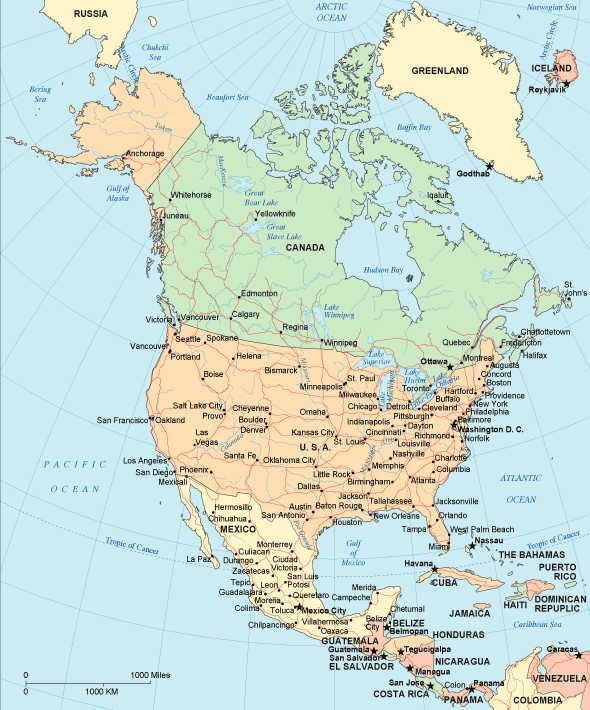
After September 11th, the United States Government, in addition to other policy initiatives, made a decision to move ahead with previous plans to establish a North American Government. After consultations with Mexico and Canada, Edmonton, Alberta, was chosen as the administrative center for the new organization.
In order to disguise the new construction, it was decided to locate many of the facilities under the West Edmonton Mall. This location was chosen partly because it has been in a state of constant construction for years and already contains a substantial amount of underground construction, making additional work less noticeable.
In 2002, a new office tower and a major underground expansion were begun underneath the new parking garage on the west side of the mall, and that facility today houses both North American Government administrators and a paramilitary base that provides a location from which special operations can be staged.
After the Tea Party protests began in April of 2009, the Obama Administration, who had decided already on the basic outline of Operation Terraform, coordinated with the other three Governments to more rapidly complete a database of the DNA of all North American citizens.
That process was assisted by the creation of an H1N1 flu scare in 2009, which caused people to obtain flu shots in record numbers. The DNA collected during that “inoculation” program means the database now has records for over 70% of the population in the North American Economic Zone.
After a frantic summer of effort by specialists from the US Army’s Medical Research Institute of Infectious Diseases, the Centers for Disease Control, the FDA, and the National Institutes of Health, a DNA replication and human cloning facility was up and running, thanks to a tunnel connecting the Mall and the sub-basements of the nearby Misericordia Community Hospital.
From October until January unmarked trucks operated by KBR’s North American Government and Defense unit have coordinated with North America’s SuperCorridor Coalition to provide logistical support, moving the newly cloned human replicants from Canada, through the United States, to holding facilities operated by the North American Government in Sonora, Mexico.
As certain white citizens of Arizona who live in conservative voting precincts were identified crossing the Mexican border, they were being replaced by these replicants, with the intent of changing the long-term voting patterns in Arizona.
Unfortunately, the number of citizens transiting the border has declined precipitously in the past several months due to violence on the Mexican side, and changes to the plan had to be considered.
Beginning in February, US agents working the border began “sweep and clear” operations to establish corridors through which KBR could import replicant individuals so that substitutions could take place inside the United States.
A processing facility was required in the Phoenix area; KBR arranged with Basic Chemical Solutions to build a high-security entrance on their property for the underground bunker built by the North American Government’s Paramilitary Command on the south side of West Lower Buckeye Road just across from the Maricopa County Jail.
We have learned that about 12,000 Arizonans a month have been replaced since February, and that the program eventually intends to remove about 20,000 persons each month to long-term internment facilities in Central Sonora and Northern Alberta.
The Administration is seeing the recent shutdown of the Minuteman Civil Defense Corps as evidence that the program is working.
The immediate goal is to turn Arizona into a reliably Democratic state by the time of the 2012 elections. If successful, the program will be established in other states, with Florida and Ohio probably being next on the list.
Operation Terraform has already affected Obama’s political agenda.
Conservatives are calling for the Administration to finish the border fence between Arizona and Sonora as part of the negotiations associated with an immigration compromise; since this would impair the ability of KBR to move people back and forth over that border the Administration has been unwilling to make such a deal.
The Democrats, however, assume that over time they will have to make fewer and fewer political compromises as more and more Conservatives are replaced by replicants who will always do the bidding of their Democratic Masters.
In the final iteration of the plan, members of the Democratic base are also being considered for replacement. Two “scouting parties” from the North American Government have infiltrated the Netroots Nation events in the past two years to gather information; based on that data a decision is expected in the next few months.
Showing posts with label immigration. Show all posts
Showing posts with label immigration. Show all posts
Wednesday, May 5, 2010


Saturday, June 16, 2007
On Nothing In Particular, Or, A Few Words About Everything
I have been mulling over several thoughts recently, none of which seem to individually offer a complete day’s work, and I ask the reader’s indulgence as I attempt to stitch some of these disconnected concepts into a larger, and hopefully more interesting, quilt.
Let’s start with immigration:
The “immigration debate” seems to be a story of Mexican migration, and the entire focus of the current discussion is how to control the Mexican border.
But that really misses what immigration is all about in this country.
Here’s the numbers: the Pew Hispanic Center tells us that about 1/3 of immigrants come from Asia, another 1/3 from Latin America, and the final 1/3 from the rest of the world.
Of the 1/3 of immigrants from Latin America, about 60% of those are Mexican.
What do these numbers tell us?
Two things:
--A “perfect fence”, if such a thing could be created, would only prevent a subset of illegal immigration.
--If you really want to control illegal immigration, build walls around airports. That’s where the immigrants actually come from.
Speaking of walls…
…how does building a giant fence on the Mexican border keep out “terrorists’?
Ignoring the fact that Timothy McVeigh didn’t need to scale any walls, I will tell you here today that the “Jalisco Wall” will never prevent more than one terrorist from entering the country.
Do you know why?
Because that terrorist will come back and say: “They have a wall at the Mexican border now…” to which the “terror manager” will reply: “Hey, look at this map! Why don’t you just cross the Canadian border? They don’t have a fence...”
And that will be the end of that.
By the way, here’s an immigration hypothetical for you:
If Canadians were predominantly non-white (or even worse, French…), what do you suppose the odds are we’d be talking about securing two borders today, instead of just one? Think about that the next time the conversation comes up.
What about that whole “immigrants and jobs” thing?
I would encourage everyone who has not seen “Roger and Me” (Michael Moore’s story of how GM “dejobbed” Flint, Michigan in the early 1980’s) to see the film, and see what happened to that city. That process, repeated a thousand times over, is why we have so few manufacturing jobs in this country.
Did Mexicans crossing over the border in the dead of night cause that?
My guess is that answer will be no.
When considering the impact of immigration, ask yourself these questions:
--Did textile mills close in the South because of Mexican immigrants?
--Did the shoe industry leave New England because of immigrants?
--Would US Steel and Bethlehem Steel still be names we recognize if it wasn’t for those pesky immigrants?
--Are the immigrants forcing the auto industry into its current troubles?
The jobs lost because of those actions didn’t go to illegal immigrants, they went to other countries.
What’s the lesson?
Even if you could monitor every person on the planet, and you could somehow keep out the “undesirables” with prefect success, it still wouldn’t fix a single one of the problems we discussed above. Money can travel to the cheapest workers these days, and a border fence (or two) isn’t much of a barrier to a multinational corporation.
Next topic:
“Can Obama possibly have the experience needed to be President?”
How often has that question come up?
“How many grains of sand are there on the beach? “ is the Zen answer.
Here’s the response.
An actor, a haberdasher, and a former Air National Guard pilot all had the skills required (in varying degrees…)-why not a sitting Senator?
Next time this issue comes up, try the “Prime Minister’s Questions” test.
Huh?
It’s simple: ever seen Mr. Blair answer those questions every week in the House of Commons? It’s a bit rough-and-tumble, and the Prime Minister is expected to have some ability to provide reasonable answers-or be shouted down in the process. Now try to picture the current crop of Presidential contenders answering “Prime Minister’s Questions” week after week, with no teleprompter in the room.
This test will quickly shorten the candidate list-but it won’t eliminate Obama.
Moving on:
Have you ever seen anybody who needs a hug more than Tucker Carlson?
I watch him yap-yap-yapping away and it just makes me feel…sad.
Somebody take him on a roller coaster or something-and soon.
The poor man needs it.
One more “vent” and I’ll call it a day:
Since ’06, as a community, we have petitioned our Government for the redress of our Grievances, if you will, on issues that are truly matters of life and death, and the responses have ranged from disappointing to maddening-and beyond.
We are in a difficult position here-even those we consider our friends are moving more slowly than we want. We cannot allow ourselves to be placated, but we have to be pragmatic as well.
I have no solution for this problem, only perspective, and a piece of advice:
When you find yourself on the verge of giving up altogether, take a step back and consider where this debate was 18 months ago-and how far we have already pushed the envelope. We are getting there, far too slowly, but we are getting there.
It is we who control the debate now.
To paraphrase a line from Walt Kelly, “we have met the majority, and it is us”.
There will be efforts to alter the terms of the discussion, and there will be diversions along the way; but we can end this war, and we can change how we deal with heath care, and we can still have a planet that resembles the one we were born on, if we just remember that we’re winning here, not them.
And with that off my chest, perhaps we can fold up the allegorical quilt until the weather turns again, and enjoy a bit of summer.
Let’s start with immigration:
The “immigration debate” seems to be a story of Mexican migration, and the entire focus of the current discussion is how to control the Mexican border.
But that really misses what immigration is all about in this country.
Here’s the numbers: the Pew Hispanic Center tells us that about 1/3 of immigrants come from Asia, another 1/3 from Latin America, and the final 1/3 from the rest of the world.
Of the 1/3 of immigrants from Latin America, about 60% of those are Mexican.
What do these numbers tell us?
Two things:
--A “perfect fence”, if such a thing could be created, would only prevent a subset of illegal immigration.
--If you really want to control illegal immigration, build walls around airports. That’s where the immigrants actually come from.
Speaking of walls…
…how does building a giant fence on the Mexican border keep out “terrorists’?
Ignoring the fact that Timothy McVeigh didn’t need to scale any walls, I will tell you here today that the “Jalisco Wall” will never prevent more than one terrorist from entering the country.
Do you know why?
Because that terrorist will come back and say: “They have a wall at the Mexican border now…” to which the “terror manager” will reply: “Hey, look at this map! Why don’t you just cross the Canadian border? They don’t have a fence...”
And that will be the end of that.
By the way, here’s an immigration hypothetical for you:
If Canadians were predominantly non-white (or even worse, French…), what do you suppose the odds are we’d be talking about securing two borders today, instead of just one? Think about that the next time the conversation comes up.
What about that whole “immigrants and jobs” thing?
I would encourage everyone who has not seen “Roger and Me” (Michael Moore’s story of how GM “dejobbed” Flint, Michigan in the early 1980’s) to see the film, and see what happened to that city. That process, repeated a thousand times over, is why we have so few manufacturing jobs in this country.
Did Mexicans crossing over the border in the dead of night cause that?
My guess is that answer will be no.
When considering the impact of immigration, ask yourself these questions:
--Did textile mills close in the South because of Mexican immigrants?
--Did the shoe industry leave New England because of immigrants?
--Would US Steel and Bethlehem Steel still be names we recognize if it wasn’t for those pesky immigrants?
--Are the immigrants forcing the auto industry into its current troubles?
The jobs lost because of those actions didn’t go to illegal immigrants, they went to other countries.
What’s the lesson?
Even if you could monitor every person on the planet, and you could somehow keep out the “undesirables” with prefect success, it still wouldn’t fix a single one of the problems we discussed above. Money can travel to the cheapest workers these days, and a border fence (or two) isn’t much of a barrier to a multinational corporation.
Next topic:
“Can Obama possibly have the experience needed to be President?”
How often has that question come up?
“How many grains of sand are there on the beach? “ is the Zen answer.
Here’s the response.
An actor, a haberdasher, and a former Air National Guard pilot all had the skills required (in varying degrees…)-why not a sitting Senator?
Next time this issue comes up, try the “Prime Minister’s Questions” test.
Huh?
It’s simple: ever seen Mr. Blair answer those questions every week in the House of Commons? It’s a bit rough-and-tumble, and the Prime Minister is expected to have some ability to provide reasonable answers-or be shouted down in the process. Now try to picture the current crop of Presidential contenders answering “Prime Minister’s Questions” week after week, with no teleprompter in the room.
This test will quickly shorten the candidate list-but it won’t eliminate Obama.
Moving on:
Have you ever seen anybody who needs a hug more than Tucker Carlson?
I watch him yap-yap-yapping away and it just makes me feel…sad.
Somebody take him on a roller coaster or something-and soon.
The poor man needs it.
One more “vent” and I’ll call it a day:
Since ’06, as a community, we have petitioned our Government for the redress of our Grievances, if you will, on issues that are truly matters of life and death, and the responses have ranged from disappointing to maddening-and beyond.
We are in a difficult position here-even those we consider our friends are moving more slowly than we want. We cannot allow ourselves to be placated, but we have to be pragmatic as well.
I have no solution for this problem, only perspective, and a piece of advice:
When you find yourself on the verge of giving up altogether, take a step back and consider where this debate was 18 months ago-and how far we have already pushed the envelope. We are getting there, far too slowly, but we are getting there.
It is we who control the debate now.
To paraphrase a line from Walt Kelly, “we have met the majority, and it is us”.
There will be efforts to alter the terms of the discussion, and there will be diversions along the way; but we can end this war, and we can change how we deal with heath care, and we can still have a planet that resembles the one we were born on, if we just remember that we’re winning here, not them.
And with that off my chest, perhaps we can fold up the allegorical quilt until the weather turns again, and enjoy a bit of summer.
Saturday, March 31, 2007
On Immigration, Or, How To Turn Purple Blue
Those of you who have been reading my work for a while have likely observed that my interest in electoral politics extends beyond this electoral cycle; and that my focus is often three or more cycles distant.
With that in mind, let’s talk immigration.
The face of immigration in America has changed the past generation or so, the Pew Hispanic Center tells us in their new report “Growing Share of Immigrants Choosing Naturalization”.
Here are the four biggest changes:
--Immigrants are more likely today to become citizens than at any time since World War II ended.
--Hispanics and Asians are the largest groups of immigrants today, replacing Europeans and Canadians.
--Immigrants today are more likely to be less educated, and therefore lower on the economic ladder than in the recent past.
--A larger proportion of immigrants are eligible for deportation (the “illegal immigrants”) than in the past.
These changes, combined with the recent expansion of immigrant communities into new parts of the country, means the Democratic Party has an opportunity to change purple, and even somewhat red states, into blue states for years to come.
These changes also create a “worst of both worlds” situation for Republicans-a population becoming more and more defined by immigration; and a base not supportive of immigration-at least not when it’s from Mexico, or points south.
So who are the immigrants?
Today, naturalized citizens represent about 12.8 million of our population. Another 11.8 million are legal permanent resident who are not yet citizens. The total of all foreign-born residents, including temporary visa holders and “deportable immigrants” totals 36 million.
Where they come from, however, has changed dramatically. This “fourth wave” of immigrants is not based primarily on European and Canadian migration. Today about 2/3 of immigrants are Asians and Hispanics.
There is a greater diversity among Asian immigrants than Hispanic-about half of all Hispanic immigrants are from one country (Mexico), which is not true of Asian immigrants.
Legal status? In 1995:
--about 20% of immigrants were undocumented (“deportable”).
Today that number is 33%
--47% were legal permanent residents.
Now that’s down to 33%.
--30% were naturalized citizens, and today that’s up to 35%.
Economic status? Trending downward, even amongst legal immigrants. 38% of today’s newest citizens earn income below 200% of the poverty level. That number rises to 52% of residents eligible for citizenship, but not yet naturalized; and 58% for those eligible in the next six years.
Immigrants are becoming less educated, as a community.
--37% of naturalized citizens hold college degrees, and 15% are not high school graduates.
--Eligible, but not naturalized citizens graduated 22% of their number from college, and 38% did not graduate high school.
--There is an improvement in this trend for legal residents not yet eligible: 35% college graduates, and 27% not high school graduates. These numbers are still below the levels for naturalized citizens, however.
It is important to note that immigrants from Mexico (as opposed to other Hispanic immigrants) have a major impact on these numbers-over 60% have not graduated high school, and 37% of Mexican immigrants are under 18.
It may also be surprising to learn that Asians are also, in large numbers, working at the bottom of the economic ladder. C.N. Le, at Asian Nation, offers an excellent examination of the data and explains that even entrepreneurial immigrants often work long hours at relatively low hourly wage self-employment, or have unpaid family employees, or both, which can depress family incomes.
Le’s data shows about 60% of Hispanics work in “Skilled Blue-Collar” or “Sales, Operations, and Support”. With the exception of Asian Indians, a plurality of all Asian immigrants also work in one of those two categories, but there is wide ethnic variability-for example, over 70% of Cambodians, Laotians or Hmongs fit into these two categories, but only 37% of Chinese work in these fields. (The plurality of Asian Indians, 25.8%, are computer workers, with the two categories we’ve been discussing being second and third.) The Census Bureau tells us janitorial, maintenance, and laundry workers, receptionists, and jail workers are included in the category.
Here's another fact that matters:
Hispanic households are more likely than non-Hispanic White households to be single female parent households.
What is required to become a citizen?
Generally, the Pew Center tells us, legal permanent residents must do the following to become citizens:
--be 18 years old.
--live in the US for five continuous years.
--demonstrate the ability to read, speak, and write basic English.
--pass the background check.
--demonstrate attachment to the US Constitution, and take and oath of allegiance to the US.
--pay a fee that can range from $225 to $330, but which may increase to a range of $460 to $595.
Which immigrants are most likely to become citizens?
About half of foreign-born residents become citizens today (52% in 2005), which is a trend that has lasted about 25 years. It is a decline from the peak of 79% in 1950.
Without going into a lot of facts and figures, it’s fair to say the longer you’ve been in the country, and the higher your income, the more likely you are to move from legal permanent resident to citizen. You may recall that Mexican-born residents tend to be less educated, and as data from 1995 to 2006 suggests, they are also about half as likely to become citizens. This trend is also affecting Asian immigration, as the ethnic mix of immigrants grows to include all Asian nationalities, as opposed to times past, when Japanese and Chinese nationals represented most Asian immigration.
So now to the good part-how do we apply this data to expanding the Democratic voting base?
First, look to the population distribution:
Here’s an excellent map, again from Asian Nation, showing, county by county, the change in pattern of Asian immigration from the 1990 to 2000 Census tabulations.
Note that areas of greatest increase are in Western States, and in States along the Atlantic Coast.
Over half (54.7%) of all Asians live in six US cities: LA, New York, San Francisco, Honolulu (with 64.9% of the total US Asian population), Washington DC/Baltimore, and Chicago.
This map shows that areas of the US where Asian populations are above 2% in a county include Iowa, Ohio, Missouri, Pennsylvania, and a belt of real estate that stretches south from Nebraska to the Gulf of Mexico (Eastern Texas!)
90% of Hispanics live in or near metropolitan areas.
Here’s a map from the Department of Agriculture’s Economic Research Service showing Hispanic population distribution outside metropolitan areas. Note that the areas of greatest population gain are, again, in the West and the Carolinas-but note the increases in the Midwest.
Ironically, greater geographic dispersal does not equal greater integration. There is a phenomenon known as “residential segregation” that points to the tendency of this community to create enclaves, if you will.
So let’s recap.
At this point we have the two most important immigrant groups, well dispersed in purple States, and representing potentially 10% of US population; who might be disposed to vote Democratic more or less forever with a lot of outreach and an introduction to D Party values-helping America’s poor become middle-class, and more, through education and economic opportunity, fighting discrimination, and a concern for the dignity of all of America’s citizens.
How do we take advantage of this situation?
Here’s the tough part: finding a way to engage insular communities with language issues. Here are some ideas...
--Help citizens become citizens. Find a way to involve prospective citizens in Democratic Party politics that doesn’t involve fundraising (remember Al Gore’s Buddhist Temple incident?)-maybe sponsor a mock Convention with immigrant groups, or mock primaries. Actively seek the advice of immigrants before platforms are set. Find ownership opportunities for new citizens in the Party-then let the fundraising begin!
--Do what Democrats have done for 70 years-look out for the American worker. Promote worker rights, continue to push minimum-wage legislation; continue to advance efforts to educate more Americans.
--Democratic candidates come to unions for support, and now it’s time for payback. Make unions and the help they provide workers a daily conversation on the campaign trail. Today the Party is reaching out to help the efforts of the SEIU in organizing. Why not run voter registration and union awareness campaigns in coordination with each other?
Every Democratic event should be a Union awareness event, as well. Help a worker make the job better, and that worker remembers you at election time. For decades, if you handle the relationship well.
--Economics matter, and home ownership and education matter most in American’s personal economics. That means we need to help immigrants buy that first house, and find the education they and their kids need. Suggesting expanding adult education could pay big dividends.
--Continue to reinforce the perception that D candidates will support immigrants-and that R candidates want to deport them.
To wrap all this up, Democrats have an historic opportunity to “lock in” a voting bloc for a generation or more-a bloc that equals about 10% of US population, is theoretically inclined to vote D anyway, and who, with outreach, would likely be happy to come along for the ride.
So let’s look around, find Hispanic and Asian communities in these purple States, and help them find their way to the American political process; then let’s welcome them aboard, now and for the future.
To quote Dr. Peter Venkman: “Lenny, you could be saving the lives...of millions of registered voters...”
Editorial Note: A great deal of today’s discussion was based on the work of the fine folks at the Pew Hispanic Center (and big thanks to you!), and comments unsupported by other links are based on data derived from the Pew Center’s report.
With that in mind, let’s talk immigration.
The face of immigration in America has changed the past generation or so, the Pew Hispanic Center tells us in their new report “Growing Share of Immigrants Choosing Naturalization”.
Here are the four biggest changes:
--Immigrants are more likely today to become citizens than at any time since World War II ended.
--Hispanics and Asians are the largest groups of immigrants today, replacing Europeans and Canadians.
--Immigrants today are more likely to be less educated, and therefore lower on the economic ladder than in the recent past.
--A larger proportion of immigrants are eligible for deportation (the “illegal immigrants”) than in the past.
These changes, combined with the recent expansion of immigrant communities into new parts of the country, means the Democratic Party has an opportunity to change purple, and even somewhat red states, into blue states for years to come.
These changes also create a “worst of both worlds” situation for Republicans-a population becoming more and more defined by immigration; and a base not supportive of immigration-at least not when it’s from Mexico, or points south.
So who are the immigrants?
Today, naturalized citizens represent about 12.8 million of our population. Another 11.8 million are legal permanent resident who are not yet citizens. The total of all foreign-born residents, including temporary visa holders and “deportable immigrants” totals 36 million.
Where they come from, however, has changed dramatically. This “fourth wave” of immigrants is not based primarily on European and Canadian migration. Today about 2/3 of immigrants are Asians and Hispanics.
There is a greater diversity among Asian immigrants than Hispanic-about half of all Hispanic immigrants are from one country (Mexico), which is not true of Asian immigrants.
Legal status? In 1995:
--about 20% of immigrants were undocumented (“deportable”).
Today that number is 33%
--47% were legal permanent residents.
Now that’s down to 33%.
--30% were naturalized citizens, and today that’s up to 35%.
Economic status? Trending downward, even amongst legal immigrants. 38% of today’s newest citizens earn income below 200% of the poverty level. That number rises to 52% of residents eligible for citizenship, but not yet naturalized; and 58% for those eligible in the next six years.
Immigrants are becoming less educated, as a community.
--37% of naturalized citizens hold college degrees, and 15% are not high school graduates.
--Eligible, but not naturalized citizens graduated 22% of their number from college, and 38% did not graduate high school.
--There is an improvement in this trend for legal residents not yet eligible: 35% college graduates, and 27% not high school graduates. These numbers are still below the levels for naturalized citizens, however.
It is important to note that immigrants from Mexico (as opposed to other Hispanic immigrants) have a major impact on these numbers-over 60% have not graduated high school, and 37% of Mexican immigrants are under 18.
It may also be surprising to learn that Asians are also, in large numbers, working at the bottom of the economic ladder. C.N. Le, at Asian Nation, offers an excellent examination of the data and explains that even entrepreneurial immigrants often work long hours at relatively low hourly wage self-employment, or have unpaid family employees, or both, which can depress family incomes.
Le’s data shows about 60% of Hispanics work in “Skilled Blue-Collar” or “Sales, Operations, and Support”. With the exception of Asian Indians, a plurality of all Asian immigrants also work in one of those two categories, but there is wide ethnic variability-for example, over 70% of Cambodians, Laotians or Hmongs fit into these two categories, but only 37% of Chinese work in these fields. (The plurality of Asian Indians, 25.8%, are computer workers, with the two categories we’ve been discussing being second and third.) The Census Bureau tells us janitorial, maintenance, and laundry workers, receptionists, and jail workers are included in the category.
Here's another fact that matters:
Hispanic households are more likely than non-Hispanic White households to be single female parent households.
What is required to become a citizen?
Generally, the Pew Center tells us, legal permanent residents must do the following to become citizens:
--be 18 years old.
--live in the US for five continuous years.
--demonstrate the ability to read, speak, and write basic English.
--pass the background check.
--demonstrate attachment to the US Constitution, and take and oath of allegiance to the US.
--pay a fee that can range from $225 to $330, but which may increase to a range of $460 to $595.
Which immigrants are most likely to become citizens?
About half of foreign-born residents become citizens today (52% in 2005), which is a trend that has lasted about 25 years. It is a decline from the peak of 79% in 1950.
Without going into a lot of facts and figures, it’s fair to say the longer you’ve been in the country, and the higher your income, the more likely you are to move from legal permanent resident to citizen. You may recall that Mexican-born residents tend to be less educated, and as data from 1995 to 2006 suggests, they are also about half as likely to become citizens. This trend is also affecting Asian immigration, as the ethnic mix of immigrants grows to include all Asian nationalities, as opposed to times past, when Japanese and Chinese nationals represented most Asian immigration.
So now to the good part-how do we apply this data to expanding the Democratic voting base?
First, look to the population distribution:
Here’s an excellent map, again from Asian Nation, showing, county by county, the change in pattern of Asian immigration from the 1990 to 2000 Census tabulations.
Note that areas of greatest increase are in Western States, and in States along the Atlantic Coast.
Over half (54.7%) of all Asians live in six US cities: LA, New York, San Francisco, Honolulu (with 64.9% of the total US Asian population), Washington DC/Baltimore, and Chicago.
This map shows that areas of the US where Asian populations are above 2% in a county include Iowa, Ohio, Missouri, Pennsylvania, and a belt of real estate that stretches south from Nebraska to the Gulf of Mexico (Eastern Texas!)
90% of Hispanics live in or near metropolitan areas.
Here’s a map from the Department of Agriculture’s Economic Research Service showing Hispanic population distribution outside metropolitan areas. Note that the areas of greatest population gain are, again, in the West and the Carolinas-but note the increases in the Midwest.
Ironically, greater geographic dispersal does not equal greater integration. There is a phenomenon known as “residential segregation” that points to the tendency of this community to create enclaves, if you will.
So let’s recap.
At this point we have the two most important immigrant groups, well dispersed in purple States, and representing potentially 10% of US population; who might be disposed to vote Democratic more or less forever with a lot of outreach and an introduction to D Party values-helping America’s poor become middle-class, and more, through education and economic opportunity, fighting discrimination, and a concern for the dignity of all of America’s citizens.
How do we take advantage of this situation?
Here’s the tough part: finding a way to engage insular communities with language issues. Here are some ideas...
--Help citizens become citizens. Find a way to involve prospective citizens in Democratic Party politics that doesn’t involve fundraising (remember Al Gore’s Buddhist Temple incident?)-maybe sponsor a mock Convention with immigrant groups, or mock primaries. Actively seek the advice of immigrants before platforms are set. Find ownership opportunities for new citizens in the Party-then let the fundraising begin!
--Do what Democrats have done for 70 years-look out for the American worker. Promote worker rights, continue to push minimum-wage legislation; continue to advance efforts to educate more Americans.
--Democratic candidates come to unions for support, and now it’s time for payback. Make unions and the help they provide workers a daily conversation on the campaign trail. Today the Party is reaching out to help the efforts of the SEIU in organizing. Why not run voter registration and union awareness campaigns in coordination with each other?
Every Democratic event should be a Union awareness event, as well. Help a worker make the job better, and that worker remembers you at election time. For decades, if you handle the relationship well.
--Economics matter, and home ownership and education matter most in American’s personal economics. That means we need to help immigrants buy that first house, and find the education they and their kids need. Suggesting expanding adult education could pay big dividends.
--Continue to reinforce the perception that D candidates will support immigrants-and that R candidates want to deport them.
To wrap all this up, Democrats have an historic opportunity to “lock in” a voting bloc for a generation or more-a bloc that equals about 10% of US population, is theoretically inclined to vote D anyway, and who, with outreach, would likely be happy to come along for the ride.
So let’s look around, find Hispanic and Asian communities in these purple States, and help them find their way to the American political process; then let’s welcome them aboard, now and for the future.
To quote Dr. Peter Venkman: “Lenny, you could be saving the lives...of millions of registered voters...”
Editorial Note: A great deal of today’s discussion was based on the work of the fine folks at the Pew Hispanic Center (and big thanks to you!), and comments unsupported by other links are based on data derived from the Pew Center’s report.
Subscribe to:
Posts (Atom)