In a bit of news that can only be described as poetic, Howard Dean plans to start registering voters this morning at the Crawford, Texas, Community Center, according to a press release that came across my inbox last evening.
According to the press release, he should be out in the parking lot at 8:45 local time...which is just about now.
Dean, we are told, will be joined by Representative Jim Dunnam and McLennan County Democratic Chair John Cullar.
Later today, Dean has a similar event planned for Austin, where he will also be giving a keynote address at the Netroots Nation Convention.
Here's the link, courtesy of PR Newswire.
Thursday, July 17, 2008


Wednesday, July 16, 2008
On The Weird Twists Of History, Part Two, Or, Why We Have A Fourth Amendment
Those who are coming to this story today have jumped into the middle of quite a tale. I put myself in a tough position last time by promising to link a British “garden of lust”, Benjamin Franklin, and 18th Century bloggers into a narrative that concludes with the nascent United States of America and its shiny new Fourth Amendment.
So far, amazingly enough, I’m pulling it off.
If you need to catch up, here’s what’s been going on:
When last we met...it was in a world of scandal and intrigue; with King George III and the Earl of Bute (and of course, their assorted minions) very upset with John Entick, author, and John Wilkes, author and world-class raconteur (and drinking buddy to Franklin), because they had the temerity to...well, blog.
The Earl of Bute had taken so much abuse from the Johns that he had been forced to resign from his position as Prime Minister...leaving the minions under his control, many said, only now from behind the scenes.
Something needed to be done...and when you have minions, you put them to use.
In 1762, as the influence of “The Monitor” continued to grow, George Montague Dunk, the Second Earl of Halifax (and a member of the Privy Council) and the highest ranking minion available, issued the King’s Chief Messenger, Nathan Carrington, a general search warrant ordering him to:
A four hour search was conducted of Entick’s home, and all his books and papers were carried away to be examined in an effort to prove that the charges of seditious libel (essentially, speaking out against the King) were valid.
In what has become one of the most important trials in British legal history—and ours—John Entick sued the messenger, literally, claiming that any general search warrant is inherently invalid, that Carrington should have known this, and that Carrington never should have relied upon the authority of Lord Halifax to permit the search.
If Entick had been trespassed upon, then the papers seized were inadmissible; and that meant Entick could not be convicted of seditious libel. Here’s how Entick’s lawyer put it, again according to Howell’s:
We need to take a moment to discuss the meaning of a general warrant—and all of a sudden we get to the part where our very own Fourth Amendment enters the story. Rather than tackling the legal issue myself, I’ll quote from the United States Supreme Court’s ruling in Stanford v. Texas, 379 U.S. 476 (1965), a seized books case:
And in fact Carrington did lose the lawsuit to Entick. This, from the ruling in Entick v Carrington, 95 Eng. Rep. 807 K.B. (1765):
So Entick won.
But what about Wilkes?
Well, the “triple headed, Cerebrean” Government Wilkes referenced in “The North Briton” No. 45 prosecuted him for seditious libel as well, using another general search warrant to effect the seizure of evidence.
Wilkes was able to prevail at trial by invoking his Parliamentary immunity from arrest on libel charges. Quoting Wilkes, describing the still-upcoming trial:
Then Wilkes returned the favor—figuratively “suing the messenger” in the second of our illegal warrant blockbusters, Wilkes v. Wood, 98 Eng. Rep. 489 (1763)
.
In fact, he’s the one who sued first...and based on the events of his trial, Entick filed the lawsuit against Carrington that we just discussed. A few words from the report of the trial:
And a few words from the Lord Chief Justice in his verdict:
The Government response to their defeat?
To prosecute Wilkes for a very, very naughty joke indeed.
It turns out that back in the crazy Monks of Medmenham days Wilkes...apparently...co-authored an exceptionally ribald book called “An Essay on Woman”, a parody of Alexander Pope’s “Essay on Man”...and here was a chance to strike back at Wilkes...if only the annoying immunity thing wasn’t in the way.
So he was promptly thrown out of Parliament, and then charged with blasphemous libel. He immediately fled the country, spending four years in exile.
Now here’s the good part: Wilkes decided to return, because, despite his outlaw status, he had been elected to Parliament (again) in April 1768. He was the subject of riots in the nights following his surrender; and it is reported that 11 persons were killed as a result of the public outcry over his imprisonment. (Matter of fact, it’s also reported that the anger over the issues surrounding Wilkes’ arrest was so profound that it reached across the Atlantic...so profound that the cities of Wilkes-Barre, Pa., and Wilkesboro, N.C. bear his name.)
A political party, the Wilkites, had sprung up...and so had the Government’s anger over Wilkes’ status, which led to his second expulsion from Parliament, on February 3, 1769. On February 16th, he was reelected—and expelled the next day. Exactly one month later...the voters did it again—and so did Parliament.
The score so far?
The British Parliament, 3; The British Voters, 0.
Round four again went to Wilkes, again temporarily—this time by a vote of 1,143 to 296.
In a move reminiscent of the 2000 US Presidential election, Parliament promptly awarded the seat to Wilkes’ opponent, Colonel Henry Lawes Luttrell.
All the while he was still in prison...and while still in prison he was elected an Alderman of London...then he was released...then, ironically, elected Sheriff...then, in 1774, in a move Ken Livingstone could surely appreciate, he was elected Lord Mayor of London—and then finally (fifth time’s the charm!) he was returned to Parliament....and this time they let him stay, which he did for another 16 years.
So remember, roughly 3500 words ago, when I said in Part One that I could draw a direct line between all of this and the FISA debate today and its impact on the Fourth Amendment?
Well, I’m not going to do it.
Instead, I’ll again let the United States Supreme Court address the question, which they do with great eloquence in Stanford v Texas:
And that’s the crux of the argument over the FISA compromise.
Should the protection of freedom from warrantless wiretapping “be accorded the most scrupulous exactitude when the "things" are”...not books, but communications?
When we see how wide a net the warrantless wiretapping program cast, does it teach us a lesson about the “constitutional impossibility of leaving the protection of those freedoms to the whim of the officers charged with executing the warrant”?
And of course, when the Fourth Amendment is endangered, can the First or the Fifth be safe?
Well, it’s been a long journey, Gentle Reader...but we are at the end.
We began this trip in a garden of lust...then we met two 18th Century bloggers...we found ourselves caught up in the struggle over general warrants (which sound mighty familiar in the “warrantless wiretap” context)...and then two extremely important trials...and then the connection between the names of some of our cities and Wilkes...and finally, as I promised, we drew a straight line between the distrust of an overly intrusive Government and our own demands for freedom...which are today again under attack.
The circle has been closed, and with that, I bid you good day.
So far, amazingly enough, I’m pulling it off.
If you need to catch up, here’s what’s been going on:
When last we met...it was in a world of scandal and intrigue; with King George III and the Earl of Bute (and of course, their assorted minions) very upset with John Entick, author, and John Wilkes, author and world-class raconteur (and drinking buddy to Franklin), because they had the temerity to...well, blog.
The Earl of Bute had taken so much abuse from the Johns that he had been forced to resign from his position as Prime Minister...leaving the minions under his control, many said, only now from behind the scenes.
Something needed to be done...and when you have minions, you put them to use.
In 1762, as the influence of “The Monitor” continued to grow, George Montague Dunk, the Second Earl of Halifax (and a member of the Privy Council) and the highest ranking minion available, issued the King’s Chief Messenger, Nathan Carrington, a general search warrant ordering him to:
“...make strict and diligent search for [Entick], mentioned in the said warrant to be the author, or one concerned in the writing of several weekly very seditious papers intitled, "The Monitor or British Freeholder, No 357, 358, 360, 373, 376, 378, and 380, London, printed to J. Wilson and J. Fell in Paternoster Row," containing gross and scandalous reflections and invectives upon his majesty’s government, and upon both Houses of Parliament, and him the plaintiff having found, to seize and apprehend and bring together with his books and papers in safe custody before the earl of Halifax to be examined concerning the premisses, and further dealt with according to law...”
--From the report of Entick v. Carrington, 19 Howell’s State Trials 1030 (1765)
A four hour search was conducted of Entick’s home, and all his books and papers were carried away to be examined in an effort to prove that the charges of seditious libel (essentially, speaking out against the King) were valid.
In what has become one of the most important trials in British legal history—and ours—John Entick sued the messenger, literally, claiming that any general search warrant is inherently invalid, that Carrington should have known this, and that Carrington never should have relied upon the authority of Lord Halifax to permit the search.
If Entick had been trespassed upon, then the papers seized were inadmissible; and that meant Entick could not be convicted of seditious libel. Here’s how Entick’s lawyer put it, again according to Howell’s:
“...As to the second. A power to issue such a [general] warrant as this is contrary to the genius of the law of England; and even if they had found what they searched for, they could not have justified under it. But they did not find what they searched for, nor does it appear that the plaintiff was the author of any of the supposed seditious papers mentioned in the warrant; so that it now appears that this enormous trespass and violent proceeding has been done upon mere surmise.
But the verdict says, such warrants have been granted by secretaries of state ever since the Revolution. If they have, it is high time to put an end to them; for if they are held to be legal, the liberty of this country is at an end. It is the publishing of a libel which is the crime, and not the having of it locked up in a private drawer in a man’s study. But if having it in one’s custody was the crime, no power can lawfully break into a man’s house and study to search for evidence against him. This would be worse than the Spanish inquisition; for ransacking a man’s secret drawers and boxes, to come at evidence against him, is like racking his body to come at his secret thoughts...
... But it is said, if the secretary of state has power to commit, he has power to search, etc. as in the case of stolen goods. This is a false consequence, and it might as well be said he has a power to torture.”
We need to take a moment to discuss the meaning of a general warrant—and all of a sudden we get to the part where our very own Fourth Amendment enters the story. Rather than tackling the legal issue myself, I’ll quote from the United States Supreme Court’s ruling in Stanford v. Texas, 379 U.S. 476 (1965), a seized books case:
“...The petitioner has attacked the constitutional validity of this search and seizure upon several grounds. We rest our decision upon just one, without pausing to assess the substantiality of the others. For we think it is clear that this warrant was of a kind which it was the purpose of the Fourth Amendment to forbid - a general warrant...
The Fourth Amendment provides that "no Warrants shall issue, but upon probable cause, supported by Oath or affirmation, and particularly describing the place to be searched, and the persons or things to be seized."
These words are precise and clear. They reflect the determination of those who wrote the Bill of Rights that the people of this new Nation should forever "be secure in their persons, houses, papers, and effects" from intrusion and seizure by officers acting under the unbridled authority of a general warrant. Vivid in the memory of the newly independent Americans were those general warrants known as writs of assistance under which officers of the Crown had so bedeviled the colonists.
The hated writs of assistance had given customs officials blanket authority to search where they pleased for goods imported in violation of the British tax laws. They were denounced by James Otis as "the worst instrument of arbitrary power, the most destructive of English liberty, and the fundamental principles of law, that ever was found in an English law book," because they placed "the liberty of every man in the hands of every petty officer."
The historic occasion of that denunciation, in 1761 at Boston, has been characterized as "perhaps the most prominent event which inaugurated the resistance of the colonies to the oppressions of the mother country. `Then and there,' said John Adams, `then and there was the first scene of the first act of opposition to the arbitrary claims of Great Britain. Then and there the child Independence was born.'"
What is significant to note is that this history is largely a history of conflict between the Crown and the press. It was in enforcing the laws licensing the publication of literature and, later, in prosecutions for seditious libel that general warrants were systematically used in the sixteenth, seventeenth, and eighteenth centuries. In Tudor England officers of the Crown were given roving commissions to search where they pleased in order to suppress and destroy the literature of dissent, both Catholic and Puritan. In later years warrants were sometimes more specific in content, but they typically authorized the arrest and search of the premises of all persons connected with the publication of a particular libel, or...the arrest and seizure of all the papers of a named person thought to be connected with a libel
Two centuries have passed since the historic decision in Entick v. Carrington, almost to the very day. The world has greatly changed, and the voice of nonconformity now sometimes speaks a tongue which Lord Camden might find hard to understand. But the Fourth and Fourteenth Amendments guarantee to John Stanford that no official of the State shall ransack his home and seize his books and papers under the unbridled authority of a general warrant - no less than the law 200 years ago shielded John Entick from the messengers of the King.”
And in fact Carrington did lose the lawsuit to Entick. This, from the ruling in Entick v Carrington, 95 Eng. Rep. 807 K.B. (1765):
“...our law holds the property of every man so sacred, that no man can set his foot upon his neighbour's close without his leave; if he does he is a trespasser, though he does no damage at all; if he will tread upon his neighbour's ground, he must justify it by law. The defendants have no right to avail themselves of the usage of these warrants since the [Glorious] Revolution [of 1688], and if that would have justified them they have not averred it in their plea, so it could not be put, nor was in issue at the trial; we can safely say there is no law in this country to justify the defendants in what they have done; if there was, it would destroy all the comforts of society; for papers are often the dearest property a man can have...
... The great end, for which men entered into society, was to secure their property. That right is preserved sacred and incommunicable in all instances, where it has not been taken away or abridged by some public law for the good of the whole...By the laws of England, every invasion of private property, be it ever so minute, is a trespass. No man can set his foot upon my ground without my license, but he is liable to an action, though the damage be nothing; which is proved by every declaration in trespass, where the defendant is called upon to answer for bruising the grass and even treading upon the soil. If he admits the fact, he is bound to show by way of justification, that some positive law has empowered or excused him....”
So Entick won.
But what about Wilkes?
Well, the “triple headed, Cerebrean” Government Wilkes referenced in “The North Briton” No. 45 prosecuted him for seditious libel as well, using another general search warrant to effect the seizure of evidence.
Wilkes was able to prevail at trial by invoking his Parliamentary immunity from arrest on libel charges. Quoting Wilkes, describing the still-upcoming trial:
[The case will] "teach ministers of arbitrary principles, that the liberty of an English subject is not to be sported away with impunity, in this cruel and despotic manner...[and also] "determine at once whether English liberty be a reality or a shadow."
Then Wilkes returned the favor—figuratively “suing the messenger” in the second of our illegal warrant blockbusters, Wilkes v. Wood, 98 Eng. Rep. 489 (1763)
.
In fact, he’s the one who sued first...and based on the events of his trial, Entick filed the lawsuit against Carrington that we just discussed. A few words from the report of the trial:
“...Serjeant Glynn [defense counsel], then enlarged fully, on the particular circumstances of the case, but remarked that the case extended far beyond Mr. Wilkes personally, that it touched the liberty of every subject of this country, and if found to be legal, would shake that most precious inheritance of Englishmen. In vain has our house been declared, by the law, our asylum and defence, if it is capable of being entered, upon any frivolous or no pretence at all, by a Secretary of State...
That of all offences that of a seizure of papers was the least capable of reparation; that, for other offences, an acknowledgement might make amends; but that for the promulgation of our most private concerns, affairs of the most secret personal nature, no reparation whatsoever could be made. That the law never admits of a general search-warrant. That in France, or Spain, even in the Inquisition itself, they never delegate all infinite power to search, and that no magistrate is capable of delegating any such power...”
And a few words from the Lord Chief Justice in his verdict:
“...When we consider the persons concerned in this affair, it ceases to be an outrage to Mr. Wilkes personally, it is an outrage to the constitution itself...
Secretary Williamson, in Charles the Second’s time, for backing an illegal warrant, was sent to the Tower by the House of Commons. The jury, he observed, had no such power to commit; he knew it well; but, for his part, he wished they had, as he was persuaded they would exercise it, in the present case, as it ought to be...”
The Government response to their defeat?
To prosecute Wilkes for a very, very naughty joke indeed.
It turns out that back in the crazy Monks of Medmenham days Wilkes...apparently...co-authored an exceptionally ribald book called “An Essay on Woman”, a parody of Alexander Pope’s “Essay on Man”...and here was a chance to strike back at Wilkes...if only the annoying immunity thing wasn’t in the way.
So he was promptly thrown out of Parliament, and then charged with blasphemous libel. He immediately fled the country, spending four years in exile.
Now here’s the good part: Wilkes decided to return, because, despite his outlaw status, he had been elected to Parliament (again) in April 1768. He was the subject of riots in the nights following his surrender; and it is reported that 11 persons were killed as a result of the public outcry over his imprisonment. (Matter of fact, it’s also reported that the anger over the issues surrounding Wilkes’ arrest was so profound that it reached across the Atlantic...so profound that the cities of Wilkes-Barre, Pa., and Wilkesboro, N.C. bear his name.)
A political party, the Wilkites, had sprung up...and so had the Government’s anger over Wilkes’ status, which led to his second expulsion from Parliament, on February 3, 1769. On February 16th, he was reelected—and expelled the next day. Exactly one month later...the voters did it again—and so did Parliament.
The score so far?
The British Parliament, 3; The British Voters, 0.
Round four again went to Wilkes, again temporarily—this time by a vote of 1,143 to 296.
In a move reminiscent of the 2000 US Presidential election, Parliament promptly awarded the seat to Wilkes’ opponent, Colonel Henry Lawes Luttrell.
All the while he was still in prison...and while still in prison he was elected an Alderman of London...then he was released...then, ironically, elected Sheriff...then, in 1774, in a move Ken Livingstone could surely appreciate, he was elected Lord Mayor of London—and then finally (fifth time’s the charm!) he was returned to Parliament....and this time they let him stay, which he did for another 16 years.
So remember, roughly 3500 words ago, when I said in Part One that I could draw a direct line between all of this and the FISA debate today and its impact on the Fourth Amendment?
Well, I’m not going to do it.
Instead, I’ll again let the United States Supreme Court address the question, which they do with great eloquence in Stanford v Texas:
"...As MR. JUSTICE DOUGLAS has put it, "The commands of our First Amendment...(as well as the prohibitions of the Fourth and the Fifth) reflect the teachings of Entick v. Carrington, supra. These three amendments are indeed closely related, safeguarding not only privacy and protection against self-incrimination but `conscience and human dignity and freedom of expression as well...
In short, what this history indispensably teaches is that the constitutional requirement that warrants must particularly describe the "things to be seized" is to be accorded the most scrupulous exactitude when the "things" are books, and the basis for their seizure is the ideas which they contain...No less a standard could be faithful to First Amendment freedoms.
The constitutional impossibility of leaving the protection of those freedoms to the whim of the officers charged with executing the warrant is dramatically underscored by what the officers saw fit to seize under the warrant in this case...”
And that’s the crux of the argument over the FISA compromise.
Should the protection of freedom from warrantless wiretapping “be accorded the most scrupulous exactitude when the "things" are”...not books, but communications?
When we see how wide a net the warrantless wiretapping program cast, does it teach us a lesson about the “constitutional impossibility of leaving the protection of those freedoms to the whim of the officers charged with executing the warrant”?
And of course, when the Fourth Amendment is endangered, can the First or the Fifth be safe?
Well, it’s been a long journey, Gentle Reader...but we are at the end.
We began this trip in a garden of lust...then we met two 18th Century bloggers...we found ourselves caught up in the struggle over general warrants (which sound mighty familiar in the “warrantless wiretap” context)...and then two extremely important trials...and then the connection between the names of some of our cities and Wilkes...and finally, as I promised, we drew a straight line between the distrust of an overly intrusive Government and our own demands for freedom...which are today again under attack.
The circle has been closed, and with that, I bid you good day.
Monday, July 14, 2008
On The Weird Twists Of History, Part One, Or, Why We Have A Fourth Amendment
This may be one of the strangest tales I have ever brought to the table, Gentle Reader, and yet one of the most fundamental in describing the birth of our Bill of Rights...and most especially the Fourth Amendment.
As many of you know, the new FISA compromise may or may not allow warrantless wiretapping of American citizens on a wholesale scale.
Something you may not know is that a similar debate raged in England (centered around the right of Government to seize the papers of whomever they chose, and use the papers as evidence against those persons) during the reign of King George III—or that it involved scandalous sexual behavior, Benjamin Franklin, the 18th Century version of blogging, and two men who decided to take on the corruption of the Crown...and won.
And because of all that, we have a Fourth Amendment today.
Ready for a tale of liberty and ribaldry?
Then let’s plunge right in, shall we?
So you live in 18th century England, you’re rich...and kind of bored.
What is a gentleman to do?
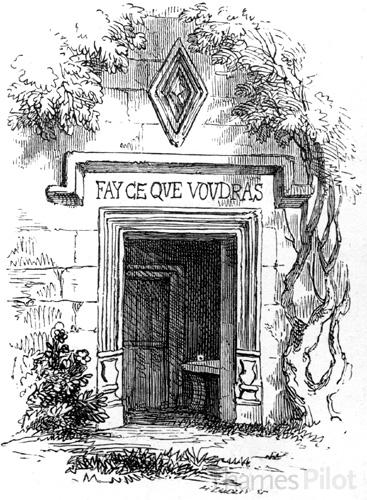
Well as it turns out, one option is to buy an old monastery, expand the cave system underneath, open yourself a well-appointed “garden of lust” with a really cool Latin motto (“Fay Ce Qve Vovdras”...”Do As You Will”), and invite a few of the most powerful men in England...and the Colonies...to join you in heavy drinking and crazy escapades that involve, to give just one example, shipping in prostitutes from London dressed up as nuns for an evening’s entertainment.
Which is exactly what Sir Francis Dashwood did in the village of West Wycombe; just six miles north of London by way of the River Thames.
It was a fabulous situation...the Abbey was secluded, on top of a hill, and shrouded by a grove of trees. The only access to the caves was by boat—and that meant it was possible to hop on a boat in London...and hop off, at the caves, unobserved...and then later, still unobserved, head back home, polite society none the wiser.
The “Monks of Medmenham”, as the group’s members called themselves (they did not call themselves “The Hellfire Club”, legends notwithstanding), did indeed include some of the most important of the English landed gentry (and, it was rumored, some of their wives...): including the Earl of Sandwich, Benjamin Franklin, and the man who will be one of the two focal points of today’s discussion, John Wilkes.
But the thing is, eventually all that romping gets a bit old; and a gentleman again finds himself with time on his hands...
Wilkes was a man with political ambition, and so he set about bribing the local voters to obtain a seat in Parliament...only to find his party tossed out of leadership and into the role of the opposition—which turned out to be perfect for somebody inclined to this sort of humor:
To take the story further we need to know that King George III (who saw “The Madness of King George”?) chose as his Prime Minister his former “finishing tutor”, John Stuart, the Earl of Bute. The new Earl had quite a personal history of his own; in fact there were questions as to whether the new King’s mother and the new Earl had a personal history of their own.
Another item of shared personal history: the new Earl and Wilkes were both members of the Monks of Medmenham.
The Earl of Bute had a problem getting his program through Parliament, and to overcome his inability to “talk up” his ideas (some suggest he experienced antipathy because he was a Scot...something Gordon Brown might well understand) he published “The Briton”, a newspaper published in London...which saw Wilkes answer with “The North Briton”, which, in a time and place that had no free press, began its very first issue of June 5, 1762, thusly:
This shot across the bow having been fired; Wilkes proceeded to lay 44 more broadsides into the hull of Government, including this quote from the final “The North Briton”, No. 45, in reference to the Earl’s resignation from Government, and the rumors that he still pulled the strings from behind the scenes:
You cannot talk about the Government in this way without consequences, and...well, we’ll come back to that in a minute.
Before we do, I want you to meet John Entick. Entick began his professional career as a schoolmaster, then an author. He had a bit of an eclectic taste—his first book being a Latin grammar, then a book on theology...and in an ironic twist, he at one point tried to publish an edition of Chaucer. He was also famous for his dictionary.
Entick was as upset by the political situation as Wilkes, and he found his voice in “The Monitor, or the British Freeholder”, which was where he wrote this:
You’ll recall my saying that there would be consequences for selling this sort of thing in King George’s and the Earl of Bute’s England, and here’s where we start getting to the heart of the story.
But not today.
Instead, in a development worthy of Luke and Laura, we’re employing the cliffhanger...so come back in about 36 hours, and we’ll have the King’s messengers roaming the countryside, a spectacular trial or two—and a guy who gets elected to Parliament from his jail cell four times in four months.
And of course, when it’s all over...the United States will have a Fourth Amendment.
As many of you know, the new FISA compromise may or may not allow warrantless wiretapping of American citizens on a wholesale scale.
Something you may not know is that a similar debate raged in England (centered around the right of Government to seize the papers of whomever they chose, and use the papers as evidence against those persons) during the reign of King George III—or that it involved scandalous sexual behavior, Benjamin Franklin, the 18th Century version of blogging, and two men who decided to take on the corruption of the Crown...and won.
And because of all that, we have a Fourth Amendment today.
Ready for a tale of liberty and ribaldry?
Then let’s plunge right in, shall we?
So you live in 18th century England, you’re rich...and kind of bored.
What is a gentleman to do?
Well as it turns out, one option is to buy an old monastery, expand the cave system underneath, open yourself a well-appointed “garden of lust” with a really cool Latin motto (“Fay Ce Qve Vovdras”...”Do As You Will”), and invite a few of the most powerful men in England...and the Colonies...to join you in heavy drinking and crazy escapades that involve, to give just one example, shipping in prostitutes from London dressed up as nuns for an evening’s entertainment.
Which is exactly what Sir Francis Dashwood did in the village of West Wycombe; just six miles north of London by way of the River Thames.
It was a fabulous situation...the Abbey was secluded, on top of a hill, and shrouded by a grove of trees. The only access to the caves was by boat—and that meant it was possible to hop on a boat in London...and hop off, at the caves, unobserved...and then later, still unobserved, head back home, polite society none the wiser.
The “Monks of Medmenham”, as the group’s members called themselves (they did not call themselves “The Hellfire Club”, legends notwithstanding), did indeed include some of the most important of the English landed gentry (and, it was rumored, some of their wives...): including the Earl of Sandwich, Benjamin Franklin, and the man who will be one of the two focal points of today’s discussion, John Wilkes.
But the thing is, eventually all that romping gets a bit old; and a gentleman again finds himself with time on his hands...
Wilkes was a man with political ambition, and so he set about bribing the local voters to obtain a seat in Parliament...only to find his party tossed out of leadership and into the role of the opposition—which turned out to be perfect for somebody inclined to this sort of humor:
When the Earl of Sandwich, a sometime friend, told him that "you will die either on the gallows, or of the pox," Wilkes said, "That must depend on whether I embrace your lordship's principles or your mistress."
--Jack Lynch, from the article “Wilkes, Liberty, and Number 45”
To take the story further we need to know that King George III (who saw “The Madness of King George”?) chose as his Prime Minister his former “finishing tutor”, John Stuart, the Earl of Bute. The new Earl had quite a personal history of his own; in fact there were questions as to whether the new King’s mother and the new Earl had a personal history of their own.
Another item of shared personal history: the new Earl and Wilkes were both members of the Monks of Medmenham.
The Earl of Bute had a problem getting his program through Parliament, and to overcome his inability to “talk up” his ideas (some suggest he experienced antipathy because he was a Scot...something Gordon Brown might well understand) he published “The Briton”, a newspaper published in London...which saw Wilkes answer with “The North Briton”, which, in a time and place that had no free press, began its very first issue of June 5, 1762, thusly:
The liberty of the press is the birth-right of a Briton, and is justly esteemed the firmest bulwark of the liberties of this country. It has been the terror of all bad ministers; for their dark and dangerous designs, or their weakness, inability, and duplicity, have thus been detected and threwn to the public, generally in too strong and just colours for them long to bear up against the odium of mankind. Can we then be surpriz’d that so various and infinite arts have been employed, at one time entirely to cast aside, at another to take off the force, and blunt the edge, of this most sacred weapon, given for the defence of truth and liberty?
This shot across the bow having been fired; Wilkes proceeded to lay 44 more broadsides into the hull of Government, including this quote from the final “The North Briton”, No. 45, in reference to the Earl’s resignation from Government, and the rumors that he still pulled the strings from behind the scenes:
The Scottish minister has indeed retired. Is his influence at an end? Or does he still govern by the three wretched tools of his power, who to their indelible infamy, have supported the most odious of his measures, the late ignominious Peace, and the wicked extension of the arbitrary mode of Excise? The North Briton has been steady in his opposition to a single, insolent, incapable, despotic minister, and is equally ready, in the service of his country, to combat the triple-headed, Cerberean administration, if the Scot is to assume that motley form.
You cannot talk about the Government in this way without consequences, and...well, we’ll come back to that in a minute.
Before we do, I want you to meet John Entick. Entick began his professional career as a schoolmaster, then an author. He had a bit of an eclectic taste—his first book being a Latin grammar, then a book on theology...and in an ironic twist, he at one point tried to publish an edition of Chaucer. He was also famous for his dictionary.
Entick was as upset by the political situation as Wilkes, and he found his voice in “The Monitor, or the British Freeholder”, which was where he wrote this:
...Now, although he allows, that “These Mixed constitutions [as opposed to absolute monarchy] are the very best, that human wisdom could ever discover for the regulation of human societies; yet that these, though perhaps productive of fewer evils, than either of the other, must necessarily partake of the evils belonging to both, and be supported by more or less violence, as they more or less approach the despotic; or of corruption, as they come nearer to the democratic principles: for corruption must always increase in due proportion to the decrease of arbitrary power; since where there is less power to command obedience, there must be more bribery to purchase it, or there can be no government at all...”
You’ll recall my saying that there would be consequences for selling this sort of thing in King George’s and the Earl of Bute’s England, and here’s where we start getting to the heart of the story.
But not today.
Instead, in a development worthy of Luke and Laura, we’re employing the cliffhanger...so come back in about 36 hours, and we’ll have the King’s messengers roaming the countryside, a spectacular trial or two—and a guy who gets elected to Parliament from his jail cell four times in four months.
And of course, when it’s all over...the United States will have a Fourth Amendment.
Friday, July 11, 2008
A Fake Consultant Exclusive: “All Suspicious Persons Will Be Monitored."
Many words have been proffered regarding the FISA bill this week, and I was actually preparing an analysis of the events when, to my surprise, I received an email that made me alter my schedule completely.
I want to apologize in advance to Danny Medress, over at Democracy for America, for whom I was preparing the analysis; and all I can tell you, Danny, is that this was of such import that the schedule had to be slipped.
That said, presented here in its entirety is the memo I received …and having read it through, I have to say I feel much safer.
WASHINGTON—July, 10, 2008
FCNS--Officials at the Department of Homeland Security, the National Security Agency, the FBI, and the National Reconnaissance Office jointly announced today that because of the new authorities and tools they have under H.R. 6304, the FISA Amendments Act of 2008, they can now absolutely assure the American people that there will be 100% coverage of every single “suspicious person” in the United States.
DHS Undersecretary Harry Paratestes told the assembled media that two major programs have been implemented to assure that 100% coverage is achieved.
First, the implementation of the “Algorithm Impact Project” which will allow specially-designed software programs to decide which Americans need to be wiretapped.
“The AI Project”, Paratestes said, “is the most effective tool to date to ensure all communications between any possible terrorist is captured and recorded.”
As has been previously reported, the AI Project will direct NSA and NRO resources by starting with a “baseline” assumption that all communications are suspicious until proven to be safe.
“Fortunately, we are responding to the threat posed by all unmonitored communications by instituting a ’full capture’ communications protocol that will capture all the communications that the AI Project does not track as unsafe”, Paratestes reported to a questioner. “This policy ensures that any dangerous communications the AI Project misses are retained for at least 10 years for analysis in case they might later become actionable.”
Paratestes also described, for the first time, the newest of the DHS security innovations to be introduced: the “Binary Management Program”.
“We simply cannot allow any suspicious person to be able to move about freely in the United States” BMP Program Manager Heywood Jablomi told the assembled press, “and to that end we intend to hire 150,000,000 new employees to remain in close contact with the other 150,000,000 suspicious persons in the United States 24 hours a day. This will achieve 100% coverage of any suspicious individuals and simultaneously achieve 100% employment. I’ll say it again, so you know we mean it: all suspicious persons will be monitored.”
Several persons expressed concerns regarding the scope and nature of the program; and those suspicious persons have been removed from the general population for a period of investigation.
“We are looking for a location to site the new detention facility that will be required”, Jablomi told the assembled reporters, “and we can announce today that we are down to two sites for final consideration: Nevada and Wyoming.”
Paratestes ended the meeting with an optimistic assessment of the future: “With everyone in America being monitored, we will finally be free and safe, in peace and freedom from fear, and in true health, through the purity and essence of our natural…fluids. God bless you all.”
I want to apologize in advance to Danny Medress, over at Democracy for America, for whom I was preparing the analysis; and all I can tell you, Danny, is that this was of such import that the schedule had to be slipped.
That said, presented here in its entirety is the memo I received …and having read it through, I have to say I feel much safer.
WASHINGTON—July, 10, 2008
FCNS--Officials at the Department of Homeland Security, the National Security Agency, the FBI, and the National Reconnaissance Office jointly announced today that because of the new authorities and tools they have under H.R. 6304, the FISA Amendments Act of 2008, they can now absolutely assure the American people that there will be 100% coverage of every single “suspicious person” in the United States.
DHS Undersecretary Harry Paratestes told the assembled media that two major programs have been implemented to assure that 100% coverage is achieved.
First, the implementation of the “Algorithm Impact Project” which will allow specially-designed software programs to decide which Americans need to be wiretapped.
“The AI Project”, Paratestes said, “is the most effective tool to date to ensure all communications between any possible terrorist is captured and recorded.”
As has been previously reported, the AI Project will direct NSA and NRO resources by starting with a “baseline” assumption that all communications are suspicious until proven to be safe.
“Fortunately, we are responding to the threat posed by all unmonitored communications by instituting a ’full capture’ communications protocol that will capture all the communications that the AI Project does not track as unsafe”, Paratestes reported to a questioner. “This policy ensures that any dangerous communications the AI Project misses are retained for at least 10 years for analysis in case they might later become actionable.”
Paratestes also described, for the first time, the newest of the DHS security innovations to be introduced: the “Binary Management Program”.
“We simply cannot allow any suspicious person to be able to move about freely in the United States” BMP Program Manager Heywood Jablomi told the assembled press, “and to that end we intend to hire 150,000,000 new employees to remain in close contact with the other 150,000,000 suspicious persons in the United States 24 hours a day. This will achieve 100% coverage of any suspicious individuals and simultaneously achieve 100% employment. I’ll say it again, so you know we mean it: all suspicious persons will be monitored.”
Several persons expressed concerns regarding the scope and nature of the program; and those suspicious persons have been removed from the general population for a period of investigation.
“We are looking for a location to site the new detention facility that will be required”, Jablomi told the assembled reporters, “and we can announce today that we are down to two sites for final consideration: Nevada and Wyoming.”
Paratestes ended the meeting with an optimistic assessment of the future: “With everyone in America being monitored, we will finally be free and safe, in peace and freedom from fear, and in true health, through the purity and essence of our natural…fluids. God bless you all.”
Wednesday, July 9, 2008
On The Air Force Bomber Problem, Part 2, Or, Let's Talk Options
When last we met we had a conversation about the challenges the Air Force faces in providing a capable bomber force. We discussed the age of the existing bomber fleet’s backbone, the B-52, the limitations of the B-1, and the fact that the B-2s is limited by the age of the aircraft’s electronics from participating in the “network-centric warfare” model most appropriate for the 21st Century military.
We also examined the probability that future air-defense systems will likely soon raise the threat level to a point where existing US aircraft will no longer be able to operate safely in the highest threat environments.
So what are we to do?
Today we’ll consider several options, including some that change the nature of the heavy bomber fleet in very fundamental ways.
Let’s start with a question that came to light after the first diary was published: why have a bomber capability at all? Here is the response I offered on my personal blog:
In order to figure out where we’re going let’s again consider what we see as affecting the future. To close out yesterday’s story we asked the following three questions:
--will the emphasis move from manned to unmanned aircraft--and by how much?
--will future wars be more likely to be fought over contested or uncontested airspace?
--and what might be the biggest "doctrinal shift" question: will the US continue to operate nuclear-capable bombers?
The use of unmanned aerial vehicles (UAVs) and remotely piloted vehicles (RPVs) seems to be the obvious solution: low risk to personnel—at least ours—greater maneuverability, and the potential for more “stealthy” designs.
But before we go too far down this path, we need to make ourselves aware that these aircraft types have limitations of their own:
First, payload: a B-1 can carry up to 30 2,000-pound bombs, but the largest of the currently anticipated UAVs (the X-47A) can only carry two 2,000-pound munitions. Fuel capacity is an issue as well-the heavier or less aerodynamic the aircraft, the more it has to refuel; reducing ”loiter times” over any location.
Next, something you would never consider as a battlefield issue: communications bandwidth. To remotely communicate with a Predator sending streaming video, for example, would require roughly half of the secure satellite bandwidth owned by the military in 2003—which was more or less equal to the capacity of two T-1 lines.
Not much has changed since then.
There are space based solutions proposed, but even the fastest satellite data connections available today are roughly the equivalent of a slow DSL (256k) Internet connection.
To field coordinated groups of UAVs and RPVs would require a quantum leap in bandwidth—and there have been some proposals, including a laser-based data transfer system that could offer 40Gbps capacity. While this would be a fantastic upgrade, it is a line of sight system, there are certain technical issues still being resolved, and lasers are subject to countermeasures that could result in an adversary disrupting the “control loop” and jamming communications between commanders and aircraft.
To route the data from such a system back to command, however, also requires “backhaul” capacity...meaning every mission would require extra UAVs just to maintain the network. There are proposals to resolve this as well as US Navy ships dedicated to providing remote network “hop” capacity (believe it or not...airships are even making a comeback); but the important point to remember from all of this is that there will be very few missions that ever involve simply sending out a couple of robot airplanes to fix the problem.
The need for refueling also limits the deployment options for UAV and RPV aircraft—at least until confidence is established in “automated” air refueling operations.
There are also issues related to the access these aircraft will have to the US domestic, military and international air traffic control systems that are yet to be addressed; meaning the protocol for operations not “in the black” are still being worked out. The goal is to be able to file instrument flight plans for missions flown by these aircraft and to separate these vehicles by altitude; today ascent and descent procedures through commercial air traffic routes are also still being worked out.
An additional issue: these aircraft have maneuverability characteristics that change the instruction set they can receive—for example, more rapid ascents and descents can be ordered than would be normal for manned aircraft.
Before we can fully consider the application of unmanned aircraft, there are two more issues to address: cost of the vehicles and the safety of the weapons load.
You might think these aircraft would be less expensive than manned aircraft, but that might not be true. One reason is because the X-47A, to give a single example, is required to carry almost 5,000 pounds of payload...and that creates a minimum size and cost limit that can’t be ignored. Three demonstrator X-47A aircraft will cost just over $1 billion, but that includes engineering and development costs that, if spread over a larger production run, would be much lower per unit.
Another cost issue is “mission creep”. It is the unofficial policy of the United States Military-Industrial Establishment that once something is designed, it needs to do more...and more...and more. For those unfamiliar with the process, see: Bradley Fighting Vehicle. This policy will impact the design of any UAV or RPV, and they will virtually all trend up to larger and larger (and more costly) designs over time.
It is possible that some relief will be found in the concept of “modularity”, but that remains to be seen.
Now a major issue: the perception of the safety of the weapons carried on board these aircraft will control how these aircraft are designed and used.
This related directly back to one of our first questions: will be continue to operate nuclear-capable bombers? If the answer is yes, then we need to realize that unmanned aircraft cannot be used for that mission...because nobody, and I mean nobody, is going to accept nuclear-armed unmanned aircraft that could be just a few software glitches away from disaster.
But the same is true for conventional weapons as well. It would not be likely that an unmanned aircraft with the payload of a B-1 would be coming down the road, if only because of the damage to US interests from an accidental attack on a hospital, or school, or some similarly horrendous target—or a “radio confusion” failure that results in the same outcome.
All of this augurs for the possibility that future unmanned aircraft are unlikely to become much larger than the current designs...even though I expect the current designs to get somewhat larger, again because of “mission creep”. Consider, however, that a vehicle carrying twice the load of an X-47A would still only carry four 2,000-pound munitions, not 30, as the B-1 does today.
Another way to deploy weapons in high threat environments is to use cruise missiles from “standoff” locations, which is a capability of the B-52; and there are efforts to develop new cruise missiles that would replace the current Tomahawk cruise missile (it’s too slow and is now vulnerable to anti-aircraft fire) with a missile functionally equivalent to the current “best available anywhere” BrahMos supersonic cruise missile being fielded by the Indian Army in a joint venture with Russia.
There are proposals to either “life extend” the existing B-52 fleet to perform this mission until 2030 (when super-duper hypersonic aircraft might be deployed) or to field a new penetrating bomber by 2018...and Congress today is moving the Air Force toward the new bomber.
You may recall that way up there at the top of the story I had promised a possible solution, and here’s where we get to the “interesting new idea” part of the deal.
Colonel Bryan J. Benson (soon to be Brigadier General Benson...and if you’re reading this, congratulations!) is the Vice Commander of the Air Mobility Command’s central control center at Scott Air Force Base in Illinois, which means he directs the operations of the Air Force’s “airline” of 1,200 transport and refueling aircraft (“motto: the proud bird with the camouflage tail!”); and in his 1996 thesis to the School of Advanced Airpower Studies he proposed developing a fleet of “Transport / Bombers” based on an aircraft platform like the Boeing 767 or Airbus A380...which also happen to be the two candidate aircraft to replace the KC-135 Airborne Tanker.
Such an aircraft would, from the inside, be a freighter, using the standard roller floors and pallet system common to all other military transport platforms. One 2.000 pound, and possibly two 500-pound bombs could be accommodated on each 88” x 108” pallet, and a 767 freighter can carry 18 pallets. This would allow the use of these aircraft to augment the bomber fleet in “uncontested airspace” situations.
Additionally, exterior racks can be fitted that would allow this type of aircraft to deploy cruise missiles from standoff locations in situations where flying over the target is unsafe.
Here’s the best part. It is very expensive to maintain a fleet of dedicated bombers and a fleet of transport aircraft...and you need extra aircrew for the bombers, at substantial cost, even if no bombing is actually going on.
But a fleet of convertible aircraft can do all sorts of things...even provide airlift capacity in disaster relief situations...and, just as with the KC-45 tankers, they would be able to perform multiple missions on the same out-and-back flight (for example, a bomb run followed by a pick-up of cargo from a “regional” base)—something today’s bombers cannot do.
And with all that said, we come to the end.
What have we learned?
Even in times of peace, there is a place for having the capability to project force by bombing...and there are situations where the threat of imminent bombing can force desirable diplomatic results.
The Air Force is quickly coming to a point where we are unable to ensure that aircrews can safely perform missions in high-risk environments...and beyond that, the bombers currently used in low-risk environments are approaching 50 years of service life.
There are several options available, including a new dedicated bomber, expansion of the use of UAV and RPV aircraft, the use of improved cruise missiles, and the Bomber / Transport concept. It is possible to adopt several of these options together, but we would be unlikely to achieve all our military objectives with any single option.
Cost, the availability of supporting infrastructure (bandwidth...), and the public perception that we might be building robot killers from the movie “Terminator” will all affect the choices we make.
This is big-money stuff, once again, and we are going to need to be informed if we want to control where all this might be going—so I hope this creates discussion, and I hope we can refine the ideas along the way...and with any luck, maybe we can influence the process.
We also examined the probability that future air-defense systems will likely soon raise the threat level to a point where existing US aircraft will no longer be able to operate safely in the highest threat environments.
So what are we to do?
Today we’ll consider several options, including some that change the nature of the heavy bomber fleet in very fundamental ways.
Let’s start with a question that came to light after the first diary was published: why have a bomber capability at all? Here is the response I offered on my personal blog:
...consider darfur.
we know that government aircraft are bombing innocent civilians.
we could presumably disable the aircraft that are doing the bombing and the airfields that support them through aerial bombing of our own; and i would submit to you that such an action would be neither indiscriminate killing nor unjustified.
if we had an administration in power that was so inclined, we could presumably diplomatically "encourage" the cessation of these somali government attacks by presenting the credible threat of bombing as the alternative if the offensive actions do not cease.
in that instance, the capability of bombing is useful without any application of force.
you may recall that iraqi "no fly zones" did control baathist air attacks on kurds and shi'a in the '90s...and while force was used, it seemed less indiscriminate than more so--and reasonably justified as well.
In order to figure out where we’re going let’s again consider what we see as affecting the future. To close out yesterday’s story we asked the following three questions:
--will the emphasis move from manned to unmanned aircraft--and by how much?
--will future wars be more likely to be fought over contested or uncontested airspace?
--and what might be the biggest "doctrinal shift" question: will the US continue to operate nuclear-capable bombers?
The use of unmanned aerial vehicles (UAVs) and remotely piloted vehicles (RPVs) seems to be the obvious solution: low risk to personnel—at least ours—greater maneuverability, and the potential for more “stealthy” designs.
But before we go too far down this path, we need to make ourselves aware that these aircraft types have limitations of their own:
First, payload: a B-1 can carry up to 30 2,000-pound bombs, but the largest of the currently anticipated UAVs (the X-47A) can only carry two 2,000-pound munitions. Fuel capacity is an issue as well-the heavier or less aerodynamic the aircraft, the more it has to refuel; reducing ”loiter times” over any location.
Next, something you would never consider as a battlefield issue: communications bandwidth. To remotely communicate with a Predator sending streaming video, for example, would require roughly half of the secure satellite bandwidth owned by the military in 2003—which was more or less equal to the capacity of two T-1 lines.
Not much has changed since then.
There are space based solutions proposed, but even the fastest satellite data connections available today are roughly the equivalent of a slow DSL (256k) Internet connection.
To field coordinated groups of UAVs and RPVs would require a quantum leap in bandwidth—and there have been some proposals, including a laser-based data transfer system that could offer 40Gbps capacity. While this would be a fantastic upgrade, it is a line of sight system, there are certain technical issues still being resolved, and lasers are subject to countermeasures that could result in an adversary disrupting the “control loop” and jamming communications between commanders and aircraft.
To route the data from such a system back to command, however, also requires “backhaul” capacity...meaning every mission would require extra UAVs just to maintain the network. There are proposals to resolve this as well as US Navy ships dedicated to providing remote network “hop” capacity (believe it or not...airships are even making a comeback); but the important point to remember from all of this is that there will be very few missions that ever involve simply sending out a couple of robot airplanes to fix the problem.
The need for refueling also limits the deployment options for UAV and RPV aircraft—at least until confidence is established in “automated” air refueling operations.
There are also issues related to the access these aircraft will have to the US domestic, military and international air traffic control systems that are yet to be addressed; meaning the protocol for operations not “in the black” are still being worked out. The goal is to be able to file instrument flight plans for missions flown by these aircraft and to separate these vehicles by altitude; today ascent and descent procedures through commercial air traffic routes are also still being worked out.
An additional issue: these aircraft have maneuverability characteristics that change the instruction set they can receive—for example, more rapid ascents and descents can be ordered than would be normal for manned aircraft.
If our air forces are never used, they have achieved their finest goal.
--Former Joint Chiefs of Staff Chairman General Nathan F. Twining , March 1956
Before we can fully consider the application of unmanned aircraft, there are two more issues to address: cost of the vehicles and the safety of the weapons load.
You might think these aircraft would be less expensive than manned aircraft, but that might not be true. One reason is because the X-47A, to give a single example, is required to carry almost 5,000 pounds of payload...and that creates a minimum size and cost limit that can’t be ignored. Three demonstrator X-47A aircraft will cost just over $1 billion, but that includes engineering and development costs that, if spread over a larger production run, would be much lower per unit.
Another cost issue is “mission creep”. It is the unofficial policy of the United States Military-Industrial Establishment that once something is designed, it needs to do more...and more...and more. For those unfamiliar with the process, see: Bradley Fighting Vehicle. This policy will impact the design of any UAV or RPV, and they will virtually all trend up to larger and larger (and more costly) designs over time.
It is possible that some relief will be found in the concept of “modularity”, but that remains to be seen.
Now a major issue: the perception of the safety of the weapons carried on board these aircraft will control how these aircraft are designed and used.
This related directly back to one of our first questions: will be continue to operate nuclear-capable bombers? If the answer is yes, then we need to realize that unmanned aircraft cannot be used for that mission...because nobody, and I mean nobody, is going to accept nuclear-armed unmanned aircraft that could be just a few software glitches away from disaster.
But the same is true for conventional weapons as well. It would not be likely that an unmanned aircraft with the payload of a B-1 would be coming down the road, if only because of the damage to US interests from an accidental attack on a hospital, or school, or some similarly horrendous target—or a “radio confusion” failure that results in the same outcome.
All of this augurs for the possibility that future unmanned aircraft are unlikely to become much larger than the current designs...even though I expect the current designs to get somewhat larger, again because of “mission creep”. Consider, however, that a vehicle carrying twice the load of an X-47A would still only carry four 2,000-pound munitions, not 30, as the B-1 does today.
Another way to deploy weapons in high threat environments is to use cruise missiles from “standoff” locations, which is a capability of the B-52; and there are efforts to develop new cruise missiles that would replace the current Tomahawk cruise missile (it’s too slow and is now vulnerable to anti-aircraft fire) with a missile functionally equivalent to the current “best available anywhere” BrahMos supersonic cruise missile being fielded by the Indian Army in a joint venture with Russia.
There are proposals to either “life extend” the existing B-52 fleet to perform this mission until 2030 (when super-duper hypersonic aircraft might be deployed) or to field a new penetrating bomber by 2018...and Congress today is moving the Air Force toward the new bomber.
Why does the Air Force need expensive new bombers? Have the people we've been bombing over the years been complaining?
--Former Alabama Governor George Wallace
You may recall that way up there at the top of the story I had promised a possible solution, and here’s where we get to the “interesting new idea” part of the deal.
Colonel Bryan J. Benson (soon to be Brigadier General Benson...and if you’re reading this, congratulations!) is the Vice Commander of the Air Mobility Command’s central control center at Scott Air Force Base in Illinois, which means he directs the operations of the Air Force’s “airline” of 1,200 transport and refueling aircraft (“motto: the proud bird with the camouflage tail!”); and in his 1996 thesis to the School of Advanced Airpower Studies he proposed developing a fleet of “Transport / Bombers” based on an aircraft platform like the Boeing 767 or Airbus A380...which also happen to be the two candidate aircraft to replace the KC-135 Airborne Tanker.
Such an aircraft would, from the inside, be a freighter, using the standard roller floors and pallet system common to all other military transport platforms. One 2.000 pound, and possibly two 500-pound bombs could be accommodated on each 88” x 108” pallet, and a 767 freighter can carry 18 pallets. This would allow the use of these aircraft to augment the bomber fleet in “uncontested airspace” situations.
Additionally, exterior racks can be fitted that would allow this type of aircraft to deploy cruise missiles from standoff locations in situations where flying over the target is unsafe.
Here’s the best part. It is very expensive to maintain a fleet of dedicated bombers and a fleet of transport aircraft...and you need extra aircrew for the bombers, at substantial cost, even if no bombing is actually going on.
But a fleet of convertible aircraft can do all sorts of things...even provide airlift capacity in disaster relief situations...and, just as with the KC-45 tankers, they would be able to perform multiple missions on the same out-and-back flight (for example, a bomb run followed by a pick-up of cargo from a “regional” base)—something today’s bombers cannot do.
And with all that said, we come to the end.
What have we learned?
Even in times of peace, there is a place for having the capability to project force by bombing...and there are situations where the threat of imminent bombing can force desirable diplomatic results.
The Air Force is quickly coming to a point where we are unable to ensure that aircrews can safely perform missions in high-risk environments...and beyond that, the bombers currently used in low-risk environments are approaching 50 years of service life.
There are several options available, including a new dedicated bomber, expansion of the use of UAV and RPV aircraft, the use of improved cruise missiles, and the Bomber / Transport concept. It is possible to adopt several of these options together, but we would be unlikely to achieve all our military objectives with any single option.
Cost, the availability of supporting infrastructure (bandwidth...), and the public perception that we might be building robot killers from the movie “Terminator” will all affect the choices we make.
This is big-money stuff, once again, and we are going to need to be informed if we want to control where all this might be going—so I hope this creates discussion, and I hope we can refine the ideas along the way...and with any luck, maybe we can influence the process.
Tuesday, July 8, 2008
On The Air Force Bomber Problem, Or, It May Be Time For That Bake Sale
I come today with a message many of you will not want to hear, particularly in a time when we are looking forward to ending a war...and in a time where we are already struggling to provide enough money for military funding, the last thing you want to hear from me is that we need to send a couple hundred billion more to the Air Force—and that we need to do it soon.
Nonetheless, we have a problem we need to fix.
Of course, I hate to present a problem without a solution...and today I have two ideas that can help with the problem—and maybe save the taxpayer a mess of money in the process.
Y’all ready?
Then let’s go...
Here’s the problem in a nutshell: the Air Force relies on bombers to perform a variety of “softening up” missions: such missions can be as simple as dropping a single bomb on a gun emplacement or as final as the last bomb dropped on the last day of human existence to soften up a missile silo.
The bomber they rely upon the most is the B-52...and it’s just getting too old to do the job it has undertaken for a half century. The newer bombers are either too small, too vulnerable to anti-aircraft systems or too few in numbers to replace the B-52--and that means we are going to have to find a replacement.
Obviously, a variety of missions require a variety of tools, so let’s take a minute to describe the bomber fleet as it currently exists.
The B-52, previously introduced, weighs in at just a bit over 480,000 pounds (about the same weight as a Boeing 767). 60,000 of that is weapons load. The aircraft can carry nuclear weapons like the B-83 gravity bomb but it is used extensively to deliver conventional weapons, which can cover the gamut from cluster munitions to “penetrating weapons” to cruise missiles. 94 of the aircraft are reportedly operational today.
A typical attack on an enemy troop formation might involve dropping 150 or so MK-82 500-pound bombs from three of these aircraft at high altitude. The effect is so shocking to the massed forces that they often surrender to the nearest US troops, and that happened over and over during the first Gulf War.
For hardened positions, the aircraft deploys MK-84 2000 pound bombs or the AGM-142 cruise missile (the Have Nap), and for situations where the “threat environment” does not allow the B-52 to fly over a normal target, the JASSM cruise missile has a range of up to 200 miles, and the AGM-86/C cruise missile allows for attacks from 600 miles away with near-“through the window” accuracy....assuming all goes well. More on that in tomorrow's part 2.
This is not a supersonic aircraft, however, and as Soviet air defenses improved in capability the need for a more survivable aircraft was identified, leading to the introduction of the B-1A during the 1980’s. The swing-wing design of this aircraft allowed for high performance at supersonic speeds and improved low-speed flight as well. An advanced version of this aircraft, the B-1B, flies today.
The B-1B does not carry nuclear weapons, but at 477,000 pounds maximum takeoff weight it can actually carry more MK-82 bombs than the B-52—as many as 84. This aircraft can also carry weapons that “glide” to a target from substantial distances (out to 40 miles) so as to increase survivability. This is a supersonic aircraft, it employs various technologies to allow it to operate at extremely low altitudes, and 69 of these aircraft are reported to be currently operational.
For a variety of reasons (including problems in the B-1 program) the Air Force introduced the B-2, the primary reason being the improvements in “stealth” design that had come to light over the intervening years; and this bat-winged aircraft is able to operate in the highest-threat environments of any US manned aircraft...again, assuming all goes well.
This is the lightest of the three aircraft, at 160,000 pounds, but it can carry highly precise GBU-37 munitions, which are designed to crack open bunkers by combining a GPS guidance system and a nearly 5000 pound warhead and the equally accurate AGM-137 TASSAM “stealth” cruise missile, which the others cannot.
This is a $2.1 billion aircraft, however, and only 20 were built. There are only 16 currently operational aircraft in the inventory...and it has a bit of a computer problem:
The B-2’s data processing systems, based on the Intel 286 processor, are limited in their ability to be upgraded to interoperate with other DOD systems. This limitation makes real-time mission changes more difficult in comparison to more modern aircraft like the F-22 or F-35. The B-2’s current processing capabilities also limit the aircraft’s ability to incorporate the latest enhancements (sensors) that would enhance its survivability.
--Congressional Research Service; “The Next Generation Bomber: Background, Oversight Issues, and Options for Congress”
There are a variety of smaller bombers as well, and the F-15, F-16, F/A-18, and the new F-22 bomber concept have all served, are serving, or may soon be serving in the role. The best known of this group, however, might be the F-117 “stealth” fighter...which is really just a small bomber in a Batman outfit.
So now that you know the players, let’s discuss the missions.
It is possible, as we discussed earlier, that the mission might be penetrating the enemy’s borders and delivering weapons in an extremely high threat environment...and the F-117 or B-2 are the only two manned aircraft in the US inventory that can perform this mission. Only the B-2 can deliver nuclear weapons in such an environment, and it has far greater unrefueled range.
In what might be described as “medium threat” environments the B-1 can use its speed to evade some threats; but for the most part these aircraft operate in zones that have “suppressed” air defenses.
The B-52 can operate only after an environment is cleared of most threats; but like a “bomb truck” it can go out and do its daily runs with high reliability; it has some self-defense capability as well as electronic countermeasure systems that some feel are superior to the B-1’s.
So that’s the aircraft and the missions, which leaves the question...what’s the problem?
It is very simple: we used to be the world leader in shooting things down.
We also used to be able to avoid—or destroy--everyone else’s “shooter-downer thingies.”
But that’s no longer true.
Iran has apparently acquired the Russian S-300 air defense system (described as a better version of our Patriot system) which means it could likely shoot down all current US aircraft with the possible exception of the B-2 and F-117—but there is every possibility that an attack launched against such an air defense system would suffer aircraft and aircrew losses.
If that’s not bad enough, Sweden’s SAAB has tested a “hypersonic” anti aircraft missile that flew at above Mach 5 speeds (roughly 6,500 mph or 10,500 Kph)...far faster than any currently acknowledged aircraft of any country.
As a result, we no longer have absolute confidence that we can hit whatever we need to if we really need to...unless we decide to launch a ballistic missile on the target...which usually means a nuclear missile.
We need better options...and now we’re getting to the “solutions” part of the thing.
The decision over what to put in place to carry out the bomber mission in the future —and how much it might cost--will depend on a few factors:
--will the emphasis move from manned to unmanned aircraft--and by how much?
--will future wars be more likely to be fought over contested or uncontested airspace?
--and what might be the biggest “doctrinal shift” question: will the US continue to operate nuclear-capable bombers?
We have covered a lot of ground today...and I am regularly guilty of letting stories go too long...so let’s stop right here—and in part 2, tomorrow, we’ll consider some answers.
Nonetheless, we have a problem we need to fix.
Of course, I hate to present a problem without a solution...and today I have two ideas that can help with the problem—and maybe save the taxpayer a mess of money in the process.
Y’all ready?
Then let’s go...
Here’s the problem in a nutshell: the Air Force relies on bombers to perform a variety of “softening up” missions: such missions can be as simple as dropping a single bomb on a gun emplacement or as final as the last bomb dropped on the last day of human existence to soften up a missile silo.
The bomber they rely upon the most is the B-52...and it’s just getting too old to do the job it has undertaken for a half century. The newer bombers are either too small, too vulnerable to anti-aircraft systems or too few in numbers to replace the B-52--and that means we are going to have to find a replacement.
Now the general who wins a battle makes many calculations in his temple ere the battle is fought. The general who loses a battle makes but few calculations beforehand. Thus do many calculations lead to victory, and few calculations to defeat: how much more no calculation at all!
It is by attention to this point that I can foresee who is likely to win or lose.
--Sun Tzu; “The Art of War”
Obviously, a variety of missions require a variety of tools, so let’s take a minute to describe the bomber fleet as it currently exists.
The B-52, previously introduced, weighs in at just a bit over 480,000 pounds (about the same weight as a Boeing 767). 60,000 of that is weapons load. The aircraft can carry nuclear weapons like the B-83 gravity bomb but it is used extensively to deliver conventional weapons, which can cover the gamut from cluster munitions to “penetrating weapons” to cruise missiles. 94 of the aircraft are reportedly operational today.
A typical attack on an enemy troop formation might involve dropping 150 or so MK-82 500-pound bombs from three of these aircraft at high altitude. The effect is so shocking to the massed forces that they often surrender to the nearest US troops, and that happened over and over during the first Gulf War.
For hardened positions, the aircraft deploys MK-84 2000 pound bombs or the AGM-142 cruise missile (the Have Nap), and for situations where the “threat environment” does not allow the B-52 to fly over a normal target, the JASSM cruise missile has a range of up to 200 miles, and the AGM-86/C cruise missile allows for attacks from 600 miles away with near-“through the window” accuracy....assuming all goes well. More on that in tomorrow's part 2.
This is not a supersonic aircraft, however, and as Soviet air defenses improved in capability the need for a more survivable aircraft was identified, leading to the introduction of the B-1A during the 1980’s. The swing-wing design of this aircraft allowed for high performance at supersonic speeds and improved low-speed flight as well. An advanced version of this aircraft, the B-1B, flies today.
The B-1B does not carry nuclear weapons, but at 477,000 pounds maximum takeoff weight it can actually carry more MK-82 bombs than the B-52—as many as 84. This aircraft can also carry weapons that “glide” to a target from substantial distances (out to 40 miles) so as to increase survivability. This is a supersonic aircraft, it employs various technologies to allow it to operate at extremely low altitudes, and 69 of these aircraft are reported to be currently operational.
For a variety of reasons (including problems in the B-1 program) the Air Force introduced the B-2, the primary reason being the improvements in “stealth” design that had come to light over the intervening years; and this bat-winged aircraft is able to operate in the highest-threat environments of any US manned aircraft...again, assuming all goes well.
This is the lightest of the three aircraft, at 160,000 pounds, but it can carry highly precise GBU-37 munitions, which are designed to crack open bunkers by combining a GPS guidance system and a nearly 5000 pound warhead and the equally accurate AGM-137 TASSAM “stealth” cruise missile, which the others cannot.
This is a $2.1 billion aircraft, however, and only 20 were built. There are only 16 currently operational aircraft in the inventory...and it has a bit of a computer problem:
The B-2’s data processing systems, based on the Intel 286 processor, are limited in their ability to be upgraded to interoperate with other DOD systems. This limitation makes real-time mission changes more difficult in comparison to more modern aircraft like the F-22 or F-35. The B-2’s current processing capabilities also limit the aircraft’s ability to incorporate the latest enhancements (sensors) that would enhance its survivability.
--Congressional Research Service; “The Next Generation Bomber: Background, Oversight Issues, and Options for Congress”
There are a variety of smaller bombers as well, and the F-15, F-16, F/A-18, and the new F-22 bomber concept have all served, are serving, or may soon be serving in the role. The best known of this group, however, might be the F-117 “stealth” fighter...which is really just a small bomber in a Batman outfit.
When you engage in actual fighting, if victory is long in coming, then men's weapons will grow dull and their ardor will be damped. If you lay siege to a town, you will exhaust your strength.
Again, if the campaign is protracted, the resources of the State will not be equal to the strain.
Now, when your weapons are dulled, your ardor damped, your strength exhausted and your treasure spent, other chieftains will spring up to take advantage of your extremity. Then no man, however wise, will be able to avert the consequences that must ensue.
Thus, though we have heard of stupid haste in war, cleverness has never been seen associated with long delays.
There is no instance of a country having benefited from prolonged warfare.
--Sun Tzu; “The Art of War”
So now that you know the players, let’s discuss the missions.
It is possible, as we discussed earlier, that the mission might be penetrating the enemy’s borders and delivering weapons in an extremely high threat environment...and the F-117 or B-2 are the only two manned aircraft in the US inventory that can perform this mission. Only the B-2 can deliver nuclear weapons in such an environment, and it has far greater unrefueled range.
In what might be described as “medium threat” environments the B-1 can use its speed to evade some threats; but for the most part these aircraft operate in zones that have “suppressed” air defenses.
The B-52 can operate only after an environment is cleared of most threats; but like a “bomb truck” it can go out and do its daily runs with high reliability; it has some self-defense capability as well as electronic countermeasure systems that some feel are superior to the B-1’s.
So that’s the aircraft and the missions, which leaves the question...what’s the problem?
It is very simple: we used to be the world leader in shooting things down.
We also used to be able to avoid—or destroy--everyone else’s “shooter-downer thingies.”
But that’s no longer true.
Iran has apparently acquired the Russian S-300 air defense system (described as a better version of our Patriot system) which means it could likely shoot down all current US aircraft with the possible exception of the B-2 and F-117—but there is every possibility that an attack launched against such an air defense system would suffer aircraft and aircrew losses.
If that’s not bad enough, Sweden’s SAAB has tested a “hypersonic” anti aircraft missile that flew at above Mach 5 speeds (roughly 6,500 mph or 10,500 Kph)...far faster than any currently acknowledged aircraft of any country.
As a result, we no longer have absolute confidence that we can hit whatever we need to if we really need to...unless we decide to launch a ballistic missile on the target...which usually means a nuclear missile.
We need better options...and now we’re getting to the “solutions” part of the thing.
In the practical art of war, the best thing of all is to take the enemy's country whole and intact; to shatter and destroy it is not so good. So, too, it is better to recapture an army entire than to destroy it, to capture a regiment, a detachment or a company entire than to destroy them.
Hence to fight and conquer in all your battles is not supreme excellence; supreme excellence consists in breaking the enemy's resistance without fighting.
Thus the highest form of generalship is to balk the enemy's plans; the next best is to prevent the junction of the enemy's forces; the next in order is to attack the enemy's army in the field; and the worst policy of all is to besiege walled cities.
--Sun Tzu; “The Art of War”
The decision over what to put in place to carry out the bomber mission in the future —and how much it might cost--will depend on a few factors:
--will the emphasis move from manned to unmanned aircraft--and by how much?
--will future wars be more likely to be fought over contested or uncontested airspace?
--and what might be the biggest “doctrinal shift” question: will the US continue to operate nuclear-capable bombers?
We have covered a lot of ground today...and I am regularly guilty of letting stories go too long...so let’s stop right here—and in part 2, tomorrow, we’ll consider some answers.
Friday, July 4, 2008
On Looking Back, Or, A Jerry Springer Administration--Why Not?
I bring to you today a story that is eight years old and as recent as today’s headlines.
A foolish tale of mirth and merriment it is indeed--and for those who want a real all-American Fourth of July story, well...this one fits better than a glass slipper on Cinderella’s foot.
The story, as you might have guessed from the headline, starts with a simple premise and ends by paraphrasing Ronald Reagan’s famous question:
Had we elected Jerry Springer in 2000 instead of George Bush the Younger, would we be better off today than we were eight years ago?
Come along for the ride, Esteemed Reader, and we shall see...
I am going to make the case that Jerry Springer would, in fact, have been the better choice by addressing four areas of Administration policy: foreign relations, legislative management, press relations, and fiscal policy.
In each of these areas I believe I can demonstrate with powerful evidence that a President Springer would have made better choices...and to show you what I mean, let’s begin with foreign relations.
There is no question that this Administration has been working both sides of the fence over negotiation versus confrontation and threats of combat as a foreign policy strategy—sometimes with the same country. Examples include North Korea and the second leg of the Axis of Evil’s milking stool, Iran.
Would a Springer Administration have been different?
You know it would.
Picture the Sunni and the Shi’a, right next to each other on stage, each in their own chair...and Secretary of State Steve right next to them to make sure things don’t get out of hand.
Steve might have to keep someone from throwing a chair or two, and Kenny might sneak up next to Shi’a’s chair when he’s not looking and startle him...but eventually, with Reverend's Schnorr's help, they’d get it all worked out...and then Jerry would give his Final Thought and everything would be resolved just in time to run a few JG Wentworth and Everest College ads.
Now let’s move on to legislative management—another area where Springer would be a huge improvement over the status quo.
Today’s Congress is often a place that is filled with inane speeches followed by the sound of something akin to the “harrumphs” you would hear if you belonged to the administration of Governor LePetomane...but imagine a Springer-influenced legislature.
If Todd was the presiding officer of the Senate, particularly odious speeches would be followed by the sound of the other Senators, following Todd’s lead, shouting “whore, whore, whore...” in response—and be honest, wouldn’t that be a better Senate than today’s?
The state of press relations has gone so far down the rabbit hole recently that one of Mr. Bush’s own Press Secretaries has written a book about how bad things became.
Could a Springer Administration do better?
I’ll put it this way: “I don’t have a question, Mr. President. I just wanted to get my beads...”
Need I say more?
And finally, a few words regarding financial management.
Compare and contrast, my friends: on the one hand, an Administration that turned a fiscal surplus into a deficit so amazing that mathematicians are probably arguing at this very moment over whether “gazillion” should make a Pinocchio-like transition and become a real number...
...or, on the other hand, an Administration that could make a fortune for the taxpayer selling “Jerry Springer: Too Hot for C-Span!” DVDs and pay-per-view events based on just the press conference footage they would generate.
So there you have it, folks: a master of “Gonzo Television” faces down a master evader--and while one of them may have screwed a prostitute...the other spent the past eight years screwing 300 million Americans.
I’ve reported, you decide.
A foolish tale of mirth and merriment it is indeed--and for those who want a real all-American Fourth of July story, well...this one fits better than a glass slipper on Cinderella’s foot.
The story, as you might have guessed from the headline, starts with a simple premise and ends by paraphrasing Ronald Reagan’s famous question:
Had we elected Jerry Springer in 2000 instead of George Bush the Younger, would we be better off today than we were eight years ago?
Come along for the ride, Esteemed Reader, and we shall see...
I am going to make the case that Jerry Springer would, in fact, have been the better choice by addressing four areas of Administration policy: foreign relations, legislative management, press relations, and fiscal policy.
In each of these areas I believe I can demonstrate with powerful evidence that a President Springer would have made better choices...and to show you what I mean, let’s begin with foreign relations.
“"Rarely is the questioned asked: Is our children learning?"
--President Bush, Florence, South Carolina, January 11th, 2000
There is no question that this Administration has been working both sides of the fence over negotiation versus confrontation and threats of combat as a foreign policy strategy—sometimes with the same country. Examples include North Korea and the second leg of the Axis of Evil’s milking stool, Iran.
Would a Springer Administration have been different?
You know it would.
Picture the Sunni and the Shi’a, right next to each other on stage, each in their own chair...and Secretary of State Steve right next to them to make sure things don’t get out of hand.
Steve might have to keep someone from throwing a chair or two, and Kenny might sneak up next to Shi’a’s chair when he’s not looking and startle him...but eventually, with Reverend's Schnorr's help, they’d get it all worked out...and then Jerry would give his Final Thought and everything would be resolved just in time to run a few JG Wentworth and Everest College ads.
"And I, unfortunately, have been to too many disasters as President."
—President Bush, Washington, D.C., June 17, 2008
Now let’s move on to legislative management—another area where Springer would be a huge improvement over the status quo.
Today’s Congress is often a place that is filled with inane speeches followed by the sound of something akin to the “harrumphs” you would hear if you belonged to the administration of Governor LePetomane...but imagine a Springer-influenced legislature.
If Todd was the presiding officer of the Senate, particularly odious speeches would be followed by the sound of the other Senators, following Todd’s lead, shouting “whore, whore, whore...” in response—and be honest, wouldn’t that be a better Senate than today’s?
The state of press relations has gone so far down the rabbit hole recently that one of Mr. Bush’s own Press Secretaries has written a book about how bad things became.
Could a Springer Administration do better?
I’ll put it this way: “I don’t have a question, Mr. President. I just wanted to get my beads...”
Need I say more?
“...fool me once...shame on...shame on you...you fool me you can’t get fooled again...”
-- President Bush, Nashville, Tennessee, September 17, 2002
And finally, a few words regarding financial management.
Compare and contrast, my friends: on the one hand, an Administration that turned a fiscal surplus into a deficit so amazing that mathematicians are probably arguing at this very moment over whether “gazillion” should make a Pinocchio-like transition and become a real number...
...or, on the other hand, an Administration that could make a fortune for the taxpayer selling “Jerry Springer: Too Hot for C-Span!” DVDs and pay-per-view events based on just the press conference footage they would generate.
So there you have it, folks: a master of “Gonzo Television” faces down a master evader--and while one of them may have screwed a prostitute...the other spent the past eight years screwing 300 million Americans.
I’ve reported, you decide.
Subscribe to:
Posts (Atom)