advice from a fake consultant

out-of-the-box thinking about economics, politics, and more... 
Showing posts with label 2008. Show all posts

Monday, July 14, 2008

On The Weird Twists Of History, Part One, Or, Why We Have A Fourth Amendment

This may be one of the strangest tales I have ever brought to the table, Gentle Reader, and yet one of the most fundamental in describing the birth of our Bill of Rights...and most especially the Fourth Amendment.

As many of you know, the new FISA compromise may or may not allow warrantless wiretapping of American citizens on a wholesale scale.

Something you may not know is that a similar debate raged in England (centered around the right of Government to seize the papers of whomever they chose, and use the papers as evidence against those persons) during the reign of King George III—or that it involved scandalous sexual behavior, Benjamin Franklin, the 18th Century version of blogging, and two men who decided to take on the corruption of the Crown...and won.

And because of all that, we have a Fourth Amendment today.

Ready for a tale of liberty and ribaldry?
Then let’s plunge right in, shall we?

So you live in 18th century England, you’re rich...and kind of bored.
What is a gentleman to do?

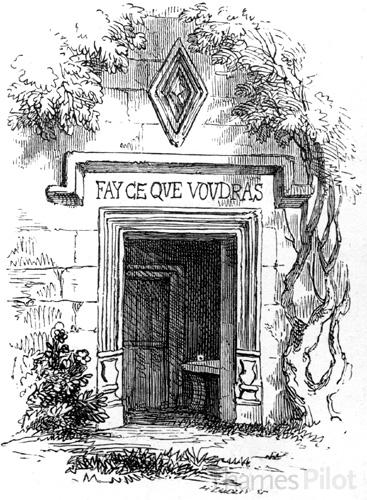
Well as it turns out, one option is to buy an old monastery, expand the cave system underneath, open yourself a well-appointed “garden of lust” with a really cool Latin motto (“Fay Ce Qve Vovdras”...”Do As You Will”), and invite a few of the most powerful men in England...and the Colonies...to join you in heavy drinking and crazy escapades that involve, to give just one example, shipping in prostitutes from London dressed up as nuns for an evening’s entertainment.

Which is exactly what Sir Francis Dashwood did in the village of West Wycombe; just six miles north of London by way of the River Thames.

It was a fabulous situation...the Abbey was secluded, on top of a hill, and shrouded by a grove of trees. The only access to the caves was by boat—and that meant it was possible to hop on a boat in London...and hop off, at the caves, unobserved...and then later, still unobserved, head back home, polite society none the wiser.

The “Monks of Medmenham”, as the group’s members called themselves (they did not call themselves “The Hellfire Club”, legends notwithstanding), did indeed include some of the most important of the English landed gentry (and, it was rumored, some of their wives...): including the Earl of Sandwich, Benjamin Franklin, and the man who will be one of the two focal points of today’s discussion, John Wilkes.

But the thing is, eventually all that romping gets a bit old; and a gentleman again finds himself with time on his hands...

Wilkes was a man with political ambition, and so he set about bribing the local voters to obtain a seat in Parliament...only to find his party tossed out of leadership and into the role of the opposition—which turned out to be perfect for somebody inclined to this sort of humor:

When the Earl of Sandwich, a sometime friend, told him that "you will die either on the gallows, or of the pox," Wilkes said, "That must depend on whether I embrace your lordship's principles or your mistress."

--Jack Lynch, from the article “Wilkes, Liberty, and Number 45”


To take the story further we need to know that King George III (who saw “The Madness of King George”?) chose as his Prime Minister his former “finishing tutor”, John Stuart, the Earl of Bute. The new Earl had quite a personal history of his own; in fact there were questions as to whether the new King’s mother and the new Earl had a personal history of their own.

Another item of shared personal history: the new Earl and Wilkes were both members of the Monks of Medmenham.

The Earl of Bute had a problem getting his program through Parliament, and to overcome his inability to “talk up” his ideas (some suggest he experienced antipathy because he was a Scot...something Gordon Brown might well understand) he published “The Briton”, a newspaper published in London...which saw Wilkes answer with “The North Briton”, which, in a time and place that had no free press, began its very first issue of June 5, 1762, thusly:

The liberty of the press is the birth-right of a Briton, and is justly esteemed the firmest bulwark of the liberties of this country. It has been the terror of all bad ministers; for their dark and dangerous designs, or their weakness, inability, and duplicity, have thus been detected and threwn to the public, generally in too strong and just colours for them long to bear up against the odium of mankind. Can we then be surpriz’d that so various and infinite arts have been employed, at one time entirely to cast aside, at another to take off the force, and blunt the edge, of this most sacred weapon, given for the defence of truth and liberty?


This shot across the bow having been fired; Wilkes proceeded to lay 44 more broadsides into the hull of Government, including this quote from the final “The North Briton”, No. 45, in reference to the Earl’s resignation from Government, and the rumors that he still pulled the strings from behind the scenes:

The Scottish minister has indeed retired. Is his influence at an end? Or does he still govern by the three wretched tools of his power, who to their indelible infamy, have supported the most odious of his measures, the late ignominious Peace, and the wicked extension of the arbitrary mode of Excise? The North Briton has been steady in his opposition to a single, insolent, incapable, despotic minister, and is equally ready, in the service of his country, to combat the triple-headed, Cerberean administration, if the Scot is to assume that motley form.


You cannot talk about the Government in this way without consequences, and...well, we’ll come back to that in a minute.

Before we do, I want you to meet John Entick. Entick began his professional career as a schoolmaster, then an author. He had a bit of an eclectic taste—his first book being a Latin grammar, then a book on theology...and in an ironic twist, he at one point tried to publish an edition of Chaucer. He was also famous for his dictionary.

Entick was as upset by the political situation as Wilkes, and he found his voice in “The Monitor, or the British Freeholder”, which was where he wrote this:

...Now, although he allows, that “These Mixed constitutions [as opposed to absolute monarchy] are the very best, that human wisdom could ever discover for the regulation of human societies; yet that these, though perhaps productive of fewer evils, than either of the other, must necessarily partake of the evils belonging to both, and be supported by more or less violence, as they more or less approach the despotic; or of corruption, as they come nearer to the democratic principles: for corruption must always increase in due proportion to the decrease of arbitrary power; since where there is less power to command obedience, there must be more bribery to purchase it, or there can be no government at all...”


You’ll recall my saying that there would be consequences for selling this sort of thing in King George’s and the Earl of Bute’s England, and here’s where we start getting to the heart of the story.

But not today.

Instead, in a development worthy of Luke and Laura, we’re employing the cliffhanger...so come back in about 36 hours, and we’ll have the King’s messengers roaming the countryside, a spectacular trial or two—and a guy who gets elected to Parliament from his jail cell four times in four months.

And of course, when it’s all over...the United States will have a Fourth Amendment.

Tuesday, February 13, 2007

On Electioneering, Or, Lessons Learned In Unlikely Places

Big Business is the source, if you read in the right places, of All Evil In The World, and as a result, should never be trusted.

The conversation today is designed to suggest that we might derive considerable wisdom from those we challenge, and particularly in the field of electioneering.

Specifically, I’d like to offer wisdom from the world of customer service, and show its application to political campaigns.

Why customer service?

Because politics is, at heart, a customer satisfaction exercise.

Voters are no different than any other customer-they seek association with a product (“Candidate-Brand”); that product, at its best, incorporates an emotional experience that bonds the customer.

Successful campaigns know (incumbents, too-see “constituent service”) each “customer contact” should be treated as a relationship nurturing experience.

In the old days (1990’s?), customer contact meant doorbelling, the rubber chicken circuit (how many Rotary breakfasts are there in America?), and checks-in-the-hand fundraising; supplemented by phone banks and direct mail.

Although the Internet has changed the technology of campaigning, I submit that it has not changed the customer expectation that voters place upon candidates.

With all that in mind, let’s discuss one aspect of the issue: the troll.

For those of you facing trolls n a daily basis in your campaigns, here’s some advice on handling angry customers:

First, from the Federal Government itself, this:

“Make it easy for your customers to complain and your customers will make it easy for you to improve.”

At first this seems counterintuitive, but it makes good sense. If politics is a listening exercise (and it is), then the easier it is to listen, and the more likely voters will feel bonded to the candidate.

To apply this advice to our topic: trollers echo the same themes over and over, but the aggregate of those messages creates a sort of informal list of possible needed responses.

There’s also this: there are those who will visit a site, not to troll, but with a point of view dissimilar to the community’s. These are the potential purple voters that all candidates will need so badly this cycle and beyond.

Embrace them-even if the desire is to “clean up” the community by ignoring them and hoping they’ll go away.

Maybe they won’t be converted, but consider the non-posters who also read these exchanges. They also judge based on how the site makes the candidate appear, and reasonable responses sell purple voters better than unreasonable ones

Gaebler Ventures, a business incubator company, offers this advice to entrepreneurs dealing with angry customers:

“Don't Take It Personally

Emotions run high in situations involving irate customers. Even though the problem may have been out of your control, the customer will likely focus his frustration toward an employee because at that moment the employee represents the company. Avoid the temptation to take the complaint personally. Instead, try to diffuse the emotion of the moment by remaining calm and responding in a reasonable manner”.

Any of this sound familiar?
Trollers are nothing if not irate.
(I told you there was a connection between politics and customer service.)

Here’s more from Vadim Kotelnikov:

“Sadly, mature companies often forget or forsake the thing that made them successful in the first place: a customer-centric business model. They lose focus on the customer and start focusing on the bottom line and quarterly results. They look for ways to cut costs or increase revenues, often at the expense of the customer. They forget that satisfying customer needs and continuous value innovation is the only path to sustainable growth. This creates opportunities for new, smaller companies to emulate and improve upon what made their bigger competitors successful in the first place and steal their customers.”

Substitute the words “Barack Obama” for “new, smaller companies” and the words “policies that fit the voter’s desires” for “continuous value innovation” and we’re on to something here. Candidates have to try to prevent trollers from the beginning by concentrating on identification with the angry, frustrated voter who eventually vents his frustration upon you and your community.

Finally, from Azriela Jaffe, a story of heating ducts, failure, and redemption:

“In late July, 1997 my husband, Stephen and I parted with $250.00 of hard-earned cash to get our home air ducts cleaned… my detail-oriented and frugal husband had inspected each duct with a flashlight to be sure he was getting good value for his money. Good thing he did! Stephen was furious to discover that the ducts hardly looked any cleaner than before… I called the company the next morning and spoke to Jeff, the man who had done the work. Jeff expressed great surprise and concern, and scheduled a return trip to our home the following day… My husband had carefully prepared a list of all of the ducts that were in question, but after glancing at the first one, Jeff replied: "We tried a new way of cleaning ducts at the beginning of this week. Obviously it didn't work. I should have caught that before I left and I didn't. I'm sorry. I will reclean every duct in your house."… He continued: "And to make up for the inconvenience, you can call me every year for the rest of the time you are living in this house. As long as I'm still in business, I'll clean your ducts again for free."

Did providing more than was expected make a customer for life? Probably.
That translates to a voter who will vote for you in this cycle and the next, without much persuasion (budget).

How can a candidate offer a troll more than they expected?

Assign a staff member to personally respond to each one.
Personalize that writer’s concerns.
Get them tickets to an event, or a bobblehead, or something.
Most importantly, try to uncloak the writer.
The less anonymous the writer can be, the less vitriolic the writer will be.

So let’s sum all this up:

There are parallels between customer service and electioneering.

Make it easy to receive complaints-and then listen.

Don’t confuse trollers with those of differing opinions.
Either way, welcome them in.

Remember-non-posters are watching, too. Be nice.

Don’t take it personally.

Remain close to the desires of the electorate-prevent trolling before it starts.

Give more to the troll than they expect.

So that’s it for today.
In closing, just remember: treat the trolls well, and they’ll go away less upset than when they came.

Or at least, you’ll be less upset at them.

And remember-with any luck, and a bit of personal attention, you might turn some votes, and even, possibly, gather a few donations along the way (!)

Best of luck-it’s a long run ahead.

Monday, February 12, 2007

On An Alternative Election Methodology, Or, Is That OJ Stalking Me?

Clinton, Edwards, Hagel, Obama, McCain, Biden, Gravel, Brownbach, Hunter, Giuliani, Kucinich, Tancredo, Romney, Dodd, Vilsak, Savage, Swift, Stanhope.

That’s only a partial list of candidates for President in 2008, and my head already hurts.

I know by the time this is over I’ll be sick and tired of elections, and probably the American electoral system generally.

Anticipating this problem, I have designed an alternative to the current system of elections that I feel has considerable merit.

Consider this:

If my plan is adopted, there will be more than 30 second sound bites defining the candidates.

If my plan is adopted, there will be more voter participation then there is today.

If my plan is adopted, there would be a reason for Tom Tancredo to actually be in this election.

So what’s this great plan?

Presidential Survivor.

Basically the way it works is we take all announced candidates, put them on an island together, and every week the American people, after watching them face some trials, vote one out.

Now here’s where it gets really good.

Today OJ Simpson sits in Florida, idling his days away on a golf course, looking for something to do.

Why waste this valuable American resource?

I say put OJ on the island, and let him stalk the losers-and then help him find the “real” killers afterward.

This plan has advantages.
For example:

The whole thing is easily accomplished with public financing-no more soft money, hard money, illegal money, period.

In fact, ad revenues and DVD sales could theoretically make elections a profit-making enterprise.

The Republican propensity to pick based on “it’s his turn, so let’s nominate Dole" (for 2008, substitute McCain) will be discarded after the first few episodes.

Fringe candidates will be quickly (and permanently) removed from contention, creating a centrist tendency that will serve us well in the future.

The desire to begin the election cycle as soon as the previous one ends will quickly dissipate-or we’ll have two seasons of the show per election cycle. Either way, America wins.

As the candidates dwindle, bipartisanship will flourish.
Other members of the political establishment will see the benefits, and as a result government administration should improve.

There’s even an economic benefit-if the show is based in Louisiana it can assist the redevelopment of the Gulf Coast!

So that’s my plan.

Now here’s my question to the community:

Who do you think will win?

Sunday, February 11, 2007

On The Wild West, Or, Who’s That Blogger?

In the 1870’s, a tall man in a tall hat would ride into town, hitch up his horse, and head to the local saloon.

Maybe he’d find himself at the general store, looking for a job and a grubstake.

Of course, many others staked their land from the back of a Calistoga wagon, or mined a hole in the ground, or panned a river. They ranched. They drove cattle.

Some of them rustled those cattle, and robbed a stagecoach or two, as well.

Put it all together, and you have the Wild West.

This in many ways resembles modern blogging.

As I look around today, I see a blog universe that has grown from individuals writing “my diary” posts, to journalism in the classic sense, to blogging “communities”, whose existence transcends the individuals posting.

It is within that universe of communities that I would like to focus today’s discussion.

A blogging community faces an inherent contradiction from the very start-the desire to advance the community’s objectives versus the freedom of speech that is clearly required if the community is to remain popular and a source of new ideas.

This issue is of particular note if the community is intended to advance a particular purpose-a product or political community, for example.

In my wandering around the Wild Web, I’ve noticed certain “management” issues that have yet to find solutions. Consider these three examples of “stagecoach robberies” that can or have occurred:

Over at BlueNC there’s a conversation ongoing regarding possible planted messages from a supporter of “possible” gubernatorial candidate Richard Moore.

Organized (or disorganized) groups of “shout-downers” (trolls on steroids) with a message opposite of the stated purpose of the community launch attacks that deter others from staying with the community.

The community’s “regulars” can become unwilling to accept the outside interactions that the owners desire

How can these concerns be addressed?

Let’s consider the BlueNC situation first.

Because these communities desire an open membership policy, there doesn’t seem to be an easy “gatekeeping” solution, and you’ll notice the comments among the members of the community reflect this reality.

Vigilance, however, has brought the issue up for comment, and that might turn out to be the most effective solution-to the extent that the connections can be noted.

But what about the “member on member” interactions? And how can the community’s management and owners appropriately respond?

Let’s put it in a political context.

If you are operating a campaign community, you want to have a “guest-friendly” environment, but be open as well. Obviously removing the most “trollish” and intentionally offensive posts is easy enough.

But what about a community that becomes insular?

The campaign is a marathon, and the communities are going to discover that 2 years is a long time to run chat and blog without weariness setting in.

How many times can the same group of regulars face “your candidate sucks!” over and over again without losing the desire to interact with outsiders at all?

This is where we get into new ground.

Obviously new methods of “wrangling the regulars” will have to be developed.

Here are a few quick suggestions:

Use the power of ownership. Consider the creation of “superusers” who are brought closer to the community’s management-maybe even a private chat room.

Create “evangelizing” opportunities for your regulars-for example, as a manager of a D candidate’s community I might challenge the superusers to visit R leaning websites to discuss my candidate, using talking points I develop in conjunction with the superusers.

Constantly remind the community of the ambassadorial and educational functions the candidate is hoping to achieve.

Create fun opportunities as well-anything from personalized gifts to VIP opportunities at various campaign events.

This is going to be a groundbreaking election cycle for the Internet, and a lot of rules are going to be written this time that will set the stage for many elections to come.

So git along, lil’ dogies. There’s a long trail ahead.

Sunday, February 4, 2007

On Being A Candidate ©, Or, The Music Never Stops

It is now becoming a fact of political life that campaigns for National office never end.

Even more importantly, for the purposes of today’s discussion, politicians never seem to leave “campaign mode”-even when not campaigning.

As an example, consider Al Gore. Even though he’s not currently engaged in a campaign, he’s central to the thinking of at least two of the current candidates: Clinton and Edwards.

An even better example, for the purposes of this discussion, is a candidate who has left and then re-entered active politics. This year that candidate is John Edwards.

(Consider that the time he spent away from politics, even if it was done for totally non political reasons, still reinforces his political image.)

In a previous discussion, I questioned whether there might be a place for Party-independent “branding” of “political actors”.

I submit there is such branding already, and that the politician as a “brand” (someone whose identity is managed without consideration of a particular electoral cycle), will become more and more commonplace.

There are a number of Rs and Ds who either drift in or out of Presidential contention (Dole, McCain, Gore) at various times, and those who are positioning themselves for 2008 and/or future runs (Clinton, Obama, Biden, Giuliani, Romney); and I offer each of these as examples of “transelectional” candidates who do or could benefit from having a permanent, well-managed brand identity.

What is a brand?

I submit that a brand is an emotional idea represented by a product (“The Marlboro Man”, “Morning In America”).

Look at how Rudy Giuliani uses this concept-the emotional reaction of his 9/11 response outweighs the discussion of the policies he actually oversaw as mayor, and that “brand identification” is the major reason he is in the Presidential discussion today.

Most candidates do not have historical events to place them in the market’s “emotional consciousness”.

So how can a candidate create a permanent emotional connection to the electoral market?

This brings us to Al Gore and John Edwards.

Both have active website communities, and are clearly benefiting from the Internet. But that really isn’t the answer to anything.

What matters is that they both have active public personae which draw the public to the candidates, and then their communities.

Personae that are based around emotional issues (global climate change, poverty); bringing a human element to both “candidates”. (I include Gore as he may or may not enter this or a future campaign.)

How can we apply this, in a practical way, to the candidates we mentioned above?

Giuliani seems well on his way-he makes “National Security” speaking appearances, and this plays well to the R base.

Hillary also seems to be making a “brand” for herself-concerned working woman with a tough side.

Nancy Pelosi-Mom at work.

McCain-scary old guy who’ll frighten the terrorists into submission.

So where’s Obama’s niche?
How about Horace Greely meets competent technocrat?

He seems to be moving in that direction, and it’s a smart move on his part; all sorts of issues (Social Security/Medicare, “terrorism”, health care, and on and on) appear to have no competent “hand on the tiller”, and the perception of competence could go a long way.

Note that in every case the brand is not associated with a particular election, office, or Party-that the “Candidate-Brands” are designed to exist long past any particular electoral cycle.

Now let’s look to the future:

If I were a politician looking to become a “Candidate-Brand”, what images might still be available for adoption? Here are three, for starters:

America’s Dad.

War hero returns to enter politics.
(Jim Webb is moving in here fast, but if a woman war hero were to emerge that would be a formidable brand indeed.)

Al Franken.

So let’s go one step further.
Let me pose a question to the community, if I may.

The players (and their brands) have probably been identified for the 2008 cycle.

But what about beyond?

Who are the “unbranded” candidates (and current non candidates-think Bloomberg, for example) for 2010 and beyond, and with which brands should they connect?

I’m looking forward to the community’s thoughts.

Thursday, January 25, 2007

On Puppies, Or, Hillary’s Math

 I am constantly reminding everyone who will listen that the centrist leaning; non-Party affiliated voters who occupy the “gap” decide Presidential elections.

All evidence suggests this will again be true in 2008. To take it further, in many constituencies, gap voters will determine Congressional races as well.

Here’s why:

From a risk/reward perspective, changing the minds of the “hard” voters on either side of the electorate through persuasion is often not worth the challenge.

To illustrate the inherent difficulties in moving voters from either fringe, I humbly offer the “Puppy Theory of Political Persuasion”:

1) There is a percentage of the population who will not object if the President were to eat a live puppy on national television, as long as some explanation for the behavior can be provided (“The puppy was a threat to National Security!”).

2) Alternatively, there is a percentage of the population who would not give Mr. Bush credit if he personally ended the Iraq War and cured AIDS, both on the same day (“He’s still in the pocket of Big Oil!”).

Is Clinton also affected by this calculus?

Can we quantify the population at either fringe who find her objectionable beyond all persuasion, or will support her no matter what?

To put it another way, can we put a number to Hillary’s Puppy Factor?

While I don’t feel capable of providing such answers at this time, I do have ideas that could stimulate the analysis.

First, I think the measurement of “non-objectors” (point 1 above) is easier for Mr. Bush than it will be for Clinton. This is because Mr. Bush has seen the enormous drop in his approval ratings over the past 5 years, which have apparently stabilized since about the fall of 2005.

The principal issue driving these numbers, I think we all agree, is Iraq.

Since the news from Iraq has continued to become worse, but the approval rating is basically stable, I submit that we are fairly close to identifying Mr. Bush’s non-objector Puppy Factor as being somewhere around 35%.

Second, there is an additional Puppy Factor, the “non-creditors” (point 2 above), which I submit is more difficult to measure than the non-objectors, unless the candidate being measured can post an upward trend similar to Mr. Bush’s downward measurement.

Should Clinton, or Obama, or others find themselves moving dramatically upward, that measurement, for that candidate, may reveal itself.

Finally, why does all this matter?

If elections are won in the gap, then the larger the gap population, the more likely a centrist candidate can effectively harvest votes from that group. Conversely, a candidate facing a smaller gap will have to harvest from a smaller universe of available votes, a tougher proposition.

Of course, another option in either case is to attempt to attract prior non-voters.

Historically this tends to yield less efficient results than harvesting known voters, which means knowing the Puppy Factor, for these candidates, can provide an indication of how much additional effort they will need to win an election.

This means if the Puppy Factors for candidates are known, each can adjust their efforts in gap outreach for better results. It will also be easier for analysts to evaluate each candidate’s potential electoral success in 2008 and beyond.

The Puppy Factor ©.
America’s newest political metric.
Look for it in an election coming to you soon.


Sunday, January 21, 2007

On Winning, Or, Democrats, Meet Joe Wood

In a recent conversation (“On Shrinking the Tent, Or, Why Third Parties Don’t Elect Presidents These Days”), I posited that the bloc of voters who have drifted away from being reliable supporters of the Democratic and Republican Parties to the middle (I call it the “gap”), are not fertile hunting grounds for a potential alternative party candidate.

History has shown us however, that these voters are often the crucial difference in election after election for established party candidates. To put it in stronger terms, no Democratic Presidential candidate has a chance in winning in 2008 without successfully piloting these waters.

If you are considering running as the Democratic candidate for President in 2008, I humbly offer you the following navigational chart.

I’ve never personally met Joe Wood, but it’s fairly easy to get to know some things about him.

Mr. Wood has a blog on the TPM Café website.
Here’s an entry: http://www.tpmcafe.com/node/28223

From taking the time to read what he says, we can learn the following:

Mr. Wood is quite conservative regarding values and morals issues.
Mr. Wood supports an aggressive national security posture.
Mr. Wood is very comfortable with the commingling of Church and State.
Mr. Wood has opinions strongly at odds with the available, demonstrable facts from time to time.
Most important of all, and the source of his feelings above, I believe, is that the central and defining component of Mr. Wood’s belief system is his faith in the Christian God.

In all these areas Mr. Wood and I hold diametrically opposite positions.
(Except one: frankly, I’m completely wrong about things from time to time, as well.)

Despite all the opposites, Mr. Wood and I have plenty in common:

We both strongly support this ongoing American experiment in Democracy.
We both fear, however, that Government no longer works for all its citizens as it should.
We both want to reduce homelessness, and poverty, and crime.
We both want to breathe clean air and drink clean water.
We don’t like flag covered coffins.
We are both concerned about our economic futures, and those of future generations.
We are both willing to listen to and respect reasoned, cogent, civil argument supported by facts.

What did Bill Clinton do that Al Gore and John Kerry couldn’t that allowed him to grab a decent chunk of the gap?

I submit he spoke to the God in the gap.

That he was willing to go to churches and talk about social justice with passion, and in a way that reminds Christians that Jesus was a social justice crusader.

A big, big, big “L” Liberal.

It worked, too. Twice he was able to keep the core Democratic constituency on board, while grabbing enough of the gap to get over the top.

Never got the universal health care passed, and also missed on other big L social justice reforms; but there’s an argument to be made that winning elections and governing are two different forms of political calculus.

However, I digress.

On how to apply the lesson offered above:

If you want the votes of Evangelical Christians, and other social conservatives, aim for the weak points in the Republican platform.

Have the guts to walk into a megachurch, stand there facing Mr. Wood and the other congregants, look them straight in the eye,
and ask this question:

“What Would Jesus Do?”

If Jesus was President, would He be fighting “the terrorists”, or Islam, or whatever we’re calling it today?
If Jesus was President, wouldn’t He be trying to create an Axis of Love?
If Jesus was President, wouldn’t we be fighting homelessness?
If Jesus was President, would 40,000,000 Americans have no health care?
If Jesus was President, would the number of working families stuck in poverty be increasing or decreasing?
If Jesus was President, wouldn’t His Administration respect His Father’s creation, the Earth, in ways it isn’t respected today?

Maybe these aren’t your exact preferred questions, but the concept is clear: show Christians in the gap that this Administration is as far from Christ-like as you can get.

John Kerry might tell you that if you try this, you’ll get Swiftboated.
So what?
That just means what you’re doing is working.

James Carville might tell you that you absolutely must respond to a Swiftboating in the same news cycle.

The problem with that is you allow the opposition to define your “brand”, and you don’t promote your message.

Here’s another possible approach: call ‘em on their desperation, respond to charges, but at the same time…

…The best defense is a good offense.

Never let the gap forget this Administration’s policies (and presumably, any likely R opponent’s) are less reflective of the Christian belief system than yours.

That the Rs are the moneychangers in the temple.

That your platform, while respecting the separation of Church and State, is still more reflective of the Ten Commandments than your opponent’s.

Remind everyone who will listen that Jesus was a Liberal.
God willing, the opposition calls you one.
Embrace the title with gusto.
Then, once again, remind everyone who will listen that Jesus was a Liberal, too.

Here’s the best part:

While Senator Obama and the Reverend Sharpton have plenty of Jesus cred, and have a sort of “home court advantage” here, you don’t have to be Christian or a religious person of any sort at all, for that matter, to use this strategy.

All you need is respect for Mr. Wood’s point of view, the willingness to engage him in a way that’s compatible with his belief system, and some good ideas that reach for the common ground you and I and Mr. Wood share.

(A side note: if your platform concentrates on the issues above, the strategy also works for Buddhists, Hindus, and followers of Islam; as virtually all the members of those communities also like breathing, good health, a place to live, and food on the table. Bonus!)

I’ll make the last thing I say today the first thing I said today:

Democrats, meet Joe Wood.
You’ll be glad you did.

Friday, January 19, 2007

On Tightening the Tent, Or, Why Third Parties Don’t Elect Presidents These Days

For today’s conversation, let’s discuss why, despite the desire for third parties, independent candidates seem to never really get over the top, why a third party will probably never succeed in actually winning elections, and where this might all lead.

Why third parties, or independent candidates at all, for that matter?

To put it simply, both the Democratic and Republican orthodoxies have decided to “shrink the tent”.

By that, I mean both parties have been directing the largest amount of their efforts lately to retaining certain core constituencies, while ignoring the remaining voters who don’t fit the correct “most likely voter” profile.

It’s easy to see the D’s and R’s playing to their “most likely” supporters, and it’s easy to see the results.

Examples are in order..

Here are two: the World Domination Through Any Means Necessary crowd has an inordinate amount of power in the R camp, and D’s are currently engaged in that crazy DLC v. All Other Democrats and Reality conflict we’ve been observing.

More? How about the “sins of omission”.

Both parties have angry constituencies, who feel ignored: Evangelical Christians want social changes imposed by Government they’ve not yet achieved.

Minorities, social justice and worker’s rights advocates also find themselves frustrated.

If you have ever voted for a candidate only because you hated the other one more (virtually every Presidential election?), you understand the sins of omission.

As has been observed frequently, this creates a big pot of potential voters for the candidate who can fill the empty spot in the middle.

So why don’t the candidates win who try to straddle this gap?
Why can’t third parties thrive?

I suspect a major part of the problem is that the gap is not homogeneous.
That is to say, the gap is populated with disaffected D and R citizens.

People who have common ground, but perhaps only believe the extent of that common ground is their disgust with the change in Government and on their own side.

Consider this list of recent independent Presidential candidates (and hopefuls); you’ll see what I mean:

Ross Perot, John Anderson, Steve Forbes, Barry Commoner, Pat Buchanan, Ralph Nader, Joe Lieberman (just kidding on that last one…At least for the moment I’m kidding.).

There’s potential D or R support for each one of these-but not much D and R support for any of ‘em.

Where are you going with all of this, fake consultant?
Gentle Reader, I’m glad you asked.

I’m suggesting this may be an example of the duality of Zen.

That, ironically, in order for the gap to be fully enabled as a political force, it will have to be diffused, and it’s power diminished, by the formation of not just a third, but also a fourth party.

These “parties”, especially at first, might need to be less tightly bound than the current D and R structures, as they might reasonably be expected to have a fairly fluid connection to potential new candidates/allies/funders “coming in from the cold”, as it were.

Where might this all lead?

Here’s some guesses:

If a fluid 3rd and 4th “party” were to evolve, party conventions, or the immediate run-up period just before might become a sort of “superprimary”, with a second-place finisher and what organization they can grab sliding to the appropriate alternative group. Obviously, this scenario also requires credible alternative candidates willing to bolt.

History, and the list above, suggests they’ll be found.

Any Presidents elected from these parties would have, at best, “challenged” relationships with D’s and R’s in Congress. This suggests a “Great Communicator/Fireside Chat” sort of an approach might be needed to attempt to influence Members through the voters in their districts.

If such “New Coke” parties were successful, would the “Classic Coke” D and R management be willing to change to recover these voting blocs?

My guess, especially on the R side, is no. More likely you would see either a sort of eternal scorched-earth campaign, to the detriment of most, or all, of the participants; or a repeat of the Reform Party situation.

The fly in the ointment here is the ability of alternative candidates to get on the ballot in 50 states. Any alternative parties, therefore, would have to depend on getting the “threshold” level of votes required in each state that guarantee a presence on the next ballot.

The only Party I’ve seen that succeeds in meeting the threshold consistently is Libertarian, and I don’t view them as the sort of “fluid” party we’re discussing here. (For fans of “The Right Stuff” I’d suggest that being on the ballot even precludes the “No bucks, no Buck Rogers” conversation.)

For reasons discussed above, the role of the Internet will continue to be explored by candidates and parties.

The currently unknown question of whether a political community can be sustained between Presidential elections would have to be addressed.
Would such a community run Congressional candidates?

A final two questions:

Keeping all this in mind; how might Mc Cain, Edwards, Obama, HRC, and players currently unknown work this dynamic?

The concept of branding, in a political context, has until now been used only by the existing Parties.

Might there be a place for Party-independent branding of political actors?