advice from a fake consultant

out-of-the-box thinking about economics, politics, and more... 

Thursday, July 24, 2008

On Extraordinary Awards, Or, Wounded Troops, Wounded Again

We come together today to discuss one of the more disturbing things that the Administration has done recently…and for a President who claims he “supports the troops”, this story is even more disturbing than usual.

It has his fingerprints all over it, however: laws ignored, rules rendered irrelevant, secrets kept from those who need to know—and ultimately, the cost of his bad decisions are being borne by those who have already paid about a high a price as could be possible in the service of this Nation.

Follow along, my friends, and I will treat you to a magic trick: one in which “Support The Wounded Troops” magically becomes “Screw The Wounded Troops” right before your very eyes…and while you probably won’t feel like applauding at the end, it’s nonetheless a trick you don’t want to miss.

We hear, from time to time, of people who receive very large cash awards for injuries—and while the amounts of money may seem exceptional, we also realize that these are people who will have exceptional burdens in the future.

These burdens are most exceptional when they are borne by soldiers in the field who are wounded in the service of the United States, and the Department of Veterans Affairs (the DVA) will, from time to time, provide “extraordinary awards” to wounded servicemembers. These awards either exceed $250,000 or are retroactive eight years or more…or both.

Until recently, DVA Regional Offices had the authority to issue such awards, and they did so with some regularity. These cases might arise, of course, because the severity of an injury causes the permanent inability of someone to ever return to gainful employment…or they might arise because newly accepted information has made a veteran (or a class of veterans) eligible for retroactive benefits that the DVA chose not to award in the past. The Agent Orange veterans fall into such a category.

The authority for the DVA’s rules and regulations is Title 38 of the US Code; the controlling rules and regulations themselves are found in Chapter 38 of the Code of Federal Regulations. It’s all well understood law with a clear application, decision, and appeals process.

It is unusual law, as well, in that the DVA has a “duty to assist” those who might have a claim in their efforts to convince the DVA to give them the award they seek. The claims system is supposed to be nonadversarial; however, the American Bar Association feels that the system does not fit that description today.

In what must have been an effort to prove the ABA correct, the DVA’s Compensation and Pension Service sent out a “fast letter” in August of 2007 requiring the Regional Offices to submit, for their approval, all “extraordinary awards”. The letter outlined a new approach for this type of review:

…Do not offer these rating decisions to any veteran’s representative for review until the C&P Service makes a final determination regarding the propriety of the decision…

… If the C&P Service concurs with the VSC [Veterans Service Center, meaning “the local office”] decision, the veteran’s representative (if applicable) will then be allowed to review the decision prior to its promulgation…

…If the C&P Service determines the decision is improper, it will provide specific corrective action.

--from the “fast letter” of August 27, 2007 (emphasis from the original)


In a letter that appears to have produced by some sort of stenographically inclined circus clown (I’m not kidding…check the link) the DVA acknowledges to Congressman Mike Thompson (CA-1) that the new reviews have caused 91 of 494 cases to be rejected for reasons that are unknown to the claimants…reviews that were conducted by the C&P Service without any opportunity for the claimants to provide input or participate in the process.

The reason we know about all this is because one veteran, Steven G. Stratford, has begun to push back—and also because of Larry Scott’s VA Watchdog dot Org website, which has been following this story for nearly a year now.

Stratford has presented to the Court of Appeals for Veterans Claims a request for a Writ of Mandamus (mandamus is found today in the word “mandate”…and a Writ of Mandamus mandates a governmental agency to act in a certain manner) that would:

…order Respondents [the DVA] to immediately rescind the unconstitutional “extraordinary award” scheme and fully restore all illegally confiscated entitlements and awards.


Unconstitutional, did you say?

As it turns out, yes.

No person shall be held to answer for a capital, or otherwise infamous crime, unless on a presentment or indictment of a Grand Jury, except in cases arising in the land or naval forces, or in the Militia, when in actual service in time of War or public danger; nor shall any person be subject for the same offence to be twice put in jeopardy of life or limb; nor shall be compelled in any criminal case to be a witness against himself, nor be deprived of life, liberty, or property, without due process of law; nor shall private property be taken for public use, without just compensation.

--The Fifth Amendment to the US Constitution


The “due process” guaranteed by the Fifth Amendment entitles the veteran to a fair appeals process, not a “double secret probation” kind of process; and the benefits for which a veteran is qualified are a property right guaranteed by the “takings clause” of the Fifth Amendment.

The story of Steven Stratford and his battle with the DVA is amazing in itself.

Stratford was a Vietnam veteran of the Air Force, and he has been at this since 1987, when he filed a claim for post-traumatic stress disorder (PTSD) which was denied twice, in 1997 and 2003. On both occasions the Court of Appeals for Veterans Claims ordered the DVA to rethink the decision…which they did, the San Diego VA Regional Office agreeing in May of 2007 that Stafford was entitled to an award retroactive to 1987.

The very next month the C&P Service began creating a new review procedure, which was announced in the “fast letter” we discussed above. No “rulemaking” was associated with the new review procedure—and no claimant was informed as to the C&P Service’s new plans.

Just before Halloween of 2007 a new decision was issued again denying the claim—it was decided the PTSD was not service-related after all, despite the DVA’s own reports earlier in the year that it was. The two reports that sided with Stratford were noticeably absent from the discussion, it is reported.

To this day the DVA refuses to allow Stratford access to his own files…and Statford’s attorney tells the Court in the application for the Writ that the DVA remains unable to provide any statutory or regulatory authority authorizing the new review process.

Stafford’s not the only one in this fight, either. Veterans For Common Sense and Veterans United For Truth are also seeking to “enjoin” the DVA (through an injunction) to follow their own Mental Health Strategic Plan, to provide immediate care for veterans who present at VA facilities with “suicidal intentions”, and, if the Order as proposed were to be adopted:

“…Defendants are hereby enjoined from applying or taking any administrative action to enforce the provisions of the Extraordinary Awards Procedure…

… Within 90 days of this Order, Defendants shall establish a comprehensive remedial plan to develop and implement procedures to satisfy the requirements of the Due Process Clause, including a right to retain paid counsel, steps to insure the availability of pre-decisonal hearings at the Regional Office adjudication level, and the readjudication of all SCDDC claims where Regional Office grant amounts or retroactive awards were reduced as a result of the Extraordinary Awards Procedure…”


And for the moment, that’s all we know, as both cases are before the courts awaiting decisions.

So that’s the story: we send people overseas to go into harm’s way on our behalf, they suffer injuries and we deny them compensation for years…sometimes even decades…and when they finally do prevail, the DVA introduces a secret new “star chamber” to keep the deck stacked against the veterans.

Unfortunately for the DVA, they may have returned injured—but they also returned as fighters…and if the courts grant the requests, we’ll see a major victory for veterans…and if that happens, maybe this Administration actually will support the troops for once.

Now that’s a magic trick I would applaud.

Saturday, July 19, 2008

On Imperfect Choices, Or, Jesus Ain't Running

A question has come across my inbox today, and as I am wont to do I began to answer my email friend (who I’ve known, by the way, since we both posted on the John Edwards blog). More or less 100 words into the reply it occurred to me that this was a question best answered in front of a larger audience.

The question? My friend is having trouble committing to Obama.

Why? I’m paraphrasing, but it would be fair to say that the sudden emergence of Obama’s “handlers” was a factor...and although it’s not in the note, I suspect the fact that Obama has “tacked to the center” recently on various issues is part of the problem as well.

It’s a great question...and in an effort to provide a great answer I’m going to offer a few words of my own—and then I thought we might reach back a bit into history and see if there might be something we can learn.

Having come to the metaphorical tee and taken the first shot, let’s head down the fairway and see where that ball might be...and where we can get it to go.

Our good friends at Democracy for America have been running “Night School” for those seeking to learn about the campaign process from the inside, and just a couple nights ago we held a training on “The Political Mind”, with George Lakoff leading the discussion.

Professor Lakoff talked about how to frame a discussion; and I’m going to see if I can apply some of what I learned in the response I offer here.

The question “should I vote for Obama, despite his imperfections?” which is the question I was asked, does not correctly frame the discussion...so allow me to offer a question from an alternative “framing”:

The real question you have to ask is which of the two candidates that might actually win—McCain or Obama—is less flawed than the other?

There will be no perfect candidates—now or ever...and waiting for the perfect candidate to support is guaranteed to lead to disillusionment every time.

To put it bluntly: Jesus ain’t running...and absent any other Deities appearing on the electoral horizon, perfection seems unattainable.

Between McCain and Obama, the choice gets quite simple.

McCain talks about military tactics, Obama talks about military strategy.

Obama talks about the ecomony, McCain talks about how his economic spokesman, Phil Gramm, the guy who wrote McCain’s economic policy, doesn’t speak for him on the economy.

For more McCain...issues...or, issues...or, ummm, issues, or just the fact that he, for some reason, hates Martin Luther King Day, check the Web.

Now for a bit of encouraging history.

We elected a President once before who was far from the President he became—a pro-business candidate who did not support the abolition of slavery, but instead a compromise leading to the gradual phase-out of the practice...something that was already occurring in the North.

“...You suggest that in political action now, you and I would differ. I suppose we would; not quite as much, however, as you may think. You know I dislike slavery; and you fully admit the abstract wrong of it. So far there is no cause of difference. But you say that sooner than yield your legal right to the slave -- especially at the bidding of those who are not themselves interested, you would see the Union dissolved. I am not aware that any one is bidding you to yield that right; very certainly I am not. I leave that matter entirely to yourself.

I also acknowledge your rights and my obligations, under the constitution, in regard to your slaves. I confess I hate to see the poor creatures hunted down, and caught, and carried back to their stripes, and unrewarded toils; but I bite my lip and keep quiet. In 1841 you and I had together a tedious low-water trip, on a Steam Boat from Louisville to St. Louis. You may remember, as I well do, that from Louisville to the mouth of the Ohio, there were, on board, ten or a dozen slaves, shackled together with irons. That sight was a continued torment to me; and I see something like it every time I touch the Ohio, or any other slave-border. It is hardly fair for you to assume, that I have no interest in a thing which has, and continually exercises, the power of making me miserable. You ought rather to appreciate how much the great body of the Northern people do crucify their feelings, in order to maintain their loyalty to the Constitution and the Union...”

--From a letter to Joshua Speed, August 24, 1855


And there was division from those in his own Party who were not inclined to make deals on the moral issues he was willing to make compromises upon:

“In the interior of the country, the cities as well as the rural districts, I found the people much more unanimous. The panic has not been felt so severely there, and the political feelings of the people are less controlled by mercenary motives. While some politicians in the large cities were somewhat inclined to smooth the difficulty over by a compromise, the Republican masses in the country are just as strongly and uncompromisingly opposed to anything that would look in the least like a lowering of the Republican standard.

I was in western New York when Thurlow Weeds compromise articles came out and when it was rumored that Seward was preparing to make a compromise speech. The feeling was very intense every where, Thurlow Weed's propositions were generally condemned, and I have heard the most conservative and moderate Republicans say, that Seward could not yield a single inch of ground without destroying himself and forfeiting forever the confidence of his friends.

What I have seen and heard, not only in New York, but in Pennsylvania and New England also, forces the conviction upon my mind, that every serious attempt on the part of the Republicans in Congress, to patch up a compromise by yielding a single one of the principles of the Chicago platform, will inevitably result in the immediate disruption of the Republican party. It turns out again what I have observed quite frequently, that as far as courage and consistency are concerned, the rank and file are far ahead of their leaders.”

--From a letter written by Carl Schurz, December 18, 1860

This candidate wanted a bi-partisan Administration...and that wasn’t making the Party faithful happy, either:

“...We have now a still higher issue -- a higher duty -- the preservation of the Republic itself! We must not "back down" -- we can make no compromise with traitors, but we can, and I think we must now, as we did in 1854-5, ignore all other issues for the time being, and invite the co-operation of men of all parties in putting down treason. The enemies of the Republic appear to be fearfully numerous, and to prevent accessions to their ranks, the friends of the Union must evrywhere become united.

To accomplish this, I beg respectfully to suggest, whether it may not be necessary to organize the administration different from what your friends, under other circumstances would have expected -- to exclude men, however worthy or prominent, who would be objectionable to the friends of the Union in other parties?

In Ohio, I am quite sure that no man would be more [accessable?] in this view, than Thomas Ewing. All parties regard him as by far most able man in the State. For the firmness and courage exhibited by him in cabinet of President Taylor, he is admired, and would be trusted by all reasonable anti slavery men. I have been intimately accquainted with him for many years, and am satisfied that upon all important public questions, his opinions do not differ from yours. While it is true that he has not professed to be a Republican, I know that he has...acted with no other party -- has voted for Republicans or not voted at all...”

--From a letter written by Thomas C. Jones, December 24, 1860


And from that highly controversial candidacy, we got Abraham Lincoln.

So what am I trying to say?

Politics is a process made up of humans.
All humans are flawed.
Therefore, we will never have a perfect candidate.
We will have to settle.

In choosing between McCain and Obama, ask yourself: who is going to be your best candidate...who is more likely to get you to the place you want to be on the issues that matter to you—and just like the SATs, there may not be a perfectly correct answer...instead, you may have to choose the “most correct answer”.

Thursday, July 17, 2008

Dean To Visit Crawford, Texas...Bloggers Close Behind

In a bit of news that can only be described as poetic, Howard Dean plans to start registering voters this morning at the Crawford, Texas, Community Center, according to a press release that came across my inbox last evening.

According to the press release, he should be out in the parking lot at 8:45 local time...which is just about now.

Dean, we are told, will be joined by Representative Jim Dunnam and McLennan County Democratic Chair John Cullar.

Later today, Dean has a similar event planned for Austin, where he will also be giving a keynote address at the Netroots Nation Convention.

Here's the link, courtesy of PR Newswire.

Wednesday, July 16, 2008

On The Weird Twists Of History, Part Two, Or, Why We Have A Fourth Amendment

Those who are coming to this story today have jumped into the middle of quite a tale. I put myself in a tough position last time by promising to link a British “garden of lust”, Benjamin Franklin, and 18th Century bloggers into a narrative that concludes with the nascent United States of America and its shiny new Fourth Amendment.

So far, amazingly enough, I’m pulling it off.
If you need to catch up, here’s what’s been going on:

When last we met...it was in a world of scandal and intrigue; with King George III and the Earl of Bute (and of course, their assorted minions) very upset with John Entick, author, and John Wilkes, author and world-class raconteur (and drinking buddy to Franklin), because they had the temerity to...well, blog.

The Earl of Bute had taken so much abuse from the Johns that he had been forced to resign from his position as Prime Minister...leaving the minions under his control, many said, only now from behind the scenes.

Something needed to be done...and when you have minions, you put them to use.

In 1762, as the influence of “The Monitor” continued to grow, George Montague Dunk, the Second Earl of Halifax (and a member of the Privy Council) and the highest ranking minion available, issued the King’s Chief Messenger, Nathan Carrington, a general search warrant ordering him to:

“...make strict and diligent search for [Entick], mentioned in the said warrant to be the author, or one concerned in the writing of several weekly very seditious papers intitled, "The Monitor or British Freeholder, No 357, 358, 360, 373, 376, 378, and 380, London, printed to J. Wilson and J. Fell in Paternoster Row," containing gross and scandalous reflections and invectives upon his majesty’s government, and upon both Houses of Parliament, and him the plaintiff having found, to seize and apprehend and bring together with his books and papers in safe custody before the earl of Halifax to be examined concerning the premisses, and further dealt with according to law...”

--From the report of Entick v. Carrington, 19 Howell’s State Trials 1030 (1765)


A four hour search was conducted of Entick’s home, and all his books and papers were carried away to be examined in an effort to prove that the charges of seditious libel (essentially, speaking out against the King) were valid.

In what has become one of the most important trials in British legal history—and ours—John Entick sued the messenger, literally, claiming that any general search warrant is inherently invalid, that Carrington should have known this, and that Carrington never should have relied upon the authority of Lord Halifax to permit the search.

If Entick had been trespassed upon, then the papers seized were inadmissible; and that meant Entick could not be convicted of seditious libel. Here’s how Entick’s lawyer put it, again according to Howell’s:

“...As to the second. A power to issue such a [general] warrant as this is contrary to the genius of the law of England; and even if they had found what they searched for, they could not have justified under it. But they did not find what they searched for, nor does it appear that the plaintiff was the author of any of the supposed seditious papers mentioned in the warrant; so that it now appears that this enormous trespass and violent proceeding has been done upon mere surmise.

But the verdict says, such warrants have been granted by secretaries of state ever since the Revolution. If they have, it is high time to put an end to them; for if they are held to be legal, the liberty of this country is at an end. It is the publishing of a libel which is the crime, and not the having of it locked up in a private drawer in a man’s study. But if having it in one’s custody was the crime, no power can lawfully break into a man’s house and study to search for evidence against him. This would be worse than the Spanish inquisition; for ransacking a man’s secret drawers and boxes, to come at evidence against him, is like racking his body to come at his secret thoughts...

... But it is said, if the secretary of state has power to commit, he has power to search, etc. as in the case of stolen goods. This is a false consequence, and it might as well be said he has a power to torture.”


We need to take a moment to discuss the meaning of a general warrant—and all of a sudden we get to the part where our very own Fourth Amendment enters the story. Rather than tackling the legal issue myself, I’ll quote from the United States Supreme Court’s ruling in Stanford v. Texas, 379 U.S. 476 (1965), a seized books case:

“...The petitioner has attacked the constitutional validity of this search and seizure upon several grounds. We rest our decision upon just one, without pausing to assess the substantiality of the others. For we think it is clear that this warrant was of a kind which it was the purpose of the Fourth Amendment to forbid - a general warrant...

The Fourth Amendment provides that "no Warrants shall issue, but upon probable cause, supported by Oath or affirmation, and particularly describing the place to be searched, and the persons or things to be seized."

These words are precise and clear. They reflect the determination of those who wrote the Bill of Rights that the people of this new Nation should forever "be secure in their persons, houses, papers, and effects" from intrusion and seizure by officers acting under the unbridled authority of a general warrant. Vivid in the memory of the newly independent Americans were those general warrants known as writs of assistance under which officers of the Crown had so bedeviled the colonists.

The hated writs of assistance had given customs officials blanket authority to search where they pleased for goods imported in violation of the British tax laws. They were denounced by James Otis as "the worst instrument of arbitrary power, the most destructive of English liberty, and the fundamental principles of law, that ever was found in an English law book," because they placed "the liberty of every man in the hands of every petty officer."

The historic occasion of that denunciation, in 1761 at Boston, has been characterized as "perhaps the most prominent event which inaugurated the resistance of the colonies to the oppressions of the mother country. `Then and there,' said John Adams, `then and there was the first scene of the first act of opposition to the arbitrary claims of Great Britain. Then and there the child Independence was born.'"

What is significant to note is that this history is largely a history of conflict between the Crown and the press. It was in enforcing the laws licensing the publication of literature and, later, in prosecutions for seditious libel that general warrants were systematically used in the sixteenth, seventeenth, and eighteenth centuries. In Tudor England officers of the Crown were given roving commissions to search where they pleased in order to suppress and destroy the literature of dissent, both Catholic and Puritan. In later years warrants were sometimes more specific in content, but they typically authorized the arrest and search of the premises of all persons connected with the publication of a particular libel, or...the arrest and seizure of all the papers of a named person thought to be connected with a libel

Two centuries have passed since the historic decision in Entick v. Carrington, almost to the very day. The world has greatly changed, and the voice of nonconformity now sometimes speaks a tongue which Lord Camden might find hard to understand. But the Fourth and Fourteenth Amendments guarantee to John Stanford that no official of the State shall ransack his home and seize his books and papers under the unbridled authority of a general warrant - no less than the law 200 years ago shielded John Entick from the messengers of the King.”


And in fact Carrington did lose the lawsuit to Entick. This, from the ruling in Entick v Carrington, 95 Eng. Rep. 807 K.B. (1765):

“...our law holds the property of every man so sacred, that no man can set his foot upon his neighbour's close without his leave; if he does he is a trespasser, though he does no damage at all; if he will tread upon his neighbour's ground, he must justify it by law. The defendants have no right to avail themselves of the usage of these warrants since the [Glorious] Revolution [of 1688], and if that would have justified them they have not averred it in their plea, so it could not be put, nor was in issue at the trial; we can safely say there is no law in this country to justify the defendants in what they have done; if there was, it would destroy all the comforts of society; for papers are often the dearest property a man can have...

... The great end, for which men entered into society, was to secure their property. That right is preserved sacred and incommunicable in all instances, where it has not been taken away or abridged by some public law for the good of the whole...By the laws of England, every invasion of private property, be it ever so minute, is a trespass. No man can set his foot upon my ground without my license, but he is liable to an action, though the damage be nothing; which is proved by every declaration in trespass, where the defendant is called upon to answer for bruising the grass and even treading upon the soil. If he admits the fact, he is bound to show by way of justification, that some positive law has empowered or excused him....”


So Entick won.
But what about Wilkes?

Well, the “triple headed, Cerebrean” Government Wilkes referenced in “The North Briton” No. 45 prosecuted him for seditious libel as well, using another general search warrant to effect the seizure of evidence.

Wilkes was able to prevail at trial by invoking his Parliamentary immunity from arrest on libel charges. Quoting Wilkes, describing the still-upcoming trial:

[The case will] "teach ministers of arbitrary principles, that the liberty of an English subject is not to be sported away with impunity, in this cruel and despotic manner...[and also] "determine at once whether English liberty be a reality or a shadow."


Then Wilkes returned the favor—figuratively “suing the messenger” in the second of our illegal warrant blockbusters, Wilkes v. Wood, 98 Eng. Rep. 489 (1763)
.
In fact, he’s the one who sued first...and based on the events of his trial, Entick filed the lawsuit against Carrington that we just discussed. A few words from the report of the trial:

“...Serjeant Glynn [defense counsel], then enlarged fully, on the particular circumstances of the case, but remarked that the case extended far beyond Mr. Wilkes personally, that it touched the liberty of every subject of this country, and if found to be legal, would shake that most precious inheritance of Englishmen. In vain has our house been declared, by the law, our asylum and defence, if it is capable of being entered, upon any frivolous or no pretence at all, by a Secretary of State...

That of all offences that of a seizure of papers was the least capable of reparation; that, for other offences, an acknowledgement might make amends; but that for the promulgation of our most private concerns, affairs of the most secret personal nature, no reparation whatsoever could be made. That the law never admits of a general search-warrant. That in France, or Spain, even in the Inquisition itself, they never delegate all infinite power to search, and that no magistrate is capable of delegating any such power...”


And a few words from the Lord Chief Justice in his verdict:

“...When we consider the persons concerned in this affair, it ceases to be an outrage to Mr. Wilkes personally, it is an outrage to the constitution itself...

Secretary Williamson, in Charles the Second’s time, for backing an illegal warrant, was sent to the Tower by the House of Commons. The jury, he observed, had no such power to commit; he knew it well; but, for his part, he wished they had, as he was persuaded they would exercise it, in the present case, as it ought to be...”


The Government response to their defeat?
To prosecute Wilkes for a very, very naughty joke indeed.

It turns out that back in the crazy Monks of Medmenham days Wilkes...apparently...co-authored an exceptionally ribald book called “An Essay on Woman”, a parody of Alexander Pope’s “Essay on Man”...and here was a chance to strike back at Wilkes...if only the annoying immunity thing wasn’t in the way.

So he was promptly thrown out of Parliament, and then charged with blasphemous libel. He immediately fled the country, spending four years in exile.

Now here’s the good part: Wilkes decided to return, because, despite his outlaw status, he had been elected to Parliament (again) in April 1768. He was the subject of riots in the nights following his surrender; and it is reported that 11 persons were killed as a result of the public outcry over his imprisonment. (Matter of fact, it’s also reported that the anger over the issues surrounding Wilkes’ arrest was so profound that it reached across the Atlantic...so profound that the cities of Wilkes-Barre, Pa., and Wilkesboro, N.C. bear his name.)

A political party, the Wilkites, had sprung up...and so had the Government’s anger over Wilkes’ status, which led to his second expulsion from Parliament, on February 3, 1769. On February 16th, he was reelected—and expelled the next day. Exactly one month later...the voters did it again—and so did Parliament.

The score so far?
The British Parliament, 3; The British Voters, 0.

Round four again went to Wilkes, again temporarily—this time by a vote of 1,143 to 296.

In a move reminiscent of the 2000 US Presidential election, Parliament promptly awarded the seat to Wilkes’ opponent, Colonel Henry Lawes Luttrell.

All the while he was still in prison...and while still in prison he was elected an Alderman of London...then he was released...then, ironically, elected Sheriff...then, in 1774, in a move Ken Livingstone could surely appreciate, he was elected Lord Mayor of London—and then finally (fifth time’s the charm!) he was returned to Parliament....and this time they let him stay, which he did for another 16 years.

So remember, roughly 3500 words ago, when I said in Part One that I could draw a direct line between all of this and the FISA debate today and its impact on the Fourth Amendment?

Well, I’m not going to do it.
Instead, I’ll again let the United States Supreme Court address the question, which they do with great eloquence in Stanford v Texas:

"...As MR. JUSTICE DOUGLAS has put it, "The commands of our First Amendment...(as well as the prohibitions of the Fourth and the Fifth) reflect the teachings of Entick v. Carrington, supra. These three amendments are indeed closely related, safeguarding not only privacy and protection against self-incrimination but `conscience and human dignity and freedom of expression as well...

In short, what this history indispensably teaches is that the constitutional requirement that warrants must particularly describe the "things to be seized" is to be accorded the most scrupulous exactitude when the "things" are books, and the basis for their seizure is the ideas which they contain...No less a standard could be faithful to First Amendment freedoms.

The constitutional impossibility of leaving the protection of those freedoms to the whim of the officers charged with executing the warrant is dramatically underscored by what the officers saw fit to seize under the warrant in this case...”


And that’s the crux of the argument over the FISA compromise.

Should the protection of freedom from warrantless wiretapping “be accorded the most scrupulous exactitude when the "things" are”...not books, but communications?

When we see how wide a net the warrantless wiretapping program cast, does it teach us a lesson about the “constitutional impossibility of leaving the protection of those freedoms to the whim of the officers charged with executing the warrant”?

And of course, when the Fourth Amendment is endangered, can the First or the Fifth be safe?

Well, it’s been a long journey, Gentle Reader...but we are at the end.

We began this trip in a garden of lust...then we met two 18th Century bloggers...we found ourselves caught up in the struggle over general warrants (which sound mighty familiar in the “warrantless wiretap” context)...and then two extremely important trials...and then the connection between the names of some of our cities and Wilkes...and finally, as I promised, we drew a straight line between the distrust of an overly intrusive Government and our own demands for freedom...which are today again under attack.

The circle has been closed, and with that, I bid you good day.

Monday, July 14, 2008

On The Weird Twists Of History, Part One, Or, Why We Have A Fourth Amendment

This may be one of the strangest tales I have ever brought to the table, Gentle Reader, and yet one of the most fundamental in describing the birth of our Bill of Rights...and most especially the Fourth Amendment.

As many of you know, the new FISA compromise may or may not allow warrantless wiretapping of American citizens on a wholesale scale.

Something you may not know is that a similar debate raged in England (centered around the right of Government to seize the papers of whomever they chose, and use the papers as evidence against those persons) during the reign of King George III—or that it involved scandalous sexual behavior, Benjamin Franklin, the 18th Century version of blogging, and two men who decided to take on the corruption of the Crown...and won.

And because of all that, we have a Fourth Amendment today.

Ready for a tale of liberty and ribaldry?
Then let’s plunge right in, shall we?

So you live in 18th century England, you’re rich...and kind of bored.
What is a gentleman to do?

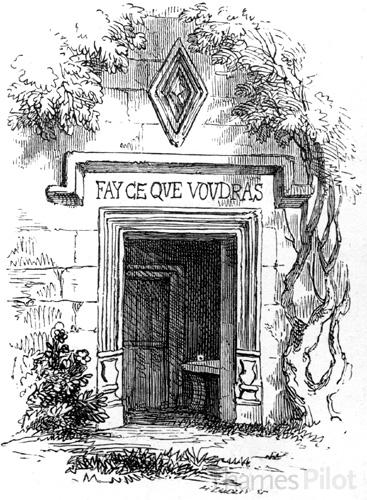
Well as it turns out, one option is to buy an old monastery, expand the cave system underneath, open yourself a well-appointed “garden of lust” with a really cool Latin motto (“Fay Ce Qve Vovdras”...”Do As You Will”), and invite a few of the most powerful men in England...and the Colonies...to join you in heavy drinking and crazy escapades that involve, to give just one example, shipping in prostitutes from London dressed up as nuns for an evening’s entertainment.

Which is exactly what Sir Francis Dashwood did in the village of West Wycombe; just six miles north of London by way of the River Thames.

It was a fabulous situation...the Abbey was secluded, on top of a hill, and shrouded by a grove of trees. The only access to the caves was by boat—and that meant it was possible to hop on a boat in London...and hop off, at the caves, unobserved...and then later, still unobserved, head back home, polite society none the wiser.

The “Monks of Medmenham”, as the group’s members called themselves (they did not call themselves “The Hellfire Club”, legends notwithstanding), did indeed include some of the most important of the English landed gentry (and, it was rumored, some of their wives...): including the Earl of Sandwich, Benjamin Franklin, and the man who will be one of the two focal points of today’s discussion, John Wilkes.

But the thing is, eventually all that romping gets a bit old; and a gentleman again finds himself with time on his hands...

Wilkes was a man with political ambition, and so he set about bribing the local voters to obtain a seat in Parliament...only to find his party tossed out of leadership and into the role of the opposition—which turned out to be perfect for somebody inclined to this sort of humor:

When the Earl of Sandwich, a sometime friend, told him that "you will die either on the gallows, or of the pox," Wilkes said, "That must depend on whether I embrace your lordship's principles or your mistress."

--Jack Lynch, from the article “Wilkes, Liberty, and Number 45


To take the story further we need to know that King George III (who saw “The Madness of King George”?) chose as his Prime Minister his former “finishing tutor”, John Stuart, the Earl of Bute. The new Earl had quite a personal history of his own; in fact there were questions as to whether the new King’s mother and the new Earl had a personal history of their own.

Another item of shared personal history: the new Earl and Wilkes were both members of the Monks of Medmenham.

The Earl of Bute had a problem getting his program through Parliament, and to overcome his inability to “talk up” his ideas (some suggest he experienced antipathy because he was a Scot...something Gordon Brown might well understand) he published “The Briton”, a newspaper published in London...which saw Wilkes answer with “The North Briton”, which, in a time and place that had no free press, began its very first issue of June 5, 1762, thusly:

The liberty of the press is the birth-right of a Briton, and is justly esteemed the firmest bulwark of the liberties of this country. It has been the terror of all bad ministers; for their dark and dangerous designs, or their weakness, inability, and duplicity, have thus been detected and threwn to the public, generally in too strong and just colours for them long to bear up against the odium of mankind. Can we then be surpriz’d that so various and infinite arts have been employed, at one time entirely to cast aside, at another to take off the force, and blunt the edge, of this most sacred weapon, given for the defence of truth and liberty?


This shot across the bow having been fired; Wilkes proceeded to lay 44 more broadsides into the hull of Government, including this quote from the final “The North Briton”, No. 45, in reference to the Earl’s resignation from Government, and the rumors that he still pulled the strings from behind the scenes:

The Scottish minister has indeed retired. Is his influence at an end? Or does he still govern by the three wretched tools of his power, who to their indelible infamy, have supported the most odious of his measures, the late ignominious Peace, and the wicked extension of the arbitrary mode of Excise? The North Briton has been steady in his opposition to a single, insolent, incapable, despotic minister, and is equally ready, in the service of his country, to combat the triple-headed, Cerberean administration, if the Scot is to assume that motley form.


You cannot talk about the Government in this way without consequences, and...well, we’ll come back to that in a minute.

Before we do, I want you to meet John Entick. Entick began his professional career as a schoolmaster, then an author. He had a bit of an eclectic taste—his first book being a Latin grammar, then a book on theology...and in an ironic twist, he at one point tried to publish an edition of Chaucer. He was also famous for his dictionary.

Entick was as upset by the political situation as Wilkes, and he found his voice in “The Monitor, or the British Freeholder”, which was where he wrote this:

...Now, although he allows, that “These Mixed constitutions [as opposed to absolute monarchy] are the very best, that human wisdom could ever discover for the regulation of human societies; yet that these, though perhaps productive of fewer evils, than either of the other, must necessarily partake of the evils belonging to both, and be supported by more or less violence, as they more or less approach the despotic; or of corruption, as they come nearer to the democratic principles: for corruption must always increase in due proportion to the decrease of arbitrary power; since where there is less power to command obedience, there must be more bribery to purchase it, or there can be no government at all...”


You’ll recall my saying that there would be consequences for selling this sort of thing in King George’s and the Earl of Bute’s England, and here’s where we start getting to the heart of the story.

But not today.

Instead, in a development worthy of Luke and Laura, we’re employing the cliffhanger...so come back in about 36 hours, and we’ll have the King’s messengers roaming the countryside, a spectacular trial or two—and a guy who gets elected to Parliament from his jail cell four times in four months.

And of course, when it’s all over...the United States will have a Fourth Amendment.

Friday, July 11, 2008

A Fake Consultant Exclusive: “All Suspicious Persons Will Be Monitored."

Many words have been proffered regarding the FISA bill this week, and I was actually preparing an analysis of the events when, to my surprise, I received an email that made me alter my schedule completely.

I want to apologize in advance to Danny Medress, over at Democracy for America, for whom I was preparing the analysis; and all I can tell you, Danny, is that this was of such import that the schedule had to be slipped.

That said, presented here in its entirety is the memo I received …and having read it through, I have to say I feel much safer.

WASHINGTON—July, 10, 2008

FCNS--Officials at the Department of Homeland Security, the National Security Agency, the FBI, and the National Reconnaissance Office jointly announced today that because of the new authorities and tools they have under H.R. 6304, the FISA Amendments Act of 2008, they can now absolutely assure the American people that there will be 100% coverage of every single “suspicious person” in the United States.

DHS Undersecretary Harry Paratestes told the assembled media that two major programs have been implemented to assure that 100% coverage is achieved.

First, the implementation of the “Algorithm Impact Project” which will allow specially-designed software programs to decide which Americans need to be wiretapped.

“The AI Project”, Paratestes said, “is the most effective tool to date to ensure all communications between any possible terrorist is captured and recorded.”

As has been previously reported, the AI Project will direct NSA and NRO resources by starting with a “baseline” assumption that all communications are suspicious until proven to be safe.

“Fortunately, we are responding to the threat posed by all unmonitored communications by instituting a ’full capture’ communications protocol that will capture all the communications that the AI Project does not track as unsafe”, Paratestes reported to a questioner. “This policy ensures that any dangerous communications the AI Project misses are retained for at least 10 years for analysis in case they might later become actionable.”

Paratestes also described, for the first time, the newest of the DHS security innovations to be introduced: the “Binary Management Program”.

“We simply cannot allow any suspicious person to be able to move about freely in the United States” BMP Program Manager Heywood Jablomi told the assembled press, “and to that end we intend to hire 150,000,000 new employees to remain in close contact with the other 150,000,000 suspicious persons in the United States 24 hours a day. This will achieve 100% coverage of any suspicious individuals and simultaneously achieve 100% employment. I’ll say it again, so you know we mean it: all suspicious persons will be monitored.”

Several persons expressed concerns regarding the scope and nature of the program; and those suspicious persons have been removed from the general population for a period of investigation.

“We are looking for a location to site the new detention facility that will be required”, Jablomi told the assembled reporters, “and we can announce today that we are down to two sites for final consideration: Nevada and Wyoming.”

Paratestes ended the meeting with an optimistic assessment of the future: “With everyone in America being monitored, we will finally be free and safe, in peace and freedom from fear, and in true health, through the purity and essence of our natural…fluids. God bless you all.”

Wednesday, July 9, 2008

On The Air Force Bomber Problem, Part 2, Or, Let's Talk Options

When last we met we had a conversation about the challenges the Air Force faces in providing a capable bomber force. We discussed the age of the existing bomber fleet’s backbone, the B-52, the limitations of the B-1, and the fact that the B-2s is limited by the age of the aircraft’s electronics from participating in the “network-centric warfare” model most appropriate for the 21st Century military.

We also examined the probability that future air-defense systems will likely soon raise the threat level to a point where existing US aircraft will no longer be able to operate safely in the highest threat environments.

So what are we to do?

Today we’ll consider several options, including some that change the nature of the heavy bomber fleet in very fundamental ways.

Let’s start with a question that came to light after the first diary was published: why have a bomber capability at all? Here is the response I offered on my personal blog:

...consider darfur.

we know that government aircraft are bombing innocent civilians.

we could presumably disable the aircraft that are doing the bombing and the airfields that support them through aerial bombing of our own; and i would submit to you that such an action would be neither indiscriminate killing nor unjustified.

if we had an administration in power that was so inclined, we could presumably diplomatically "encourage" the cessation of these somali government attacks by presenting the credible threat of bombing as the alternative if the offensive actions do not cease.

in that instance, the capability of bombing is useful without any application of force.

you may recall that iraqi "no fly zones" did control baathist air attacks on kurds and shi'a in the '90s...and while force was used, it seemed less indiscriminate than more so--and reasonably justified as well.


In order to figure out where we’re going let’s again consider what we see as affecting the future. To close out yesterday’s story we asked the following three questions:

--will the emphasis move from manned to unmanned aircraft--and by how much?

--will future wars be more likely to be fought over contested or uncontested airspace?

--and what might be the biggest "doctrinal shift" question: will the US continue to operate nuclear-capable bombers?

The use of unmanned aerial vehicles (UAVs) and remotely piloted vehicles (RPVs) seems to be the obvious solution: low risk to personnel—at least ours—greater maneuverability, and the potential for more “stealthy” designs.

But before we go too far down this path, we need to make ourselves aware that these aircraft types have limitations of their own:

First, payload: a B-1 can carry up to 30 2,000-pound bombs, but the largest of the currently anticipated UAVs (the X-47A) can only carry two 2,000-pound munitions. Fuel capacity is an issue as well-the heavier or less aerodynamic the aircraft, the more it has to refuel; reducing ”loiter times” over any location.

Next, something you would never consider as a battlefield issue: communications bandwidth. To remotely communicate with a Predator sending streaming video, for example, would require roughly half of the secure satellite bandwidth owned by the military in 2003—which was more or less equal to the capacity of two T-1 lines.

Not much has changed since then.

There are space based solutions proposed, but even the fastest satellite data connections available today are roughly the equivalent of a slow DSL (256k) Internet connection.

To field coordinated groups of UAVs and RPVs would require a quantum leap in bandwidth—and there have been some proposals, including a laser-based data transfer system that could offer 40Gbps capacity. While this would be a fantastic upgrade, it is a line of sight system, there are certain technical issues still being resolved, and lasers are subject to countermeasures that could result in an adversary disrupting the “control loop” and jamming communications between commanders and aircraft.

To route the data from such a system back to command, however, also requires “backhaul” capacity...meaning every mission would require extra UAVs just to maintain the network. There are proposals to resolve this as well as US Navy ships dedicated to providing remote network “hop” capacity (believe it or not...airships are even making a comeback); but the important point to remember from all of this is that there will be very few missions that ever involve simply sending out a couple of robot airplanes to fix the problem.

The need for refueling also limits the deployment options for UAV and RPV aircraft—at least until confidence is established in “automated” air refueling operations.

There are also issues related to the access these aircraft will have to the US domestic, military and international air traffic control systems that are yet to be addressed; meaning the protocol for operations not “in the black” are still being worked out. The goal is to be able to file instrument flight plans for missions flown by these aircraft and to separate these vehicles by altitude; today ascent and descent procedures through commercial air traffic routes are also still being worked out.

An additional issue: these aircraft have maneuverability characteristics that change the instruction set they can receive—for example, more rapid ascents and descents can be ordered than would be normal for manned aircraft.

If our air forces are never used, they have achieved their finest goal.

--Former Joint Chiefs of Staff Chairman General Nathan F. Twining , March 1956


Before we can fully consider the application of unmanned aircraft, there are two more issues to address: cost of the vehicles and the safety of the weapons load.

You might think these aircraft would be less expensive than manned aircraft, but that might not be true. One reason is because the X-47A, to give a single example, is required to carry almost 5,000 pounds of payload...and that creates a minimum size and cost limit that can’t be ignored. Three demonstrator X-47A aircraft will cost just over $1 billion, but that includes engineering and development costs that, if spread over a larger production run, would be much lower per unit.

Another cost issue is “mission creep”. It is the unofficial policy of the United States Military-Industrial Establishment that once something is designed, it needs to do more...and more...and more. For those unfamiliar with the process, see: Bradley Fighting Vehicle. This policy will impact the design of any UAV or RPV, and they will virtually all trend up to larger and larger (and more costly) designs over time.

It is possible that some relief will be found in the concept of “modularity”, but that remains to be seen.

Now a major issue: the perception of the safety of the weapons carried on board these aircraft will control how these aircraft are designed and used.

This related directly back to one of our first questions: will be continue to operate nuclear-capable bombers? If the answer is yes, then we need to realize that unmanned aircraft cannot be used for that mission...because nobody, and I mean nobody, is going to accept nuclear-armed unmanned aircraft that could be just a few software glitches away from disaster.

But the same is true for conventional weapons as well. It would not be likely that an unmanned aircraft with the payload of a B-1 would be coming down the road, if only because of the damage to US interests from an accidental attack on a hospital, or school, or some similarly horrendous target—or a “radio confusion” failure that results in the same outcome.

All of this augurs for the possibility that future unmanned aircraft are unlikely to become much larger than the current designs...even though I expect the current designs to get somewhat larger, again because of “mission creep”. Consider, however, that a vehicle carrying twice the load of an X-47A would still only carry four 2,000-pound munitions, not 30, as the B-1 does today.

Another way to deploy weapons in high threat environments is to use cruise missiles from “standoff” locations, which is a capability of the B-52; and there are efforts to develop new cruise missiles that would replace the current Tomahawk cruise missile (it’s too slow and is now vulnerable to anti-aircraft fire) with a missile functionally equivalent to the current “best available anywhere” BrahMos supersonic cruise missile being fielded by the Indian Army in a joint venture with Russia.

There are proposals to either “life extend” the existing B-52 fleet to perform this mission until 2030 (when super-duper hypersonic aircraft might be deployed) or to field a new penetrating bomber by 2018...and Congress today is moving the Air Force toward the new bomber.

Why does the Air Force need expensive new bombers? Have the people we've been bombing over the years been complaining?

--Former Alabama Governor George Wallace


You may recall that way up there at the top of the story I had promised a possible solution, and here’s where we get to the “interesting new idea” part of the deal.

Colonel Bryan J. Benson (soon to be Brigadier General Benson...and if you’re reading this, congratulations!) is the Vice Commander of the Air Mobility Command’s central control center at Scott Air Force Base in Illinois, which means he directs the operations of the Air Force’s “airline” of 1,200 transport and refueling aircraft (“motto: the proud bird with the camouflage tail!”); and in his 1996 thesis to the School of Advanced Airpower Studies he proposed developing a fleet of “Transport / Bombers” based on an aircraft platform like the Boeing 767 or Airbus A380...which also happen to be the two candidate aircraft to replace the KC-135 Airborne Tanker.

Such an aircraft would, from the inside, be a freighter, using the standard roller floors and pallet system common to all other military transport platforms. One 2.000 pound, and possibly two 500-pound bombs could be accommodated on each 88” x 108” pallet, and a 767 freighter can carry 18 pallets. This would allow the use of these aircraft to augment the bomber fleet in “uncontested airspace” situations.

Additionally, exterior racks can be fitted that would allow this type of aircraft to deploy cruise missiles from standoff locations in situations where flying over the target is unsafe.

Here’s the best part. It is very expensive to maintain a fleet of dedicated bombers and a fleet of transport aircraft...and you need extra aircrew for the bombers, at substantial cost, even if no bombing is actually going on.

But a fleet of convertible aircraft can do all sorts of things...even provide airlift capacity in disaster relief situations...and, just as with the KC-45 tankers, they would be able to perform multiple missions on the same out-and-back flight (for example, a bomb run followed by a pick-up of cargo from a “regional” base)—something today’s bombers cannot do.

And with all that said, we come to the end.

What have we learned?

Even in times of peace, there is a place for having the capability to project force by bombing...and there are situations where the threat of imminent bombing can force desirable diplomatic results.

The Air Force is quickly coming to a point where we are unable to ensure that aircrews can safely perform missions in high-risk environments...and beyond that, the bombers currently used in low-risk environments are approaching 50 years of service life.

There are several options available, including a new dedicated bomber, expansion of the use of UAV and RPV aircraft, the use of improved cruise missiles, and the Bomber / Transport concept. It is possible to adopt several of these options together, but we would be unlikely to achieve all our military objectives with any single option.

Cost, the availability of supporting infrastructure (bandwidth...), and the public perception that we might be building robot killers from the movie “Terminator” will all affect the choices we make.

This is big-money stuff, once again, and we are going to need to be informed if we want to control where all this might be going—so I hope this creates discussion, and I hope we can refine the ideas along the way...and with any luck, maybe we can influence the process.